For most developers building social features in their product or workflow, a unified API is the right call. Zernio is the most complete option: 15 platforms through one REST endpoint, and the full social layer (posting, comments, DMs, analytics, and ads) instead of posting alone. Pick a native platform API only when you need something no unified layer exposes.
Situational picks: choose Buffer if you're already in its ecosystem and need basic API. Upload-Post or Post for Me for posting-only side projects. Postiz if you want to self-host. Phyllo if you need creator audience data instead of publishing.
→ Start building with Zernio's social media API: 15 platforms, one call, no credit card required.
Table of contents
- What is a social media API?
- Unified vs. native social media APIs: which do you need?
- When does a unified social media API make sense?
- When do native platform APIs make sense?
- Best unified social media APIs for developers
- Best native platform APIs for developers
- Platform coverage and feature comparison
- Social media APIs for AI agents and MCP
- How to choose the right social media API
- Social media API pricing compared
- FAQ
What is a social media API?
A social media API is a programmatic interface that lets your code interact with a social platform: creating posts, reading comments, sending DMs, pulling analytics, managing accounts, and more.
There are two distinct categories. Native platform APIs are published directly by the platforms (Meta, X, TikTok, LinkedIn). They give you the deepest access to platform-specific features, but each one has its own authentication flow, rate limits, permissions system, and breaking-change cadence.
Unified social media APIs (like Zernio, Ayrshare, Upload-Post) sit on top of all those native APIs and expose one consistent REST endpoint. You call one API; the unified layer handles format normalization, auth, retries, and media transcoding per platform.
The right choice depends entirely on what you're building. This guide covers both.
Unified vs. native social media APIs: which do you need?
The decision comes down to two things: how many platforms you need, and whether you need platform-specific advanced features.
| Factor | Unified API | Native API |
|---|---|---|
| Integration time | Hours | Months per platform |
| Platforms covered | 11-15 at once | 1 per integration |
| Auth complexity | Single Bearer token | OAuth per platform |
| Maintenance burden | On the API vendor | On your team |
| Rate limit management | Handled for you | Managed by you |
| Best for | Multi-platform tools, SaaS, agents | Ads, deep analytics, platform-native features |
When does a unified social media API make sense?
You're posting to more than two platforms. The integration cost of native APIs compounds fast. Instagram's OAuth setup alone takes a few days. Add LinkedIn, TikTok, X, YouTube, and Reddit and you're looking at weeks of work before writing a single feature for your actual product.
You're building a SaaS with end-users connecting their social accounts. Each end-user needs their own OAuth tokens per platform. A unified API handles this as a service: users authenticate once through the unified layer, which manages platform tokens, refresh cycles, and expiry for you.
You're building an AI agent that publishes content. Agents need simple, predictable tool interfaces. The Zernio MCP server gives LLMs 280+ ready-made tools covering posting, scheduling, analytics, and inbox management across 15 platforms. No custom wrappers needed. More on this in the AI agents section below.
You want the full social layer, not just posting. Most developers underestimate how much they'll need beyond posting. Comments, DMs, analytics, and webhooks are all separate API surfaces. A unified API can bundle all of these.
You need predictable infrastructure costs. Native APIs are "free to call" but expensive to scale: rate limit headroom, quota extensions, and per-request billing add up fast. Unified APIs charge flat monthly tiers, so your social infra cost is predictable.
When do native platform APIs make sense?
You need platform-specific ad management. Meta's Advantage+ campaigns, X's Promoted Tweets, TikTok's Spark Ads: none of these are exposed by unified APIs. If ad tech is your core product, go native.
You need full analytics depth. Native APIs expose metrics that unified layers don't normalize: Instagram's story view paths, YouTube's traffic source breakdowns, LinkedIn's job function demographics. If your product's value is deep analytics on one or two platforms, native is worth the complexity.
You're building platform-native social experiences. AR filters, TikTok's Q&A replies, YouTube chapters: these require the native API. Unified APIs cover standard posting formats; they don't expose platform-specific interaction primitives.
Best unified social media APIs for developers
1. Zernio: best unified social media API for developers and AI agents
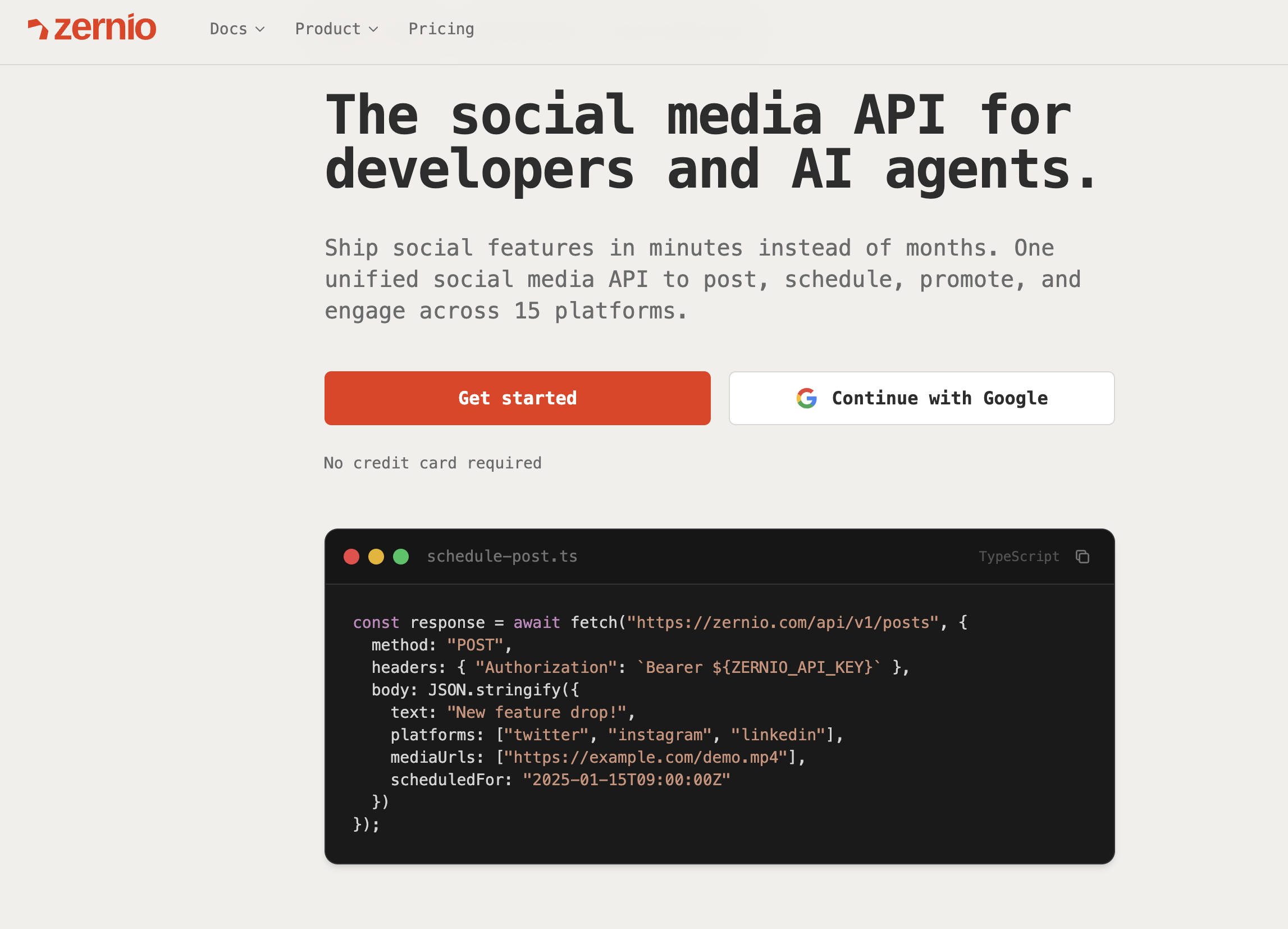
Zernio is a unified social media posting API built specifically for developers and AI agents. One REST endpoint, 15 platforms, flat pricing. The full social layer: posting, comments, DMs, analytics, ads, webhooks, and MCP.
Platforms supported:
Twitter/X, Instagram, TikTok, LinkedIn, Facebook, YouTube, Threads, Reddit, Pinterest, Bluesky, Google Business, Telegram, Snapchat, WhatsApp.
Key features:
- Single Bearer token auth for all 15 platforms (no per-platform OAuth complexity for the developer)
- Normalized payloads: one JSON shape for all platforms; Zernio handles format differences, character limits, and media specs per platform
- Bulk scheduling via CSV upload
- Webhooks: instant push notifications on post success, failure, or engagement events
- Comment-to-DM automation: auto-DM users who comment specific keywords
- 8 SDKs: Node.js, Python, Go, Ruby, Java, PHP, .NET, Rust
- MCP server at mcp.zernio.com with 280+ tools for AI agents
- CLI with structured JSON output
- Vercel Chat SDK adapter for multi-platform chatbots
- n8n, Make, and Zapier integrations
Pricing:
Pay-per-account with graduated volume discounts. Every feature is included from account one — no add-ons, no tiers, no feature gates.
| Accounts connected | Per account/month |
|---|---|
| First 2 accounts | Free |
| Accounts 3-10 | $6 |
| Accounts 11-100 | $3 |
| Accounts 101-2,000 | $1 |
What this looks like in practice:
| Scale | Monthly cost |
|---|---|
| 10 accounts | $48/mo |
| 50 accounts | $168/mo |
| 100 accounts | $318/mo |
| 500 accounts | $718/mo |
| 2,000 accounts | $2,218/mo |
Note: X/Twitter API costs pass through at exact platform rates ($0.005/read, $0.010/write, $0.015/DM). All other platforms fully included.
Rate limits: Managed for you. Zernio handles platform-level rate limits internally with intelligent retry logic and exponential backoff. You don't manage rate limits yourself.
Requirements: Sign up, grab an API key, make your first call. No app review, no approval process, no demo call. First 2 accounts are free immediately, no credit card required.
What Zernio doesn't cover: Native ad auction internals at full depth (Meta's Advantage+ optimization signals, LinkedIn's matched audience management at full partner-level access). For standard ad campaigns, Zernio's Ads API handles it. For deep ad tech products, native APIs give you more.
Best for: Developers building AI content tools, social automation apps, multi-account SaaS products, and AI agents that publish to social media.
Performance: 99.7%+ uptime, under 50ms response times. Live production data at zernio.com/open.
2. Ayrshare: established unified social media API
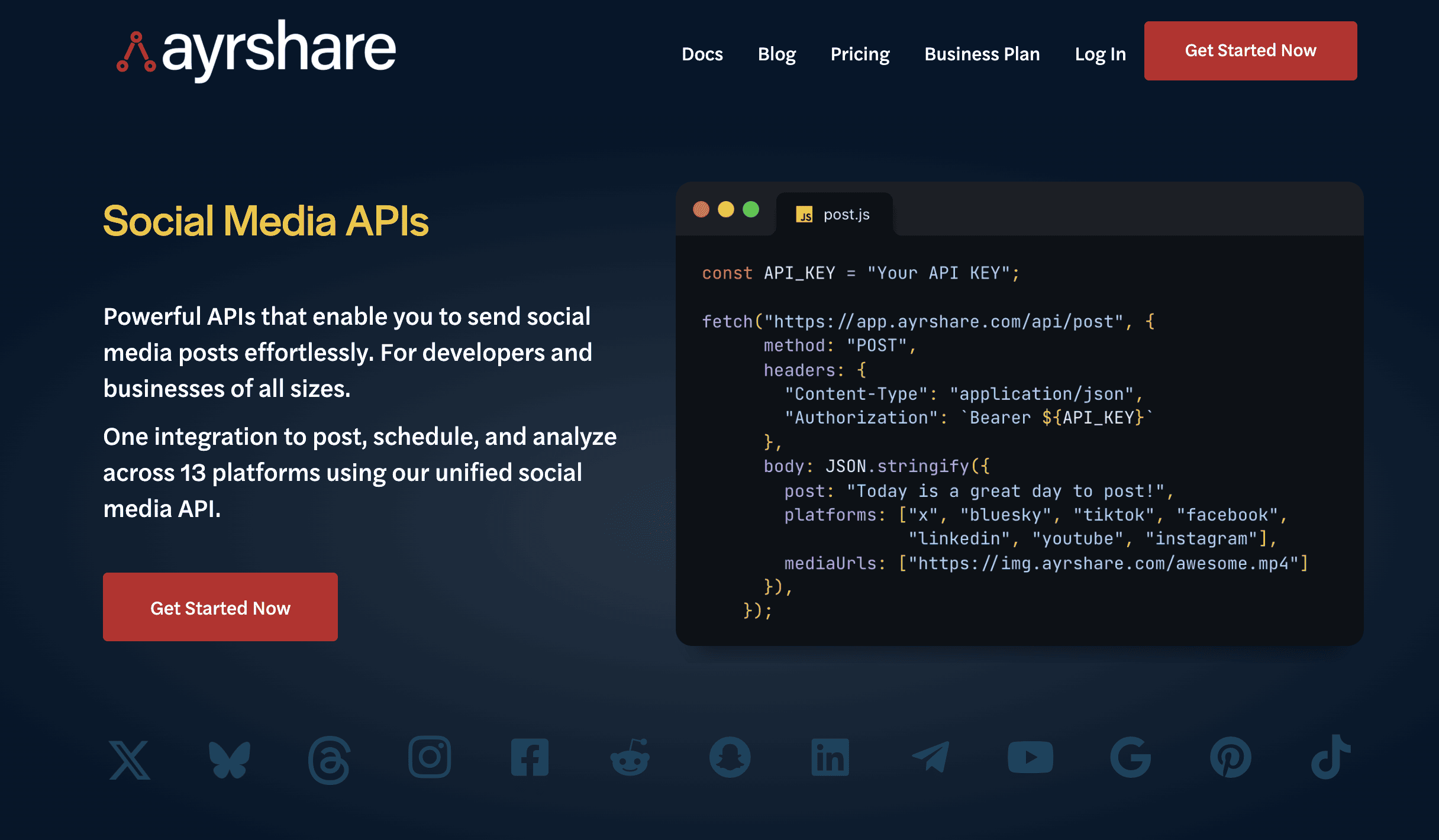
Ayrshare is the category incumbent. First to market, broadest enterprise track record, solid documentation. Covers 13 platforms and has SDK coverage across most languages.
Platforms supported: 13 (Facebook, Snapchat, Bluesky, Reddit, Telegram, Google Business Profile, Instagram, Threads, LinkedIn, X (Twitter), TikTok, YouTube, Pinterest).
Key features:
- Posting, scheduling, and basic analytics across 13 platforms
- Webhook support for post events
- Team and approval workflows in the dashboard
- Hashtag suggestions and media management
- Multiple SDKs
Pricing:
| Plan | Monthly | Profiles |
|---|---|---|
| Premium | $149/mo | 1 |
| Launch | $299/mo | 10 |
| Business | $599/mo | 50 |
| Enterprise | Custom | Custom |
Where the pricing model hurts: Per-profile billing means every social account an end-user connects costs you money on an ongoing basis. At 100 connected accounts, you're at ~$900/mo. At 1,000 accounts, you're looking at $9,000+/mo. For SaaS builders embedding social publishing, this model punishes growth.
Rate limits: Managed internally; specific limits not publicly documented.
Requirements: Sign up and go for standard use. Enterprise tier requires a sales conversation.
What's missing: No MCP server. No AI agent tooling. No CLI.
Best for: Teams that prioritized Ayrshare's brand recognition, or enterprise buyers already in their ecosystem who haven't hit the per-profile pricing ceiling.
→ Zernio vs. Ayrshare detailed comparison
3. Upload-Post: fast, straightforward posting API
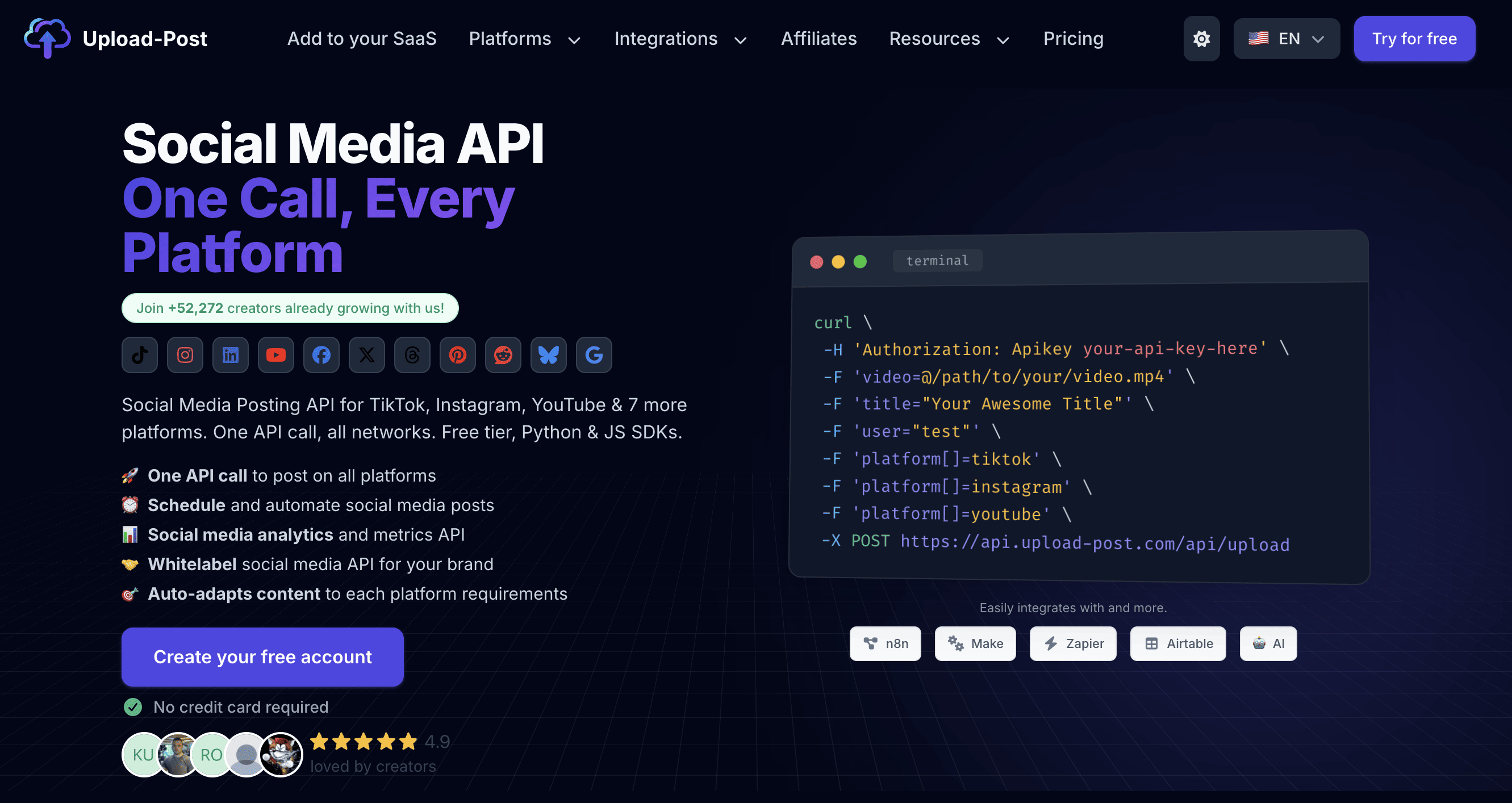
Upload-Post is a fast-growing alternative positioning as a simpler Ayrshare with a clean API.
Platforms supported: 11. Missing WhatsApp, Telegram, and Snapchat vs. Zernio.
Key features:
- Video transcoding API powered by FFmpeg (unique in the category)
- Clean REST API with predictable responses
- n8n community node with templates
- Good documentation and code examples
Pricing:
| Plan | Monthly | Profiles | Posts |
|---|---|---|---|
| Free | $0 | 1 | Limited |
| Basic | $24/mo | 5 | Unlimited |
| Professional | $50/mo | 25 | Unlimited |
| Advanced | $147/mo | 75 | Unlimited |
Rate limits: Not publicly documented; managed internally.
Requirements: Sign up and go. No approval process.
What's missing: Posting only. No comments API, no DMs API, no analytics API. Means that if your product needs to read social data or manage inboxes, you're building that yourself.
Best for: Projects that genuinely only need multi-platform posting and scheduling, with no engagement or analytics requirements.
4. Unipile: LinkedIn and messaging-focused API
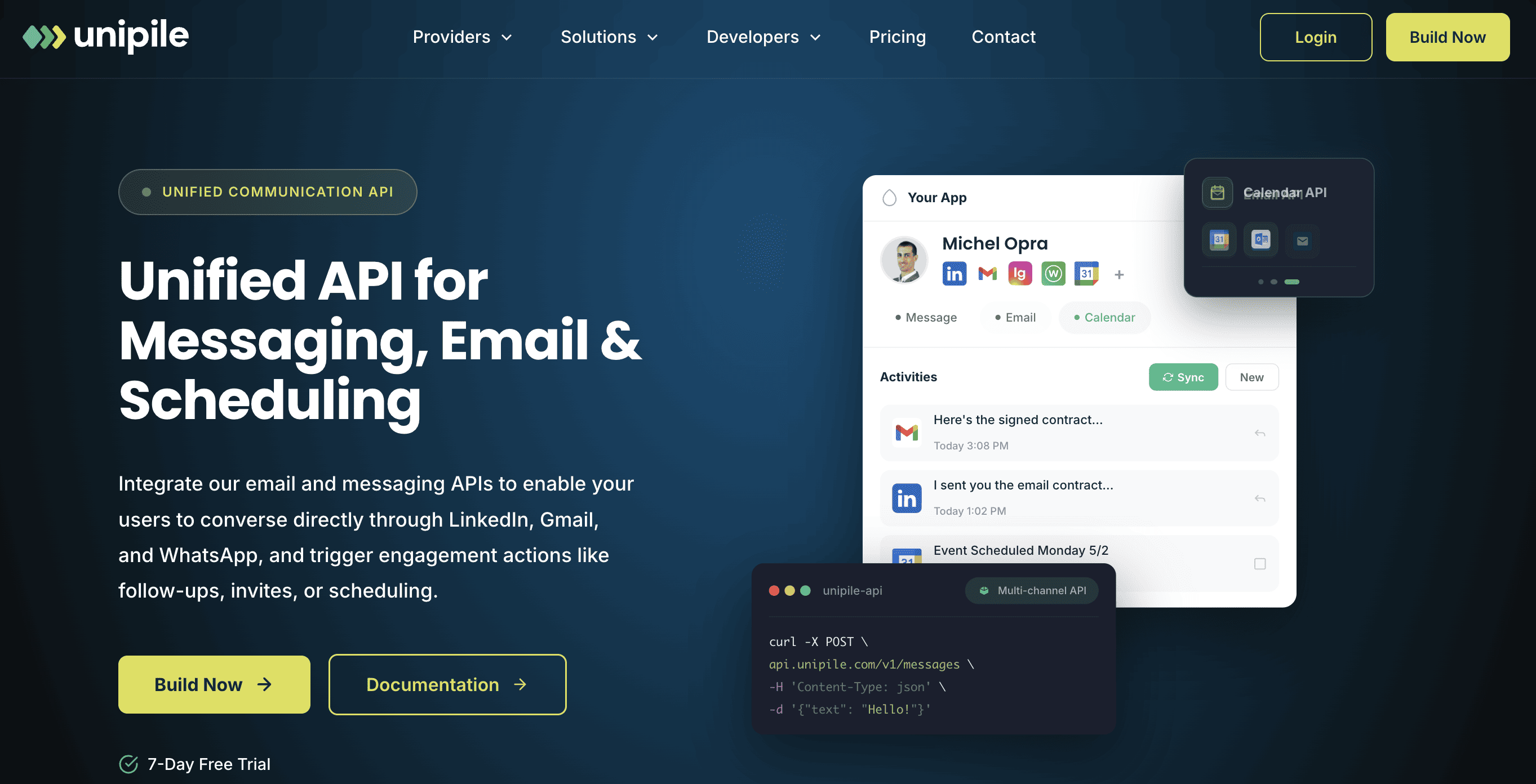
Unipile specializes in LinkedIn inbox access and messaging APIs. It's a messaging layer, not a posting competitor.
Platforms supported: LinkedIn (primary), plus Email, WhatsApp, Instagram DMs, Messenger.
Key features:
- LinkedIn inbox read/write (this is the core differentiator)
- Connection request management
- DM automation across messaging platforms
- CRM-style contact enrichment
Pricing: ~$500/mo at scale. Custom enterprise pricing.
Rate limits: Dependent on platform limits (especially LinkedIn's per-member throttling).
Requirements: Sign up. Platform limits apply.
What's missing: No social posting. No analytics. No MCP server. Narrow scope by design.
Best for: LinkedIn outreach tools, sales engagement platforms, and anything that needs programmatic LinkedIn inbox access. If you also need multi-platform posting, you'll need Zernio alongside Unipile (or instead of it, if DMs on LinkedIn are a secondary need).
5. Octolens: the unified API for social listening
The APIs above solve posting, sending DMs, reviewing ads and accessing analytics. Octolens solves the reverse: one endpoint that returns every mention of a keyword across the social web as structured JSON.
Platforms supported: Reddit, X/Twitter, LinkedIn, YouTube, TikTok, Bluesky, Hacker News, GitHub, Stack Overflow, plus news, newsletters, and podcasts (15+ sources).
Key features:
- One endpoint, one schema for mentions from all sources
- AI relevance filtering and sentiment (handles common-word brand names)
- Webhooks for real-time delivery into your own pipeline
- MCP server + open-source CLI for agent workflows
Pricing: $199/mo (15k mentions, 10 keywords) to $599/mo (50k, 40 keywords). API, webhooks, and MCP on every plan.
Rate limits: Mention volume is plan-based, not request-throttled.
Requirements: Sign up, add keywords.
What's missing: No posting, no DMs, no ads data. Read-only by design.
Best for: Agents and internal tools that need to know what people are saying: triaging public complaints, turning mentions into CRM leads or tickets, brand monitoring in your own stack. If your agent posts via Zernio, Octolens is how it hears the rest of the internet.
Stop building social integrations from scratch.
One API call to publish, schedule, and manage posts across 15+ platforms.
What can each unified social media API actually do?
Posting is table stakes. The real question is whether the API covers the rest of the social operation. Here's what each unified API exposes as endpoints.
| Capability | Zernio | Ayrshare | Upload-Post | Buffer | Postiz |
|---|---|---|---|---|---|
| Publish now | Yes | Yes | Yes | Yes | Yes |
| Schedule | Yes | Yes | Yes | Yes | Yes |
| Bulk upload (CSV) | Yes | Yes | Partial | No | Partial |
| Comments (read + reply + moderate) | Yes | Yes | No | Community tool only | No |
| DMs / inbox | Yes (7 platforms) | Limited | No | No | No |
| Analytics API | Yes | Yes | No | Not via API yet | Limited |
| Ads API | Yes (7 ad platforms) | No | No | No | No |
| Webhooks | Yes | Yes | Limited | Limited | Limited |
| OAuth-as-a-service | Yes | Yes | Yes | Yes | Self-hosted |
| MCP server | Yes (480+ tools) | No | Yes (open, ~40 tools) | Yes (open) | Yes |
| CLI | Yes | No | No | Yes | Yes |
| SDK count | 8 | 7 | 2 | Growing | 1 |
| Platforms | 15 | 13 | 10 | 11 | 28 |
How does authentication work across these APIs?
The auth story is the biggest hidden cost of going native, and the biggest thing a unified API abstracts.
With native APIs, every platform is its own project. Meta uses OAuth 2.0 with Business Verification and App Review. X uses OAuth 1.0a or 2.0 PKCE. LinkedIn gates personal-profile posting behind partner access. Each has its own scopes, token refresh cycle, and expiry behavior. You build and maintain all of it.
With a unified social media API like Zernio, you authenticate once. One API key is a single bearer credential (Authorization: Bearer YOUR_API_KEY) for all 15 platforms. You never handle per-platform OAuth yourself.
When you're building a SaaS where end-users connect their own accounts, Zernio runs OAuth-as-a-service. You send the user to one connect URL and Zernio handles the platform token, refresh, and expiry:
curl "https://zernio.com/api/v1/connect/instagram?profileId=PROFILE_ID&redirect_url=https://your-app.com/callback" \
  -H "Authorization: Bearer YOUR_API_KEY"
The response returns an authUrl. Redirect your user there, they authorize, and the account lands in their profile. Add headless=true for a fully white-label flow with no Zernio-hosted screens.
Best native platform APIs for developers
These are the official APIs from the platforms themselves. Use them when you need platform-specific capabilities that no unified layer exposes: ad management, full analytics depth, or platform-native interaction features.
6. Meta Graph API: Facebook and Instagram
Meta for Developers offers a unified platform for accessing the powerful Facebook and Instagram Graph APIs, making it an indispensable resource for applications needing deep integration with these dominant social networks.
What it covers: Posting to Facebook Pages and Instagram Business/Creator accounts, Messenger, WhatsApp Business, Instagram Direct, Reels, Stories, carousels, ads, and advanced analytics.
Key features:
- Post to Instagram and Facebook (personal profiles require special partner access)
- Instagram Reels, Stories, carousel posts, and product tags
- Facebook Page management and Messenger bot integration
- Full ad management (Advantage+, retargeting, custom audiences)
- Instagram DMs (Business accounts, within 24-hour messaging window)
- Webhooks for real-time comment and DM notifications
Pricing: Free to call. No per-request fee. Rate limits are the constraint, not cost.
Rate limits:
- Instagram automated DMs: 200/hour per account
- Instagram DM window: only users who engaged in the last 24 hours
- Standard Graph API: 200 calls per hour per user token; 4,800 per day for app-level calls
- Marketing API: separate limit tiers based on ad spend
Requirements:
- A Facebook Developer account and a registered App
- Business Verification for production access (Legal entity, documents)
- App Review before going live with permissions like
instagram_basic,pages_read_engagement,read_insights - A Business Manager account for ad features
- Review timeline: 1-4 weeks for standard apps, longer for sensitive permissions
When to use it: Ad management, deep Instagram analytics, Story-specific workflows, Messenger bots. For standard multi-platform posting to Instagram and Facebook as two of many channels, Zernio handles both without the approval overhead.
Website: https://developers.facebook.com/
7. X (Twitter) API: official Twitter developer API
The X (Twitter) Developer Platform offers official API access to the vast, real-time conversation happening on X. It provides a robust set of endpoints for developers to listen to public conversations, analyze user data, create posts, and build applications that integrate deeply with the platform's core functionalities.
What it covers: Posting tweets, reading timelines, search, Direct Messages, user data, and real-time streaming.
Key features:
- Post, delete, and like tweets; manage threads
- Home timeline and user mention timeline access
- Real-time filtered stream (keyword and topic monitoring)
- User lookup, followers, following
- Direct Messages
- Polls and media (images, GIFs, video)
Pricing (as of February 2026):
X pricing moved to pay-per-use as the default for new developers in February 2026.
| Model | Cost | Notes |
|---|---|---|
| Pay-per-use (new default) | $0.01/post created, $0.005/post read | 2M reads/month cap, then Enterprise required |
| Basic (legacy, existing subscribers only) | $200/mo | Fixed monthly |
| Pro (legacy) | $5,000/mo | 1M tweets/month |
| Enterprise | From ~$42,000/mo | Custom; negotiated directly |
Rate limits:
- Pay-per-use: 15-minute rolling windows per endpoint; 2M reads/month hard cap
- Per-user and per-app limits apply separately under OAuth 1.0a / OAuth 2.0 PKCE
Requirements:
- Developer account at developer.twitter.com
- App registration
- Read terms carefully: automated posting that appears organic violates ToS
- Enterprise access requires direct negotiation with X
When to use it: Real-time trend monitoring, social listening at scale, or X-specific ad campaigns.
Website: https://developer.x.com/
8. TikTok API: official TikTok developer platform
The TikTok for Developers platform provides official API access to the world's leading short-form video network, enabling applications to interact directly with TikTok's ecosystem.
What it covers: Video upload and publishing, basic account data and analytics, Login Kit for social authentication, and Research API for data analysis.
Key features:
- Content Posting API: upload videos to TikTok accounts (requires approval)
- Login Kit: let users sign in with TikTok (easiest to access)
- Research API: query public TikTok data for academic/research purposes
- Display API: read user profile and video list
- TikTok Business API: Spark Ads, branded content tools (separate application)
Pricing: No direct API pricing. Access is permission-based, not paid. If approved, no per-call fee for standard endpoints.
Rate limits:
- Display API: ~100 requests/day (basic access)
- Research API: 1,000 requests/day, up to 100,000 records/day
- Content Posting API: limits not publicly documented; depend on approval tier
- Most endpoints: 10-50 calls/second depending on tier
Requirements:
- Register as a TikTok developer at developers.tiktok.com
- For Content Posting API: formal application with detailed use case; review takes weeks to months
- Non-US developers face additional restrictions
- TikTok Business API (for Spark Ads and branded content): separate application through TikTok for Business
When to use it: TikTok-specific workflows: Spark Ads, branded content integration, TikTok LIVE data. For standard multi-platform video publishing to TikTok as one of many channels, a unified API handles this without the approval wait.
Website: https://developers.tiktok.com/
9. LinkedIn API: official LinkedIn developer platform
The LinkedIn Developer Network provides access to the world's largest professional network, offering APIs for applications focused on B2B marketing, sales, and talent solutions. Unlike more open platforms, LinkedIn focuses on structured, high-value integrations, primarily through its vetted partner programs, which offer deeper access to company pages, advertising campaigns, and professional data.
What it covers: Company Page posting, basic analytics, user authentication, and (with Marketing Developer Program access) ad management and sponsored content.
Key features:
- Post to LinkedIn Company Pages (personal profile posting requires specific Partner access)
- Articles and document uploads via Pages
- Page analytics: impressions, clicks, follower demographics
- LinkedIn Login (OpenID Connect)
- Marketing Developer Program: campaign management, Lead Gen Forms, matched audiences (MDP approval required)
Pricing: Free to call. No per-request pricing for standard endpoints.
Rate limits:
- Application-level: 100,000 calls/day default
- Per-member throttling: as few as 10 requests/day for some endpoints
- MDP access has separate limits based on ad spend tier
- No self-serve rate limit increases; higher limits require a partner agreement
Requirements:
- LinkedIn Developer account and registered app
- For Company Page posting: page admin access
- For personal profile posting: requires specific LinkedIn partner program access (not available to standard developers)
- For Marketing Developer Program (ads, Lead Gen): formal application with use-case description; manual review takes weeks to months
- Development vs. Standard tier determines how many Ad Accounts you can manage
When to use it: LinkedIn ad campaigns, Lead Gen Form automation, or deep company page analytics. For standard LinkedIn posting as part of a multi-platform strategy, a unified API covers LinkedIn without the MDP review.
Website: https://developer.linkedin.com/
10. YouTube Data API v3: official YouTube API
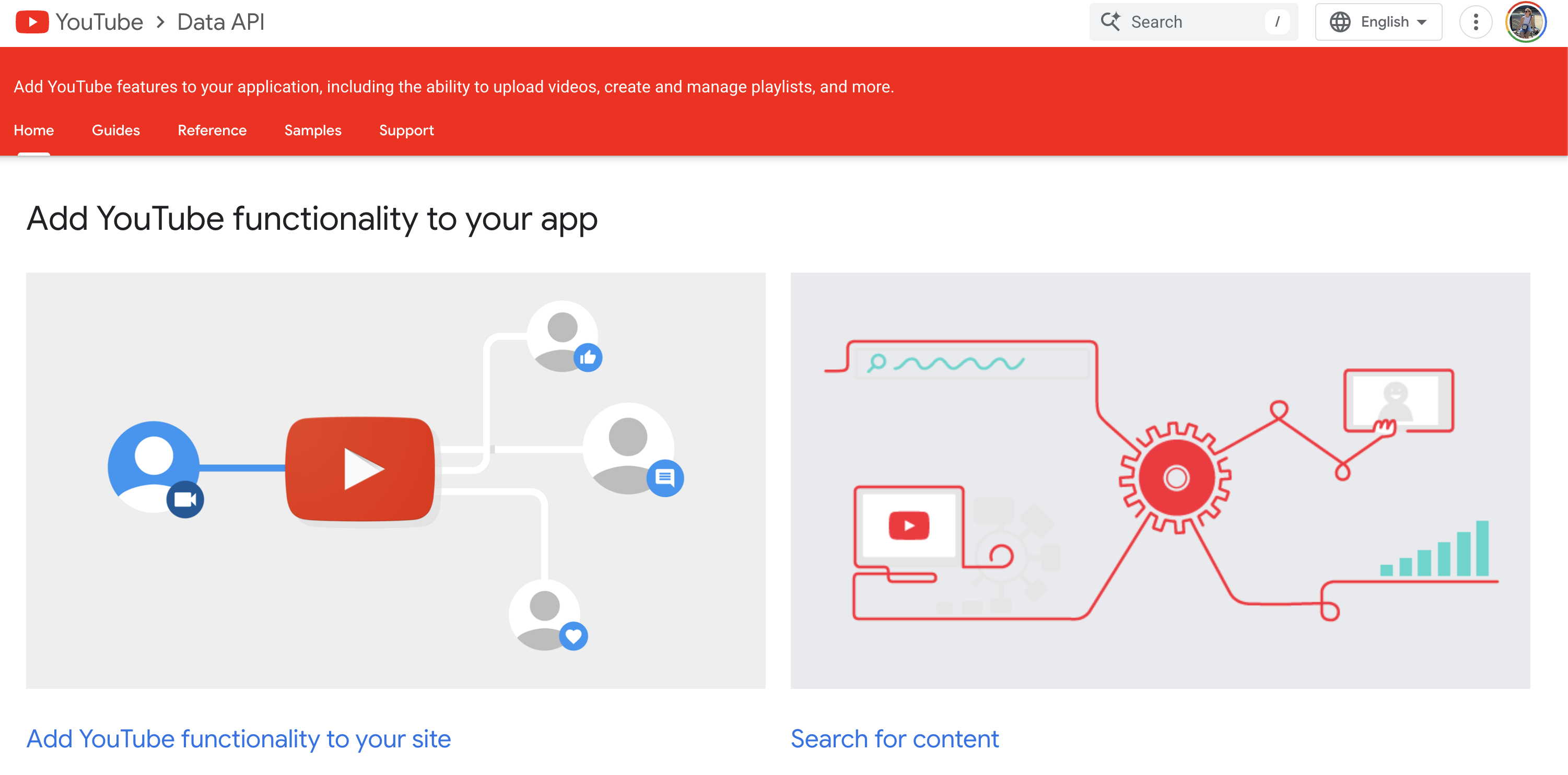
The YouTube Data API provides programmatic access to the world's largest video platform, allowing developers to integrate YouTube's vast functionalities directly into their applications.
What it covers: Video uploads, playlist management, channel analytics, comment management, captions, and live streaming controls.
Key features:
- Upload videos to YouTube channels
- Manage playlists and video metadata (titles, descriptions, tags, chapters)
- Read channel analytics: views, watch time, subscriber count
- Comment management: list, insert, delete, moderate comments
- Live streaming: create broadcasts, manage streams
- Subtitles and caption management
Pricing: Free up to 10,000 quota units/day per project. Beyond that, apply for a quota extension through Google's audit process.
The 10,000-unit daily limit means you can upload about 6 videos/day before hitting the ceiling. Multiple API keys in the same project share the same quota pool. Quota resets at midnight Pacific Time.
Requirements:
- Google Developer account and Google Cloud project
- OAuth 2.0 for user-authenticated actions (uploads, channel management)
- API key for read-only public data
- Quota extension: submit an audit form demonstrating compliance with YouTube API Terms of Service; Google reviews manually
When to use it: YouTube-specific workflows: chapter markers, end screens, Cards, Shorts-specific insights, monetization data. For standard video publishing to YouTube as one of many platforms, Zernio handles YouTube uploads without quota headaches.
Website: https://developers.google.com/youtube/v3
11. Reddit API: official Reddit developer platform
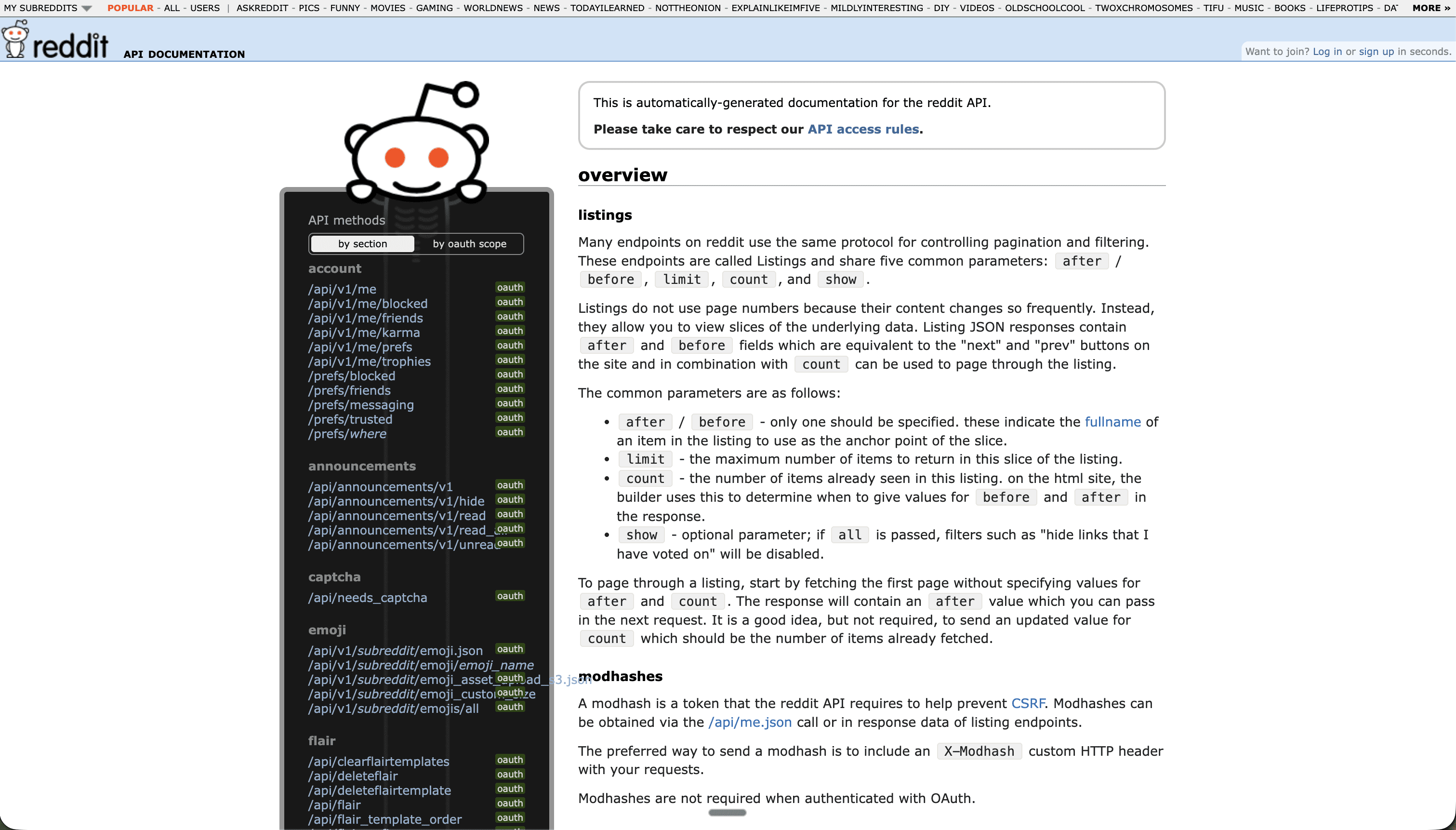
The Reddit Developer Platform provides access to one of the internet's largest and most active collections of communities through its Data API. This OAuth-based API is a powerful tool for developers looking to tap into Reddit's vast repository of user-generated content, including posts, comments, and subreddit data, as well as build moderation and community management tools.
What it covers: Post creation (text, link, image, video), comment management, voting, subreddit data, and user data.
Key features:
- Submit posts to subreddits (text, link, image, video, polls)
- Comment and reply management
- Subreddit search and moderation tools
- User profile and post history
- Reddit Search (available with commercial access)
Pricing:
| Tier | Cost | Notes |
|---|---|---|
| Free (personal use) | $0 | Non-commercial only; 60 req/min with OAuth |
| Commercial | From $12,000/year | Manual approval required; also ~$0.24/1,000 calls |
| Enterprise | Custom | High-volume; negotiated directly |
Reddit enforces commercial use strictly. If you monetize anything built on Reddit data, you need a commercial agreement. Reddit actively enforces this and has shut down apps that violated it.
Rate limits:
- With OAuth (recommended): 60 requests/minute, 10-minute rolling window
- Without OAuth: 10 requests/minute (IP-based)
- Research API: up to 1,000 requests/day
Requirements:
- Reddit developer account and registered app at reddit.com/prefs/apps
- OAuth 2.0 for user-authenticated actions
- Commercial agreement for any monetized use
- Reddit's pre-approval process for certain app types (introduced in 2025)
When to use it: Community monitoring, subreddit analytics, or Reddit-native moderation workflows. For posting to Reddit as part of a multi-platform strategy, Zernio covers Reddit without a commercial API contract.
Website: https://www.reddit.com/dev/api/
12. Pinterest API: official Pinterest developer platform
What it covers: Pin creation and management, board management, catalog publishing, audience insights, and organic analytics for Pinterest Business accounts.
Key features:
- Create and update Pins (images, videos, carousels) across boards
- Board management: create, list, update boards and sections
- Pinterest Catalogs: bulk product feed publishing for shopping
- Audience insights: demographics, interests, engagement by pin
- Conversion tracking and Pinterest Tag events
- Trends API: search interest data over time
Pricing: Free. Pinterest charges nothing for API access.
Rate limits:
- Trial access (Sandbox): 1,000 requests/day
- Standard access: up to 100 requests/second per user per app
- Rate limit headers returned with each response so you can track consumption
Requirements:
- Pinterest Business account
- Pinterest Developer account and registered app at developers.pinterest.com
- Start with Trial (Sandbox) access by default; must request Standard access upgrade through the Developer dashboard with a use-case review
- OAuth 2.0 for all user-authenticated actions
- Standard access review is manual; Pinterest evaluates your app before approving production access
When to use it: Pinterest-specific workflows: product catalog publishing, Idea Pin creation, or deep pin analytics. For publishing to Pinterest as part of a multi-platform strategy, Zernio's Pinterest API integration works without the manual approval process.
Website: https://developers.pinterest.com/
13. Threads API: official Meta developer platform for Threads

What it covers: Publishing posts and replies to Threads, pulling post analytics, and managing threads on behalf of authenticated users. Part of Meta's developer platform, launched in late 2024.
Key features:
- Publish Threads posts: text, images, and videos
- Reply management: post replies, access reply threads
- Post insights: views, likes, replies, reposts, quotes
- User profile data for authenticated accounts
- Search (500 queries per rolling 7-day period)
- Embed posts in external web pages
Pricing: Free. Meta does not charge for Threads API access.
Rate limits:
- Publishing: 250 posts per 24-hour period per profile
- Replies: 1,000 replies per 24-hour period per profile
- Search: 500 queries per rolling 7-day window
- Embedding: up to 5,000,000 requests per 24-hour period
- App-level call count: 4,800 x number of impressions per rolling 24-hour window
Requirements:
- Facebook Developer account and registered Meta app
- OAuth 2.0 user authentication
- App Review required to use most Threads permissions; key scopes:
threads_basic,threads_content_publish - App Review is manual and takes multiple days; Meta evaluates your use case before granting production access
- Users must have a Threads account connected to their Instagram account
When to use it: Threads-first workflows where you need reply threading, fine-grained Threads analytics, or native Threads features not yet available through unified APIs. For publishing to Threads as part of a multi-platform distribution strategy, Zernio covers Threads alongside the other 14 platforms in one call.
Website: https://developers.facebook.com/docs/threads/
Native platform APIs: what "free" actually costs
Native APIs are free to call, but scaling them costs in different ways.
| Platform API | Direct cost | Hidden cost |
|---|---|---|
| Meta Graph API | Free to call | Business Verification, App Review (1-4 weeks), engineering maintenance |
| X/Twitter API | $0.01/post, $0.005/read (pay-per-use) | Costs spike fast at volume; 2M read cap |
| TikTok API | Free (if approved) | Approval takes weeks; non-US access restricted |
| LinkedIn API | Free to call | MDP approval for ads (weeks/months); tight per-member rate limits |
| YouTube Data API | Free to 10K units/day | 6 video uploads/day before hitting the free quota |
| Reddit API | Free (personal use) | Commercial use requires $12K+/year contract |
The real cost of native APIs is engineering time: building the integration (weeks per platform), maintaining it when platforms deprecate endpoints (ongoing), and handling rate limit failures (on-call risk). A social media posting API like Zernio eliminates all three.
Social media APIs for AI agents and MCP
If you're building an AI agent, the API surface design matters as much as the features.
An agent needs to:
- Know what tools are available (tool discovery)
- Call those tools with well-typed inputs (tool execution)
- Parse structured responses without custom transformation (output normalization)
- Handle errors gracefully and retry (reliability)
Standard social media APIs fail at all four of these for agents. They weren't designed for LLM interaction. You end up building a custom tool wrapper layer around every API before your agent can use it.
The Zernio MCP server at mcp.zernio.com exposes 480+ tools that any MCP-compatible LLM client can discover and call directly. This includes Claude Desktop, Cursor, and any client implementing the Model Context Protocol. No wrapper layer needed.
What an agent can do through Zernio MCP:
- Create and schedule posts across 15 platforms
- Read and reply to comments
- Send DMs
- Pull follower analytics and engagement metrics
- Manage posting queues
- Handle bulk operations
- Monitor inbox conversations
- Launch, pause and manage ads across ad platforms
The CLI outputs structured JSON for every command, making it easy to pipe into agent reasoning loops without parsing HTML or inconsistent API responses.
For an in-depth integration guide, see: social media API for AI agents.
Key takeaway
For most developers building apps that need multi-platform social media publishing, a unified social media API is the right call. It saves months of integration work, eliminates platform maintenance risk, and gives you a predictable cost structure.
Use native platform APIs (Meta Graph, X API, TikTok API, LinkedIn API) when you specifically need ad management, deep platform analytics, or platform-native features that no unified layer exposes.
FAQ
What's the best social media API for a SaaS product?
Zernio. It connects to 15 platforms through one API, so your users get every network from day one. It also handles login for you: send each user to one link, and Zernio takes care of connecting their accounts and keeping them connected. You never have to build login for each platform. Turn on headless=true and it all runs under your own brand, with no Zernio screens in the way.
Can you run social ads through an API without creating a Meta app?
Yes. Zernio is an approved Meta Marketing Partner, so its Ads API lets you create, pause, edit, and delete Meta campaigns. Same for TikTok, Google, LinkedIn, Pinterest, X ads, and ChatGPT ads through one integration. You can also connect MCP to manage Meta Ads through Zernio and let your AI assistant manage your ads.
Which social media API is best for AI agents?
The one with a real MCP server. AI agents need tool discovery, typed inputs, and structured output they can parse without custom wrappers. Zernio's hosted MCP server at mcp.zernio.com exposes 480+ tools covering the full publish, engage, analyze, and boost loop. It works with Claude Desktop, Cursor, and any MCP client.
What is a unified social media API and how does it work?
A unified social media API sits on top of multiple platform APIs and exposes one consistent endpoint. You make one API call with your content; the unified layer handles per-platform auth tokens, format normalization, media transcoding, rate limit retries, and delivery to each platform.
How long does it take to integrate a social media API?
With a unified social media API like Zernio, most developers report working integrations in under an hour. Building native integrations for 14 platforms independently takes 6+ months of engineering time: separate OAuth apps, media handling per platform, rate limit management, and ongoing maintenance when platforms change their APIs.
What are the rate limits for major social media APIs?
Every social API has rate limits. Native APIs make you manage them: Meta Graph is 200 calls/hour, LinkedIn can be 10 requests/day per member, YouTube is 10,000 quota units/day. Unified APIs like Zernio manage platform limits for you with automatic backoff, and expose one request budget that scales with your connected accounts (60/min up to 2 accounts, 600/min up to 2,000). On a 429, honor the Retry-After header.
Is there a free social media API for developers?
Yes. Zernio's free plan includes 2 social accounts and unlimited posts. Upload Post has a free tier with 10 posts/month. Most native platform APIs are free to call up to their rate limits.
Is there a GDPR-compliant, EU-based social media API?
Yes. Zernio is built in Spain, GDPR-native by default, and SOC 2 compliant, with a public trust portal at trust.zernio.com. This matters for European SaaS companies with data-residency requirements.
What's the best API for social media analytics?
For unified cross-platform analytics, Zernio's Analytics API returns impressions, reach, engagement, saves, clicks, and follower growth across platforms, plus per-post daily timelines. Native APIs give the deepest single-platform metrics.
Which social media API handles video best?
Unified APIs normalize video specs per platform so you upload once. Zernio handles per-platform transcoding, aspect ratios, and size limits automatically. Upload-Post exposes an FFmpeg-based transcoding API if video processing is your core need. Native APIs (YouTube Data API, TikTok Content Posting API) give the most control but require per-platform upload handling.
What's the difference between a social media API and a social media data API?
A social media API typically refers to publishing and management: creating posts, scheduling, managing comments and DMs. A social media data API (like Brandwatch, Data365, or Phyllo) focuses on read-only access for analytics, monitoring, sentiment analysis, and creator data. Zernio covers both: its social media analytics API pulls likes, shares, reach, impressions, follower growth, and engagement rates across platforms.