If you're building a SaaS or martech tool that needs to connect thousands of your customers' social accounts, you're not choosing a "post to social" API. You're choosing multi-tenant infrastructure: OAuth lifecycle, token refresh, per-platform rate limits, publishing reliability, and analytics normalization, all running across every account at once.
The hard part isn't the first post. It's the ten-thousandth account staying connected while your bill stays predictable. In this blog post we will review building infrastructure using native vs unified social media APIs for that goal.
Want to skip straight to building? Get a Zernio API key free: one bearer token, 15 platforms, scales to thousands of accounts with no code changes.
What is a social media API for SaaS apps?
A social media API for SaaS apps is a REST API that lets your product act on social platforms programmatically: publishing posts, sending and receiving direct messages, replying to comments, and pulling analytics, without a human clicking through each platform's native interface.
Two kinds exist:
- Native APIs come directly from each social media platform (Meta's Graph API, X's API, TikTok's Content Posting API).
- Unified social media APIs are third-party services that combine multiple native APIs behind one integration, one auth model, and one data format.
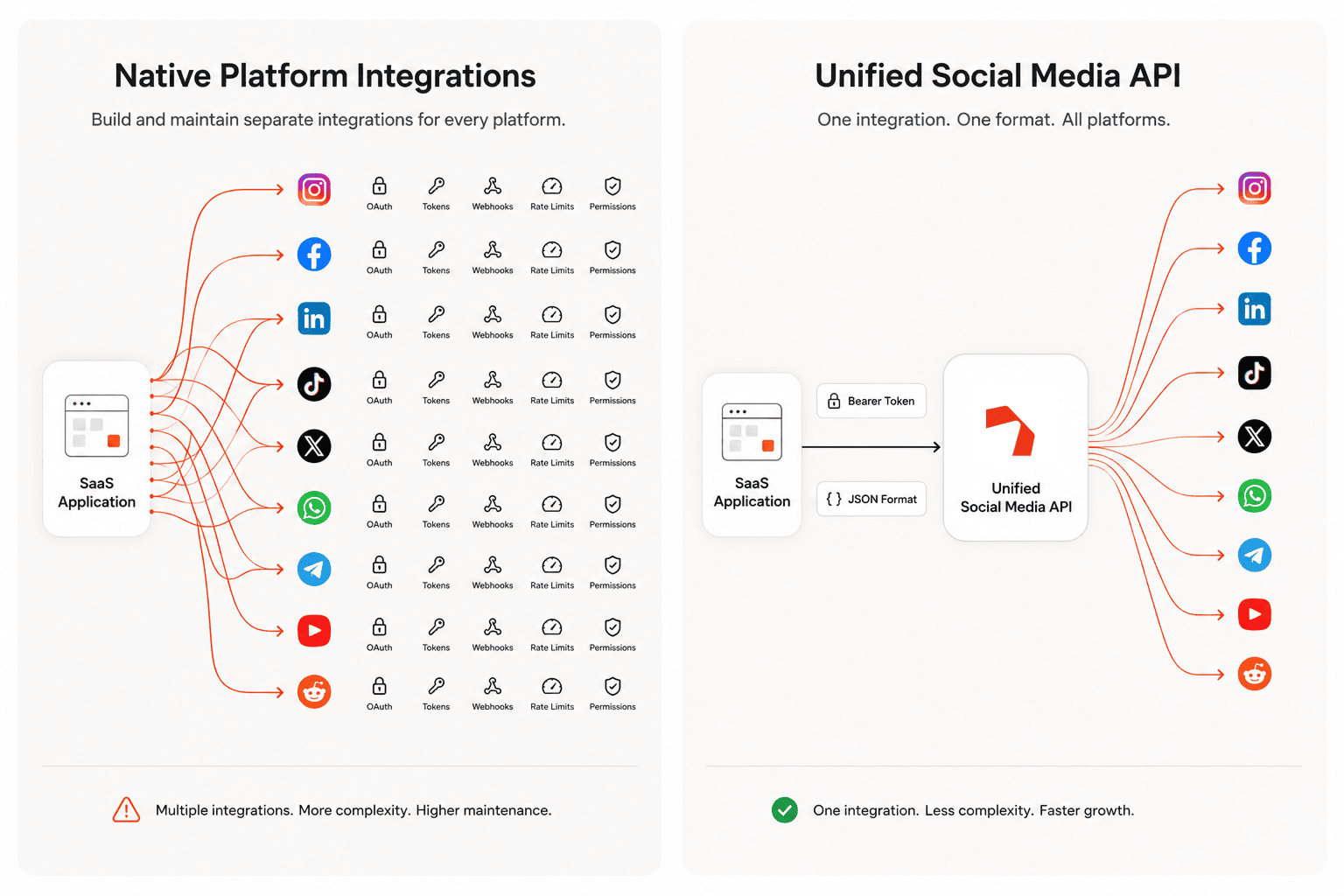
For a martech product with thousands of end-users connecting their own accounts, the choice is really about who owns the multi-tenant plumbing. Build natively and your team owns 15 OAuth flows, 15 token-refresh schemes, and 15 rate-limit models across every tenant. Build on a unified API like Zernio and that plumbing becomes one integration.
A note on terminology: you'll see this same category called a social networking API, a social app API, a social media posting API, or a social media scheduling API depending on who's writing about it. They all point at the same thing: a REST API that acts on social platforms on your app's behalf.
How do you architect a multi-tenant social integration for thousands of accounts?
The scalable pattern separates account connection, publishing, and event handling into distinct layers, so no single part becomes a bottleneck at thousands of accounts. Whether you build it yourself or buy it, the architecture is the same. The difference is how much of it your team owns.
Account connection layer. Each tenant's users connect their own social accounts through OAuth. You store the connection, its scopes, and its owning tenant, then keep tokens alive as they expire. Building this natively means a separate OAuth and refresh implementation per platform. On a unified social media API like Zernio, it's one connection flow that returns a connected account ID, with token refresh handled for you.
Asynchronous publishing. At scale you never publish directly from a user request. A post gets recorded, queued, and handled by workers that manage retries, rate limits, and per-platform rules. Zernio runs this layer for you: one publish call fans out to every target platform, retries transient failures, and reports status by webhook.
Event and webhook processing. New comments, delivered DMs, and failed posts arrive as webhooks rather than something you poll for across thousands of accounts. One webhook endpoint on your side receives normalized events for every platform.
Tenant-isolated data model. Your schema keys everything to a tenant: tenant → connected account → post → status/metrics. Zernio's account IDs map cleanly to this, so tenant isolation stays in your control while the platform differences stay in Zernio's.
Build all four layers natively across five platforms and you're looking at three to six months before your product's actual feature ships, plus standing maintenance as each platform changes. A unified API collapses the connection, publishing, and event layers into one integration, and leaves you owning only the tenant model.
Which social media API scales best for a martech platform?
For a martech tool connecting thousands of customer accounts, the realistic options split into three categories: full unified social APIs, OAuth-only infrastructure, and messaging-focused APIs. Here's how the common choices compare on what matters at scale.
| Provider | Category | Full social layer (post + comments + DMs + analytics + ads) | Platforms | Pricing model at scale |
|---|---|---|---|---|
| Zernio | Unified social API | Yes, all five | 15 | Flat per-account, drops to $1/account |
| Ayrshare | Unified social API | Posting-led, engagement varies | 13 | Per-profile, scales up with each account |
| Nango | OAuth / token infrastructure | No, you build the social logic | Depends on what you build | Per-connection infrastructure pricing |
| Unipile | Messaging / social | Messaging-led (LinkedIn, DMs) | Fewer social publishing platforms | Per-account messaging pricing |
The trade-off is straightforward. Nango handles OAuth and token refresh well but leaves you to build every social feature on top. Unipile is strong for LinkedIn and DM-heavy sales tools but isn't a full publishing layer. A unified social API gives you posting, engagement, analytics, and ads in one integration.
Among unified options, the pricing model is what separates them at thousands of accounts: per-profile pricing charges more for every customer you add, while Zernio's flat per-account rate drops as you grow.
Why build on an API instead of integrating each platform in-house?
"Just add social posting" is rarely a small task. Here's what actually eats the engineering time, per platform, and multiplies across every tenant:
Permission review. Instagram and Facebook require a registered Meta Business app and an app review before you can request the scopes that let you post or read DMs on a user's behalf. That review isn't instant, and it can bounce back with follow-up questions.
Scopes. Every platform breaks permissions into narrow scopes (post-only, read-analytics, manage-DMs, moderate-comments), and you request, justify, and track the right combination for every feature, per platform.
Token refresh. Access tokens expire. Some platforms issue short-lived tokens that need refreshing every hour. Miss a refresh cycle and a user's connected account silently stops working, and at a thousand accounts that's a support fire, not an edge case.
Webhooks and rate limits. Real-time events need webhook infrastructure, or you're stuck polling and burning through rate limits that differ by platform and by endpoint.
Platform policy. Each platform's developer terms restrict what you store, how long you cache, and what you disclose to end-users. Violate them and you risk losing API access entirely.
That maintenance doesn't stop after launch. Platforms ship changes and updates to their APIs, and any one of them can quietly break your integration. A unified API absorbs that churn so your team ships the integration once.
| Factor | Native platform APIs | Unified social media APIs |
|---|---|---|
| Development effort | High (a separate integration per platform) | Low (one integration, all platforms) |
| Maintenance | You monitor every platform for breaking changes | The provider absorbs platform changes |
| Time to first post | Weeks to months per platform | Minutes |
| Consistency | Each platform has its own auth, formats, errors | One bearer token, one JSON shape |
| Messaging + comments | Separate build per platform | Included in the same integration |
| Control | Maximum (every feature the platform exposes) | Limited to what the provider supports |
Stop building social integrations from scratch.
One API call to publish, schedule, and manage posts across 15+ platforms.
What do builders actually build with a social media API?
These are the use cases that show up most among SaaS and martech teams adding a social media API.
AI content and marketing agents that publish what they generate. A tool generates a caption, image, or video, then needs it live on Instagram, TikTok, LinkedIn, and X, plus the comments and DMs that follow. In its first ~58 days on Zernio, HeyMark connected 181 accounts and its two-way inbox processed over 96,000 comments and DMs on behalf of users, all through one integration.
AI platforms that run a whole go-to-market motion. Vibiz takes a business from idea to running: content, social, ads, leads, and CRM. It supports all 15 platforms Zernio covers and has published over 73,700 posts across more than 3,000 connected accounts. Building that in-house was a multi-month project the team chose not to take on.
Social media management platforms. SaaS tools where end-users connect their own accounts and manage content from inside the product, the category Buffer and Hootsuite serve, but built on an API instead of a dashboard someone else owns.
CRM and sales tools with social touchpoints. A CRM that shows a lead's recent LinkedIn activity, or lets a rep reply to an Instagram comment or send a WhatsApp message without leaving the tool.
Agency and multi-brand dashboards. Agencies managing dozens of client accounts build a white-labeled dashboard on an API instead of paying per seat across every client.
AI agents that act on social autonomously. An agent that generates a post, publishes it, checks performance, and boosts the winner with no human in the loop. This pattern needs structured tool calls, not a dashboard. Zernio's MCP server and AI agent guide covers it in depth.
Does a social media API also handle messaging and DMs?
A social media API that only posts is doing half the job. Most martech products eventually need messaging too: replying to a DM, following up on a comment, or sending a WhatsApp notification.
To be direct about what "messaging API for SaaS" actually covers here: Zernio's DMs API sends and receives direct messages across seven platforms: Twitter/X, Instagram, Facebook, Reddit, Bluesky, Telegram, and WhatsApp. The Comments API covers reading, replying to, and moderating comments across ten platforms. Both use the same bearer token as posting, so a product that publishes updates and replies to customer DMs doesn't run two separate integrations.
| Platform | Posting | Comments | DMs | Analytics |
|---|---|---|---|---|
| Twitter/X | ✓ | ✓ | ✓ | ✓ |
| ✓ | ✓ | ✓ | ✓ | |
| ✓ | ✓ | ✓ | ✓ | |
| ✓ | — | ✓ | — | |
| Telegram | ✓ | — | ✓ | — |
| ✓ | ✓ | ✓ | — | |
| Bluesky | ✓ | ✓ | ✓ | — |
| TikTok | ✓ | ✓ | — | ✓ |
| ✓ | ✓ | — | ✓ | |
| YouTube | ✓ | ✓ | — | ✓ |
| Threads | ✓ | ✓ | — | ✓ |
| ✓ | — | — | ✓ | |
| Google Business | ✓ | ✓ | — | ✓ |
| Snapchat | ✓ | — | — | ✓ |
| Discord | ✓ | — | — | — |
How does a social media API handle OAuth for third-party apps?
OAuth is what lets your product connect a user's social account without ever seeing their password. The user clicks "connect Instagram," gets redirected to Instagram's own consent screen, approves a specific set of permissions, and your app receives a token scoped to exactly what was approved.
Doing this natively means building and maintaining a separate OAuth flow per platform, each with its own token lifetimes, refresh logic, and app-review requirements. A social media API with OAuth-as-a-service handles it differently: your end-user still goes through each platform's real consent screen, but your app doesn't register a developer app with every platform, and you don't maintain 15 separate OAuth implementations.
A single publish call looks the same regardless of which platform it targets, or how many accounts you're running:
curl -X POST https://api.zernio.com/v1/posts \
  -H "Authorization: Bearer YOUR_API_KEY" \
  -H "Content-Type: application/json" \
  -d '{
    "content": "Shipping a new feature today.",
    "platforms": ["instagram", "linkedin", "x"],
    "accountIds": ["acct_123", "acct_456", "acct_789"]
  }'
What does a social media API cost at thousands of accounts?
Pricing for social media APIs falls into three models: pay-per-call, per-profile subscriptions, and flat per-account pricing. The model matters far more than the sticker price once you're connecting thousands of accounts.
Per-profile pricing (the model several incumbents use) charges for every end-user account you connect, so your infrastructure cost grows in direct proportion to your own product's growth. That's a strange incentive to build on: every new customer makes you less profitable.
Zernio uses graduated pay-per-account pricing. Every feature (posting, comments, DMs, analytics, ads) is included from account #1, and the per-account cost drops as you scale.
| Account range | Zernio, per account/month |
|---|---|
| First 2 accounts | Free |
| Accounts 3–10 | $6 |
| Accounts 11–100 | $3 |
| Accounts 101–2,000 | $1 |
| 2,000+ accounts | Lower per account rate |
See the full breakdown on the pricing page.
How do you integrate a social media API into a SaaS product, step by step?
Zernio is a unified social media and messaging API built for exactly the problems in the sections above: permission review, scopes, token refresh, webhooks, rate limits, and platform policy, handled once, behind one bearer token, across 15 platforms including WhatsApp and Telegram for messaging.
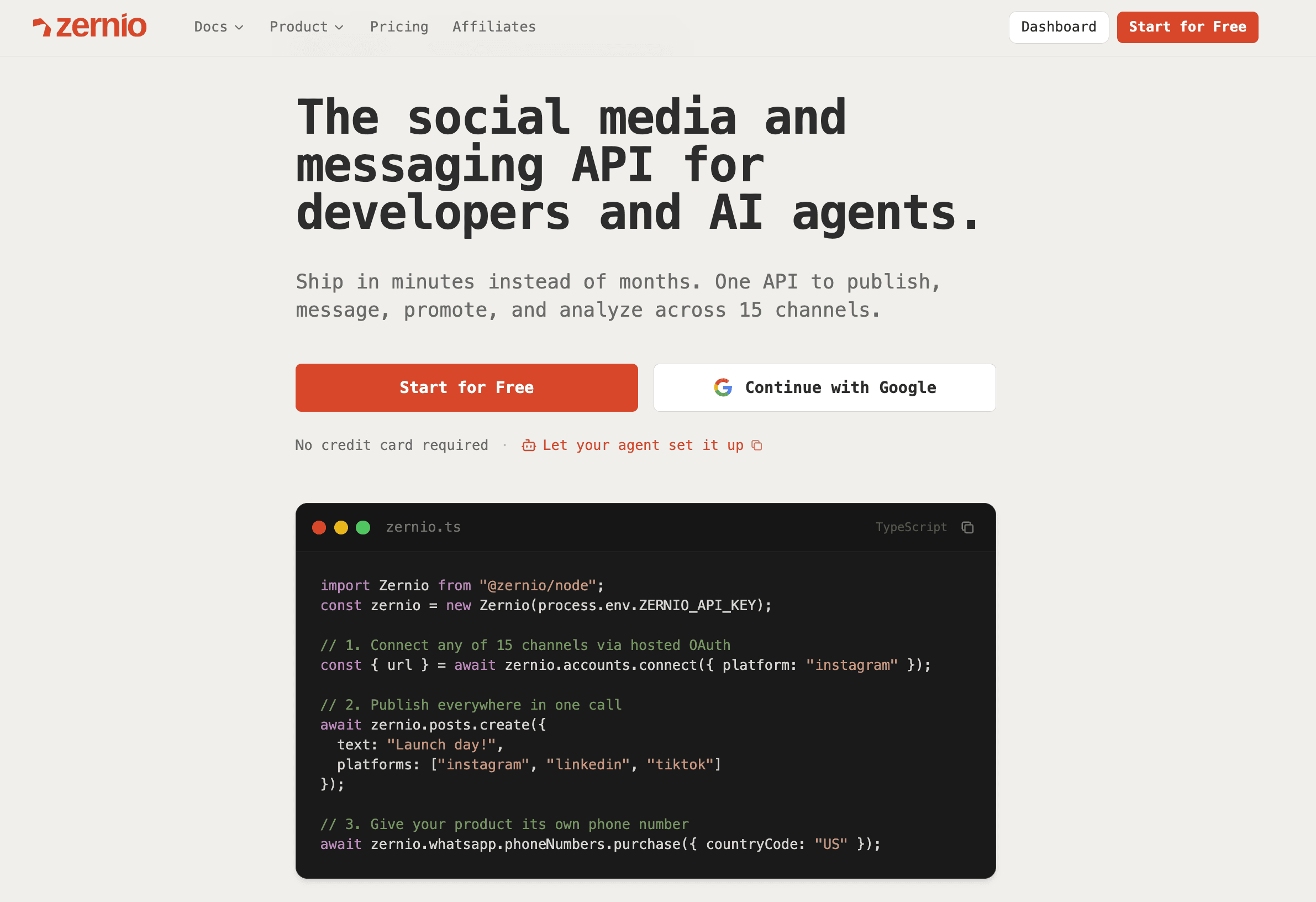
Here's what integrating Zernio into your product actually looks like, step by step.
Step 1: Create an account and get an API key.
Sign up and generate a bearer token from the dashboard. The first two connected accounts are free, no credit card required.
Step 2: Let your end-users connect their accounts.
Zernio's OAuth-as-a-service handles the consent screen for every platform. Your user clicks "connect Instagram" (or other platform), approves the real platform consent screen, and Zernio returns a connected account ID. You never register a developer app with each platform yourself.
const { authUrl } = await zernio.connect.getConnectUrl({
  platform: 'twitter',
  profileId: 'prof_abc123'
});
// Redirect user to this URL to authorize
console.log('Open this URL:', authUrl);
Step 3: Make your first publish call.
One endpoint, one JSON payload, any combination of platforms:
const { post } = await zernio.posts.createPost({
  content: 'This posts immediately!',
  publishNow: true,
  platforms: [
    { platform: 'twitter', accountId: 'acc_xyz789' }
  ]
});
Step 4: Add messaging and comments if your product needs them.
The DMs API and Comments API use the same bearer token and the same account IDs from step 2. No separate integration for engagement.
await fetch(
  "https://zernio.com/api/v1/inbox/conversations/CONV_ID/messages",
  {
    method: "POST",
    headers: {
      Authorization: "Bearer YOUR_API_KEY",
      "Content-Type": "application/json"
    },
    body: JSON.stringify({
      accountId: "ACC_ID",
      message: "Hey! How can I help you today?"
    })
  }
);
Step 5: Subscribe to webhooks instead of polling.
Register a webhook URL to get notified when a post publishes, a comment comes in, or a DM arrives, instead of writing a polling loop against 15 different rate limits.
That's the whole path from zero to a working integration: a bearer token, an OAuth connection flow your users go through once per platform, and one JSON shape for everything your product needs to do on social.
Zernio uses graduated pay-per-account pricing model: every feature (posting, comments, DMs, analytics, ads) is included from account #1, and the per-account cost drops as you scale.
| Account range | Zernio, per account/month |
|---|---|
| First 2 accounts | Free |
| Accounts 3–10 | $6 |
| Accounts 11–100 | $3 |
| Accounts 101–2,000 | $1 |
X/Twitter API usage is passed through at X's exact rates (reads $0.005/request, writes $0.01/request, DM sends $0.015/request) with no markup; every other platform is fully included in the account price.
Key takeaway
A social media API for SaaS apps replaces per-platform OAuth, media rules, and rate limits with one integration that covers posting, messaging, comments, and analytics.
Native APIs make sense for validating a single feature on one platform. Once you need several platforms, or messaging alongside posting, a unified API is faster to ship and cheaper to maintain than building and babysitting the integrations yourself.
FAQ
Can a social media API handle 10,000+ connected accounts?
Yes. Zernio scales to thousands of connected accounts with no code changes. OAuth-as-a-service handles mass onboarding, tokens refresh automatically across every account, and pricing drops to less than $1/account at volume. For usage above 2,000 accounts, talk to the team about volume terms.
What happens when tokens expire for thousands of accounts at once?
Zernio refreshes tokens automatically before they expire, so accounts don't silently drop offline. When a platform revokes a token or requires reauthorization, you receive a webhook so your product can prompt that specific user to reconnect, instead of you monitoring expiry across every account yourself.
Should a martech tool use a unified API or build on OAuth infrastructure like Nango?
OAuth infrastructure handles token management but leaves you to build every social feature (posting, comments, DMs, analytics, ads) per platform. A unified social API like Zernio includes those features in one integration. Choose OAuth-only infrastructure if you need to own all the social logic; choose a unified API if you want posting and engagement working in hours.
Which social media API works best for AI agents that manage social autonomously?
Look for a hosted MCP server, structured JSON responses, and bearer token auth, since agents need predictable tool calls instead of a dashboard. Zernio's MCP server exposes 480+ tools at mcp.zernio.com and works with Claude Desktop, Cursor, and other MCP clients to publish, analyze, and boost posts in one loop.
How do you find a SOC 2 compliant social media API?
Check the provider's trust portal directly instead of taking a pricing-page badge at face value. Zernio is SOC 2 and GDPR compliant, EU-based, with certification details published at trust.zernio.com.