Multi-tenancy allows social media management platforms to serve multiple users or organisations from a single application while keeping each customer’s data and social media connections separate. For SaaS developers and enterprise platform builders, this means choosing a social media API that supports separate client profiles, embedded OAuth connections, and secure access to each user’s connected accounts.
In this guide, you’ll learn what a multi-tenant social media platform is, when your business or SaaS product might need one, and what to look for in a unified API for multi-tenant, cross-platform social media management. You’ll also see how the Zernio API supports multi-tenancy for enterprise platforms and SaaS applications.
What is a multi-tenant social media platform?
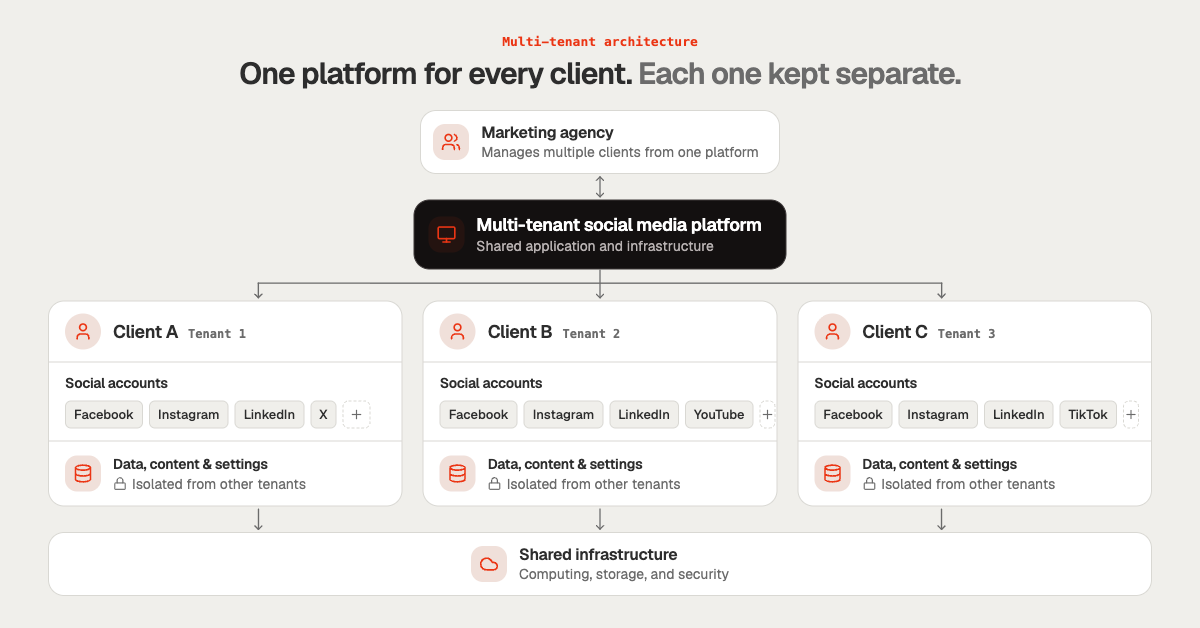
A multi-tenant social media platform allows multiple users and businesses to manage their social media accounts through a single platform while keeping each tenant’s data, accounts, settings, and permissions isolated. It uses shared infrastructure and an application environment to serve multiple tenants without deploying a separate application for every customer.
For example, a SaaS platform for marketing agencies enables them to manage social media accounts for multiple clients. Each agency can create client profiles, connect their clients' social accounts, and manage their content from the same application. Each client's accounts, content, and permissions remain isolated, allowing multiple clients to use the platform securely.
When you might need a multi-tenant social media platform
A multi-tenant social media platform is useful when one application needs to serve multiple businesses, teams, or customers without mixing their data and access.
Some of the reasons why you might need a multi-tenant social media platform include:
1. Your agency manages multiple clients' social accounts
If your agency is managing social media for multiple clients, a multi-tenant platform lets you manage their accounts from one application while keeping each client’s workspace separate. You can organise their connected accounts, content calendars, posts, and analytics independently, making it easier to manage multiple clients without mixing their data.
2. You are building a product with social media features
If you are building a CRM, e-commerce platform, or other SaaS product with social posting, messaging, or analytics, multi-tenancy allows each user to connect and manage their social accounts separately from other users.
3. You want to offer your social media platform as a white-label product
As a founder or developer, you may want to expand your application’s social media functionality and offer it to businesses under their own brands. A multi-tenant architecture gives each business its own workspace, users, connected accounts, branding, and settings within the same underlying application and infrastructure.
4. You publish and manage social media content on behalf of clients
If you are a social media manager or content team that publishes content for clients, you need to manage each client’s account connections and publishing permissions separately. A multi-tenant platform lets you connect each client to the application, schedule their content, and publish to their accounts without requiring a separate application or workflow for every client.
5. Your organisation has multiple content teams
If you work in a large organisation, franchise, or team with different responsibilities, you may need an application with separate roles and permissions for different team members. A multi-tenant platform can let content writers create content while content managers or editors review and publish it, helping teams collaborate effectively.
What you need in a multi-tenant social media platform
To build a multi-tenant social media management platform, you need a developer-first API that supports advanced social media workflows and integrations. It should also allow you to manage client profiles, handle webhooks, and authenticate and maintain connected social accounts.
Some of the key API features you need to build a multi-tenant social media management platform include:
1. Supports multiple client profiles
In a multi-tenant social media platform, each tenant has its own workspace, connected social accounts, and users, isolated from other tenants. Therefore, your selected social media API must allow you to create separate client profiles, connect social media accounts to each profile, and make API requests for each client.
For example, an agency managing social media for three businesses could create a separate profile for each business. When the agency publishes a post for Client A, the API request must use Client A’s connected accounts and API credentials to ensure the post is published to the correct accounts.
2. Embedded social account authentication
A unified API for multi-tenant social media management must provide built-in authentication support for multiple social media platforms. These APIs support embedded authentication flows that let you perform the entire authentication and authorisation process within your application, without redirecting users to third-party platforms or showing the vendor’s brand. Users can connect their Facebook, Instagram, LinkedIn, and X accounts and authorise your application to schedule and publish posts directly from your platform, keeping the entire experience under your own branding.
3. Per-platform API customisation
Major social media platforms offer different API capabilities for features such as post publishing, analytics, and messaging, allowing you to manage connected social accounts programmatically. Before choosing a social media API for your multi-tenant social media management platform, ensure it provides broad access to the official platform API, adheres to its limits, and allows you to customise your integrations based on your needs.
4. Webhooks support for real-time events
Multi-tenant social media applications need to respond immediately when data changes or events occur on connected social accounts. Webhooks make this possible by notifying your application when an action occurs, such as a new comment, message, account change, or publishing update, keeping each client's workspace and social activity up to date.
5. Automatically manage tokens and handle API limits
Social media platforms have their own authentication requirements, access tokens, token refresh processes, rate limits, and API errors. A unified social media API that supports multi-tenancy should handle much of this underlying maintenance, simplify authentication processes, and standardise API errors, so you don’t have to build and maintain separate authentication logic for every platform.
6. Provide analytics for each connected client
An API that supports multi-tenant social media platforms must keep analytics associated with each client and their connected accounts. This allows businesses to access metrics such as post performance, engagement, reach, and overall account performance from their own workspace, helping them make better decisions, optimise their content strategy, and identify high-performing topics and content.
Stop building social integrations from scratch.
One API call to publish, schedule, and manage posts across 15+ platforms.
Zernio: Unified social media API for building multi-tenant platforms
Zernio is a unified social media management and messaging API that supports multi-tenancy for SaaS applications, automation workflows, customer engagement, and marketing platforms.
It offers a developer-first API built for AI agents and software applications that need content scheduling and publishing, social media analytics and reporting, and conversation management via direct messages, comments and reviews, all through a single API or MCP server integration.
Zernio supports multi-tenancy by simplifying authentication across 18 platforms, allowing you to create separate client profiles and connect multiple social media accounts to each profile. It also handles social media API updates and maintenance, webhook delivery, and automatic retries for failed API requests, so you do not have to maintain separate integration logic for each platform.
Why choose Zernio?
1. Built-in per-profile multi-tenancy
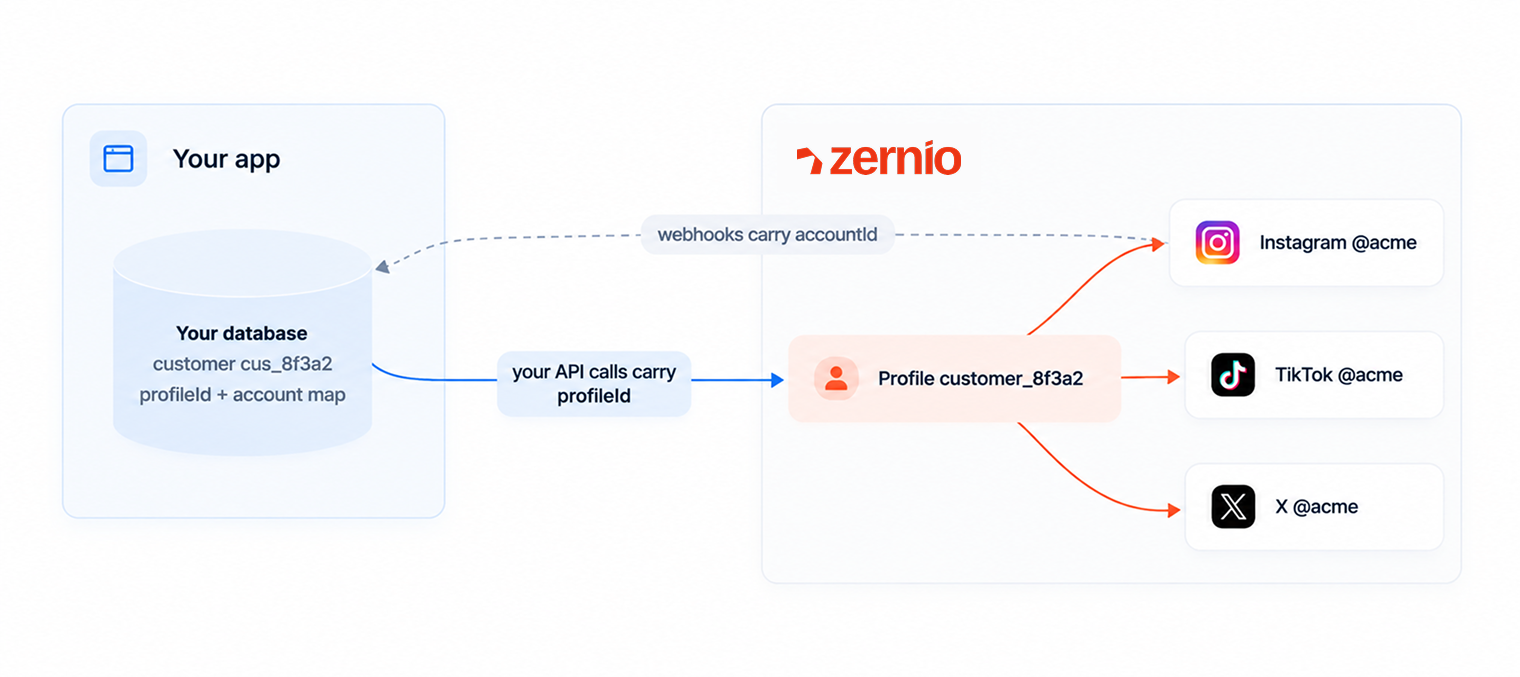
Zernio allows users to create a separate profile for each customer, giving your application a simple way to support multi-tenancy. To set up multi-tenancy with Zernio, you only need an API key and a database column to store each customer’s profileId. Each customer can then connect multiple social media accounts to their profile.
2. Scoped API keys with permissions
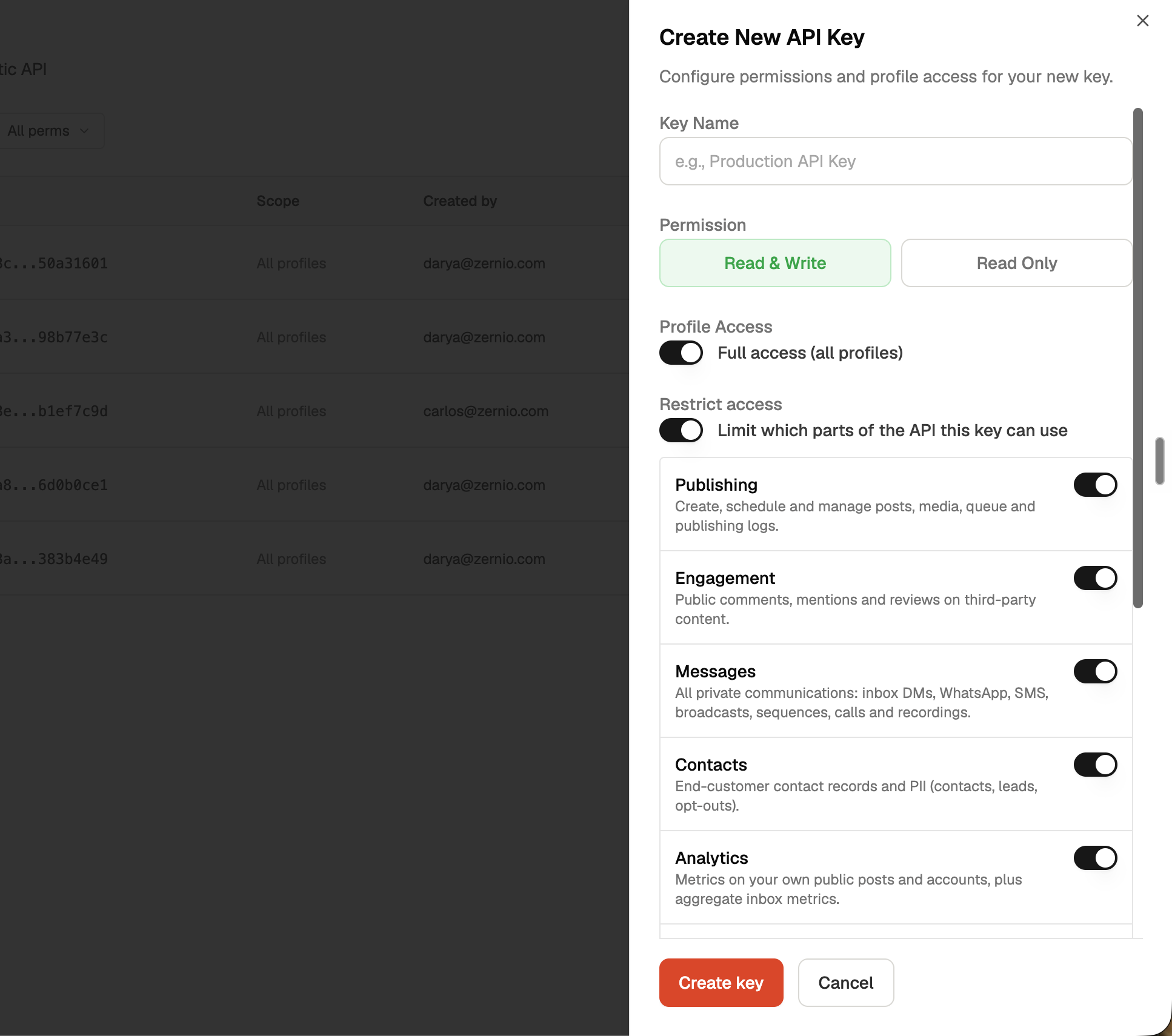
Zernio allows you to create API keys restricted to specific client profiles, assign read-only or read-and-write permissions, and control which features each key can access. For example, you can create a read-only API key that only allows access to connected accounts, analytics, messages, and engagements.
3. Webhooks support with client routing
Zernio provides built-in webhooks that notify your application when events occur across its social media features, such as when a post is published, a direct message is received, an account is disconnected, or analytics data is updated. You can also route webhook events to specific clients by setting profileIds on a webhook endpoint. By default, the API endpoint receives events from all profiles, but you can restrict it to specific profiles so it only receives events associated with those clients.
4. Embedded OAuth with token connection monitoring
Zernio lets you embed social authentication directly into your application, allowing customers to connect their social accounts without being redirected to a third-party platform. It also monitors connected accounts and alerts you when access tokens become invalid, such as when a customer changes their password, revokes access, or triggers a platform security check.
5. Broad social media feature support
Zernio provides a broad range of social media features through a single API, including multi-platform content scheduling and publishing, a unified social inbox for DMs, messages, and reviews, analytics, ads management, voice calls, iMessage, and SMS. This allows you to provide different social media capabilities to each client while managing their connected accounts and data through the same multi-tenant integration.
6. Rate limit management and automatic retries
Zernio manages API rate limits and provides automatic retry mechanisms for failed requests due to temporary errors, helping multi-tenant applications handle high request volumes reliably. Rate limits scale with the number of connected social accounts. You can also monitor your remaining request capacity with the X-RateLimit-Remaining header and use the Retry-After header to determine when to retry a request after a 429 response.
7. Social media API integration maintenance
Zernio manages social media API updates and integration changes under the hood, keeping your connected accounts compatible with the platforms they use. This reduces the maintenance required to support multiple social networks across your multi-tenant application.
Zernio supports integrations with 18 platforms, including Facebook, Instagram, X, Pinterest, LinkedIn, TikTok, YouTube, Reddit, Bluesky, Threads, Telegram, WhatsApp, Discord, Snapchat, Slack, Shopify, WordPress, and Google Business.
8. Transparent and predictable pricing
Zernio uses a pay-per-connected-account pricing model, making costs predictable as you add customers to your multi-tenant platform. Each connected account includes access to post scheduling and publishing, analytics, social inbox, ads, webhooks, full API access, and MCP server integration.
You can also view the current spend split by customer profile, making it easier to track each customer’s share of your Zernio costs.
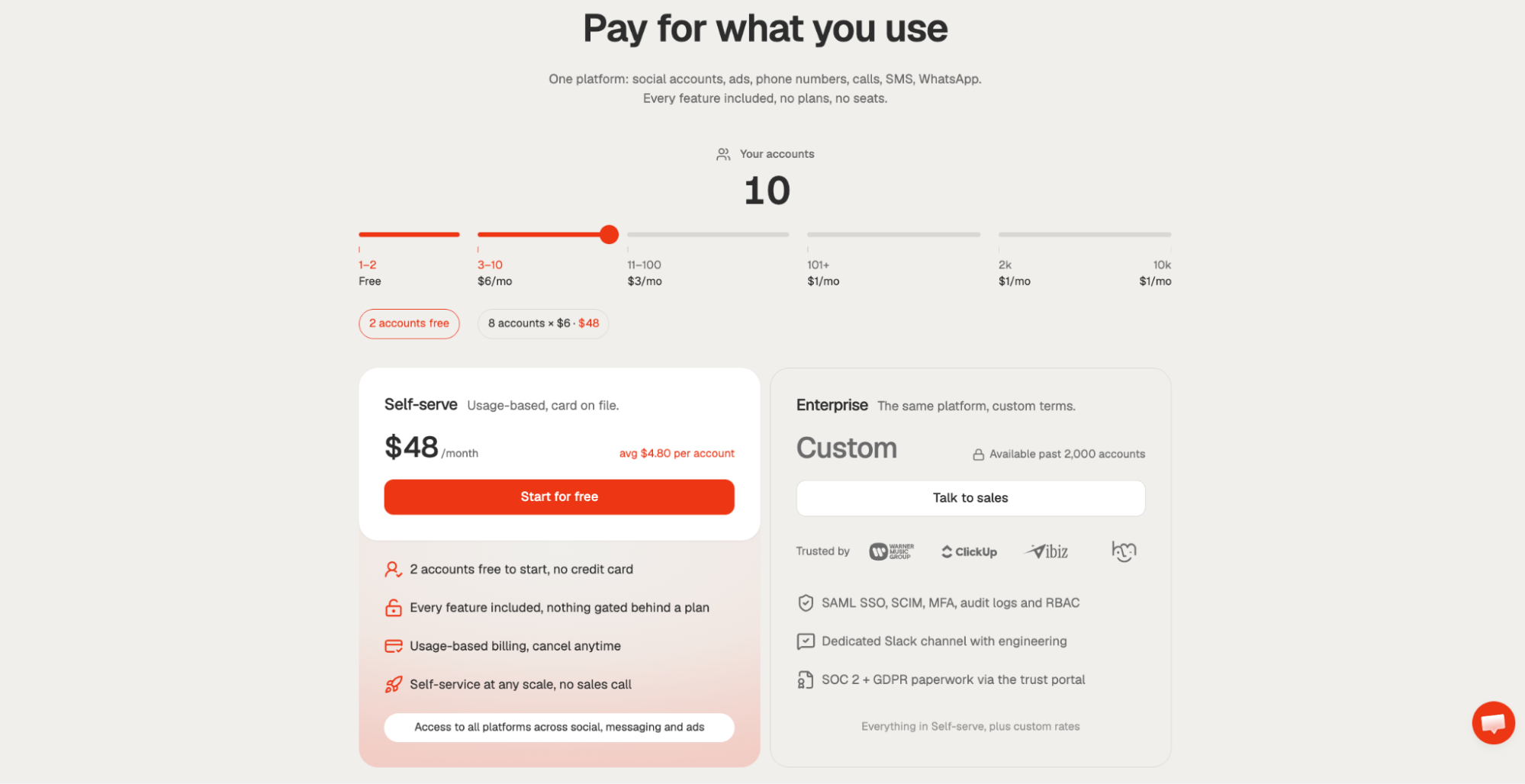
Summary: Building a multi-tenant social media management platform
Building a multi-tenant social media management platform requires more than connecting multiple social networks to one application. You need a way to create separate client profiles, isolate tenant data and permissions, authenticate each customer’s social accounts, handle webhooks and API limits, and maintain integrations as social platforms change their APIs.
A unified social media API, like Zernio, reduces the development work required to support these features across multiple platforms. Zernio provides multi-tenant client profiles, scoped API keys, embedded social authentication, webhooks, analytics, cross-platform content publishing, social inbox features, and API maintenance through a single API integration.
If you’re building multi-tenant social media management features into a SaaS application or customer engagement platform, choose Zernio for fast and easy integration.
FAQs
How do you build a multi-tenant social media management platform?
To build one, you need tenant or client profiles, data isolation, embedded and customisable authentication and authorisation, social account connections, content publishing, webhooks, analytics, API rate-limit handling, and billing or usage tracking. Zernio handles many of the platform-specific integrations and authentication requirements.
How do you isolate tenants in a SaaS application?
You should associate each tenant with a unique tenant ID or client profile ID and use it to scope API requests and access to their data and connected social accounts. Authentication alone does not provide tenant isolation, so authorisation and data-access controls, such as scoped API keys and permission rules, must also prevent one tenant from accessing another tenant’s resources.
How do I integrate multiple social media platforms into a SaaS application?
You can integrate each platform’s official API separately, or use a unified social media API that provides a common interface across multiple platforms. Zernio reduces the need to build and maintain separate authentication, publishing, webhook, error-handling, and API-limit logic for each platform.
How does OAuth work in a multi-tenant social media platform?
OAuth allows each customer to authorise your application to access their social media account without sharing their social media password. In a multi-tenant application, you must associate each connected account with its authentication credentials and ensure its data remains isolated from other customers.
Can one customer connect multiple social media accounts?
Yes. A multi-tenant social media platform built with Zernio allows each customer to connect multiple social media accounts and platforms to their own profile. For example, one customer might connect Facebook Pages, Instagram accounts, LinkedIn Pages, X accounts, and TikTok accounts to their profile while keeping those connections separate from other customers.
What is the difference between a tenant and a connected social account?
A tenant represents the customer or organisation using your platform. A connected social account is an individual social media account belonging to that tenant. For example, an agency could have one tenant profile for a client and connect that client’s Facebook, Instagram, and LinkedIn accounts to the profile.