The four main social media management platforms are Sprout Social, Hootsuite, Agorapulse, and Buffer. Each targets a different team size and use case: Sprout for enterprise, Hootsuite for agencies, Agorapulse for community-focused brands, and Buffer for small teams. If you need programmatic control, like embedding social into a product, automating workflows with AI agents, or managing accounts at API level, then the comparison shifts entirely. Zernio, a unified social API, is the fifth option that belongs in any complete 2026 comparison.
This guide covers all five in detail: features, pricing, where each wins, and where each falls short.
Table of contents
- How do these platforms compare at a glance?
- How should you think about the social media management category?
- Zernio: detailed review
- Sprout Social: detailed review
- Hootsuite: detailed review
- Agorapulse: detailed review
- Buffer: detailed review
- Statusbrew: detailed review
- How do enterprise platforms compare on governance and compliance?
- How do pricing and ROI compare across platforms?
- Which platform fits your team and use case?
- FAQ
How do these platforms compare at a glance?
| Platform | Best for | Core strength | Starting price | Programmatic/API access |
|---|---|---|---|---|
| Sprout Social | Enterprise teams | Deep analytics + compliance | $249/mo | Limited (enterprise add-on) |
| Hootsuite | Agencies + mid-market | Multi-account workflows | $99/mo | Available on enterprise plans |
| Agorapulse | Community-focused brands | Unified inbox + engagement | $69/mo | Basic API access |
| Buffer | Solopreneurs + small teams | Simple scheduling | $6/mo per channel | Basic API access |
| Statusbrew | Teams & agencies | Unified inbox + approvals + 270+ reporting | $129/mo | MCP server (Enterprise plan) |
| Zernio | Developers, AI agents, programmatic social management | Full social layer via REST API | Free (first 2 accounts), then $6/account/mo | API-first: full REST, MCP server, CLI |
How should you think about the social media management category?
The "social media management" category covers two distinct types of product, and mixing them up leads to the wrong purchase decision.
GUI-first platforms (Sprout, Hootsuite, Agorapulse, Buffer) are built for marketing teams who log in, create content, schedule posts, monitor conversations, and pull reports - all through a dashboard. The user is a human. These tools are optimized for ease of use, visual workflows, and collaboration between marketers.
API-first infrastructure (Zernio) is built for engineers and technical teams who need to control social accounts programmatically - publishing from inside a product, automating workflows, feeding data to AI agents, or giving end-users the ability to connect their own social accounts. The "user" is often code.
There's also an emerging third type of buyer: companies that use GUI tools today but want to add programmatic control - marketing teams at technical companies, growth teams at SaaS products, or businesses that want an AI agent handling parts of their social operation (reply routing, auto-publishing, performance-based boosting) without rebuilding their entire stack. This is the group that often gets stuck choosing between tools that don't quite fit.
The category map looks like this:
| Human-facing (dashboard) | Machine-facing (API) | |
|---|---|---|
| Scheduling + publishing | Sprout, Hootsuite, Agorapulse, Buffer | Zernio |
| Engagement (comments + DMs) | Sprout, Hootsuite, Agorapulse | Zernio |
| Analytics | Sprout, Hootsuite, Agorapulse, Buffer | Zernio |
| Ads management | Sprout (limited), Hootsuite (limited) | Zernio |
| AI agent workflows | None natively | Zernio (MCP server, CLI, JSON output) |
| Embed into your product | Not possible | Zernio (white-label OAuth, webhooks) |
Stop building social integrations from scratch.
One API call to publish, schedule, and manage posts across 15+ platforms.
Most companies need to pick one row or the other. A few need both - a dashboard for the marketing team plus an API for the engineering team to build on top of.
Zernio: detailed review
Starting price: Free (first 2 accounts), then $6/account/mo (accounts 3-10), $3/account/mo (11-100), $1/account/mo (101-2,000)
Best for: Developers building social into products, SaaS companies embedding social publishing, AI agent builders, marketing teams wanting programmatic control
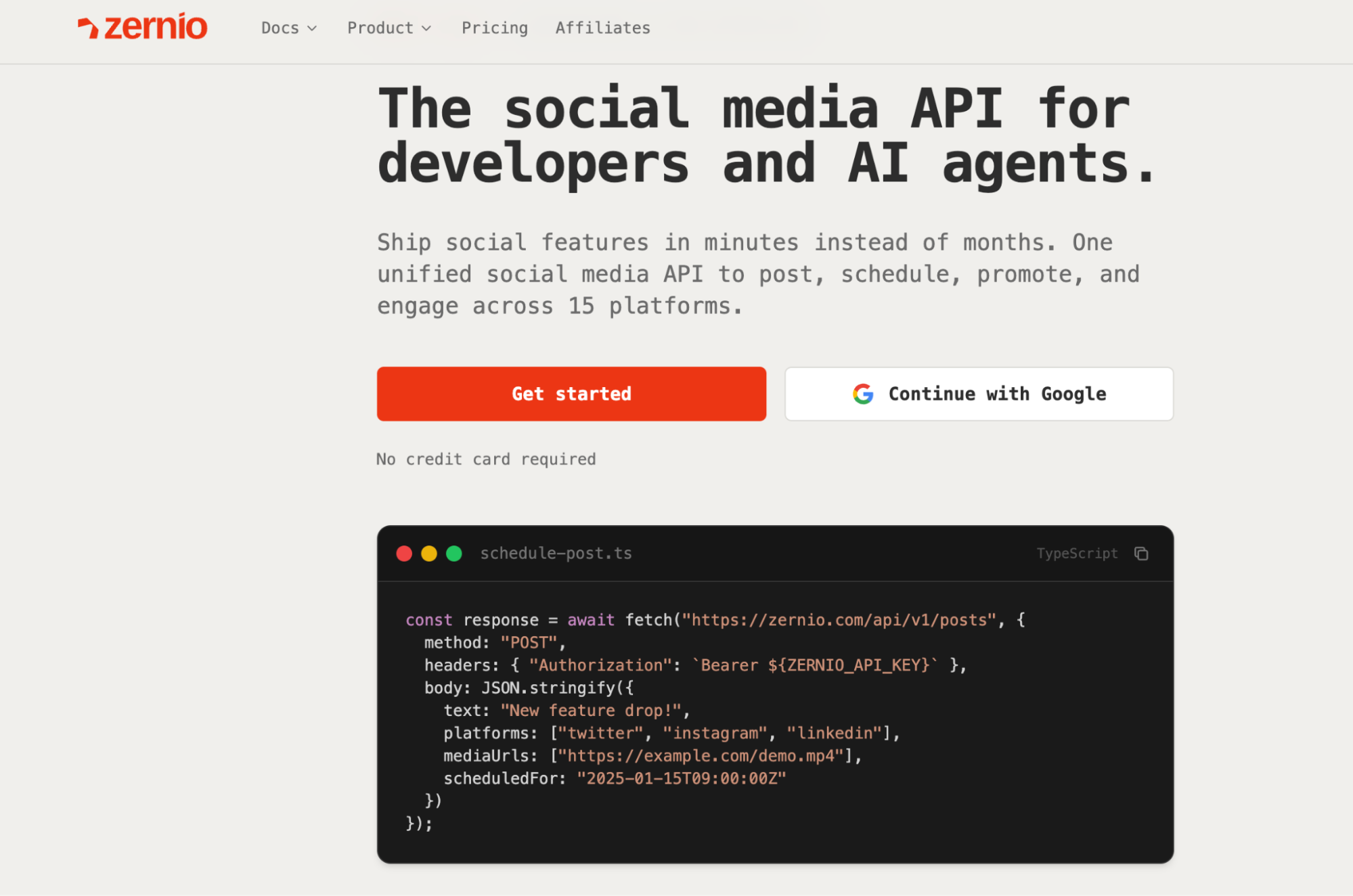
Zernio is a unified social media management API that lets your app post to Instagram, TikTok, LinkedIn, Facebook, X, and 10+ other platforms through a single REST endpoint and an MCP server for AI agents. Publishing, comments, DMs, analytics, and ads management through one bearer token, one JSON schema, one integration. It's in this comparison because in 2026, a growing share of companies don't want to log into a social media management dashboard at all. They want their product, their AI agent, or their internal tooling to handle social - programmatically, at scale.
Three types of companies end up evaluating Zernio social media management API alongside GUI tools:
Developers and engineering teams building social publishing, engagement, or analytics into a product. The alternative is building and maintaining 15 separate platform integrations; that's 6-12 months of engineering time for auth, media normalization, rate limit handling, and ongoing maintenance when platforms change their APIs. Zernio collapses that into one integration, typically working in under an hour.
Companies adding AI agent workflows to their social operation. If you want an AI agent to publish content automatically, route incoming comments, auto-boost high-performing posts, or analyze performance and report, then Zernio is the only API in this category with native agent infrastructure: a hosted MCP server (280+ tools at mcp.zernio.com), a CLI with structured JSON output, OpenClaw social media posting, and LLM-readable documentation.
Marketing teams who've outgrown GUI tools and want API-level control: scheduling via code, webhooks for real-time events, bulk uploads via API, custom dashboards built on top of Zernio's data, without paying per-seat fees that grow with every new hire.
The full social layer includes:
-
Posting API: text, images, video, carousels - scheduled or post immediately to any combination of 15 platforms
const { post } = await zernio.posts.createPost({ content: 'Cross-posting to all my accounts!', scheduledFor: '2024-01-16T12:00:00', timezone: 'America/New_York', platforms: [ { platform: 'twitter', accountId: 'acc_twitter123' }, { platform: 'linkedin', accountId: 'acc_linkedin456' }, { platform: 'bluesky', accountId: 'acc_bluesky789' } ] }); - Comments API: read, reply, moderate across platforms
- Messaging/DMs API: send and receive DMs across 7 platforms
- Analytics API: impressions, reach, engagement, follower tracking, etc - normalized across platforms
- Ads API: promote posts programmatically, create campaigns, manage audiences across 7 ad platforms (Meta, Google, TikTok, LinkedIn, Pinterest, X)
- Comment-to-DM automation: auto-DM users who comment specific keywords
- OAuth-as-a-service: end-users connect their social accounts through one OAuth flow - no per-platform developer apps needed
- Webhooks: real-time events for post status, messages, comments
Where Zernio wins:
- The only option here that can be embedded inside your own product - white-label, no Zernio branding visible to end-users
- Full social layer (posting + comments + DMs + analytics + ads) vs. the posting-only competitors in the API space
- 15 platforms including WhatsApp, Telegram, and Discord - gaps in most alternatives
- Native AI agent infrastructure: MCP server, CLI with JSON output, structured error handling agents can parse and recover from
- Pricing that rewards scale: cost per account drops as you grow, every feature included, no add-ons or tiers
- SOC 2 + GDPR compliant - important for European SaaS companies
Where Zernio loses:
- No beautiful dashboards for non-technical team members to log in and use (well, there is a visual dashboard included with the API, but it's secondary to the API-first workflow)
- Not the right fit for a marketing team that just wants to schedule posts and doesn't need programmatic access - Buffer at a fraction of the setup time
Pricing summary:
| Accounts | Monthly cost |
|---|---|
| First 2 | Free |
| 3-10 | $6/account |
| 11-100 | $3/account |
| 101-2,000 | $1/account |
With Twitter/X API costs passed through at exact X rates. All other platforms fully included.
At 100 accounts: $318/mo. Everything included: no per-seat charges, no feature tiers, no add-ons.
Sprout Social: detailed review

Starting price: $249/month (Standard, 5 profiles, 1 seat)
Best for: Enterprise marketing teams, regulated industries
Sprout Social is the enterprise choice in this category. Its analytics suite is one of the most detailed of any GUI platform, letting you build reports, drill into individual post performance, and track team response times across your inbox. If your team needs to tie social activity directly to business outcomes, Sprout has the reporting depth to do it.
The Smart Inbox pulls all comments, DMs, and mentions across platforms into one feed. The CRM layer inside that inbox is genuinely useful: every contact has a full conversation history, internal notes, and assignable tasks. For brands running high-touch customer service at scale, this matters.
Sprout's ViralPost technology analyzes real-time audience engagement patterns to determine the optimal publish time - more automated than Hootsuite's manual best-time suggestions.
Where Sprout wins:
- Analytics and custom reporting in the GUI-platform category
- Enterprise compliance: message-level audit trails, SSO, advanced permissions
- CRM-like inbox with full conversation history per contact
- Social listening (paid add-on) for brand monitoring and competitor tracking
Where Sprout loses:
- Price. The Standard plan at $249/month covers 5 profiles and 1 seat. Adding users gets expensive fast - pricing is per-seat.
- The features that make it worth the price (listening, competitive benchmarking, advanced analytics) are mostly locked behind higher tiers or paid add-ons.
- No programmatic control - you can't build workflows that trigger publishing from your product or automate actions based on external data.
- Overkill for teams that don't need the compliance and analytics depth.
Pricing summary:
- Standard: $249/mo (5 profiles, 1 seat)
- Professional: $399/mo (unlimited profiles, 1 seat, more analytics)
- Advanced: $499/mo (adds listening, sentiment analysis)
- Enterprise: custom
Hootsuite: detailed review

Starting price: $99/month (Professional, 10 accounts, 1 user)
Best for: Agencies, mid-market teams, multi-account management
Hootsuite's core strength is multi-account workflow management. Its dashboard handles high volumes of accounts without becoming chaotic, which is why agencies have used it for a while. The approval workflow has a flexible configuration: you can set up multi-step review chains where junior team members draft content, senior staff approves, and clients sign off before anything goes live.
Bulk scheduling via CSV is a practical feature for agencies filling content calendars in advance. The Best Time to Publish tool scans past performance and audience activity to suggest optimal posting windows.
Competitive benchmarking in Hootsuite's analytics lets you track how your performance compares to competitors across key metrics - an angle Sprout also covers but in different depth.
Where Hootsuite wins:
- Multi-account management at scale - the dashboard holds up under volume
- Competitive benchmarking built into analytics
- Strong team permission model: granular role assignments, client-facing access controls
- RSS feed auto-posting for content curation
Where Hootsuite loses:
- Pricing has crept up significantly. The $99/mo plan covers only 1 user - adding a second seat costs more.
- Many of Hootsuite's best features (advanced analytics, social listening, full competitive benchmarking) are higher-tier or add-on purchases.
- The interface is dated compared to Agorapulse and Buffer - functional but not user-friendly to use daily.
- Hootsuite has no API access on standard plans. Programmatic control requires enterprise contracts.
Pricing summary:
- Professional: $99/mo (10 accounts, 1 user)
- Team: $249/mo (20 accounts, 3 users)
- Enterprise: custom (unlimited, advanced features)
Agorapulse: detailed review

Starting price: $69/month (Standard, 3 profiles, 2 users)
Best for: Community managers, brands focused on inbox-zero engagement
Agorapulse built its reputation on the unified inbox. Its "inbox zero" philosophy treats every interaction - comment, DM, mention, review - as a task that needs to be dealt with. Items get reviewed, assigned, or archived. For brands that get high engagement volume and care deeply about response quality, this is a disciplined engagement workflow in the category.
Content queues work differently here than in Hootsuite or Sprout. You can create labeled queues (blog posts, evergreen content, seasonal campaigns) and set scheduling rules for each, and Agorapulse will automatically mix and recycle content across categories.
The assignment and review process is clean: team members see exactly what's on their plate, nothing is ambiguous, and the activity reports make it easy for managers to track team performance.
Where Agorapulse wins:
- Unified inbox - inbox-zero methodology is genuinely effective
- Content queue categorization and evergreen recycling
- Pricing includes 2 users from the base plan - better value than Sprout or Hootsuite for small teams
- Clean team collaboration: clear assignment, review, and activity tracking
- Competitor analysis is easy to use and actionable
Where Agorapulse loses:
- Analytics are solid but not as deep as Sprout - custom report building is more limited
- Not built for managing dozens of client accounts simultaneously (that's Hootsuite's territory)
- Less enterprise governance depth than Sprout - audit trails and compliance features are lighter
- No programmatic access beyond basic API endpoints
Pricing summary:
- Standard: $69/mo (3 profiles, 2 users)
- Professional: $99/mo (10 profiles, 2 users)
- Advanced: $149/mo (adds automation, power reports)
- Custom: enterprise
Buffer: detailed review
Starting price: $6/month per channel (Essentials plan)
Best for: Solopreneurs, creators, early-stage startups, small teams that want consistent scheduling without complexity
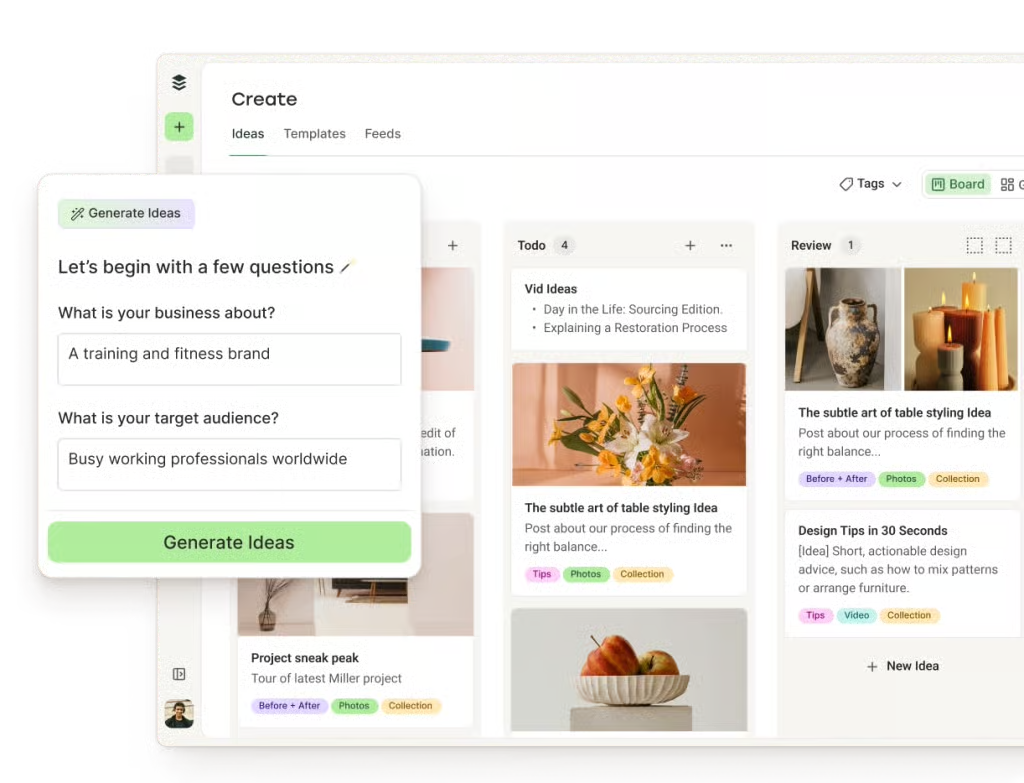
Buffer's positioning is deliberate simplicity. You set your posting schedule, add content to the queue, and Buffer handles the rest. There's no complex inbox, no multi-step approval chains, no competitive benchmarking - and that's the point. For a solo founder or a creator managing 3-5 social channels, the extra features in Sprout or Hootsuite create friction, not value.
The per-channel pricing model works well at low account counts. At $6/channel, managing 4 channels costs $24/month. The Start Page link-in-bio feature and basic analytics round out the package for content creators.
Buffer's publishing interface is very clean. The drag-and-drop queue, the browser extension for adding content on the fly, and the mobile app all work as expected with minimal learning curve.
Where Buffer wins:
- Pricing: genuinely cheap for low channel counts
- The simplest interface in this comparison - minimal learning curve
- Good enough analytics for small teams: engagement, reach, best-time suggestions
- Per-channel model means you only pay for what you actually use
Where Buffer loses:
- Per-channel pricing scales badly. At 20+ channels, Buffer gets expensive fast, and at that point, Hootsuite's flat user pricing often wins.
- No meaningful team collaboration on the base plan - approval workflows and role management require the Team plan ($12/channel/mo)
- Analytics are basic: no competitive benchmarking, no custom reports, no team performance tracking
- Engagement management is minimal. There's no unified inbox equivalent - community management teams will find it inadequate.
- Buffer has no API access to build on top of.
Pricing summary:
- Essentials: $6/mo per channel (1 user, unlimited scheduling)
- Team: $12/mo per channel (unlimited users, approval workflows)
- Agency: custom
Statusbrew: detailed review
Starting price: $129/month (Standard, 3 users, 10 profiles)
Best for: Teams and agencies that want publishing, engagement, and reporting in one dashboard, priced by plan rather than per seat
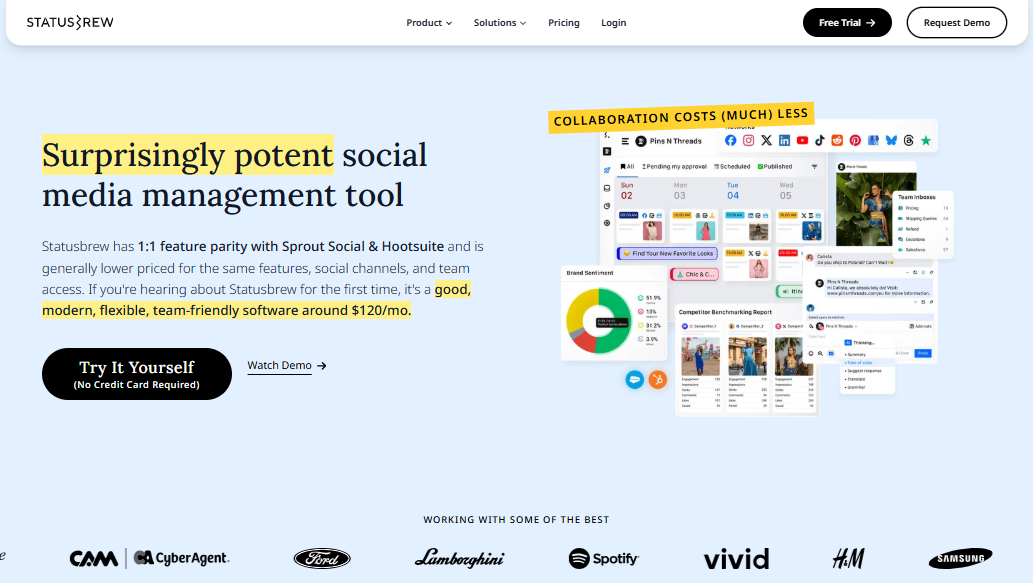
Statusbrew is a social media management platform built for teams and agencies managing multiple social media channels. It brings publishing, a unified inbox, approval workflows, reporting, and social listening into a single dashboard, and organizes work with Workspaces and Profile Groups so each client or brand stays separate.
Its pricing model is the differentiator against Sprout and Hootsuite: plans bundle a set number of users and profiles rather than charging per seat, so the cost stays predictable as the team grows. The unified inbox pulls comments, DMs, mentions, and reviews, including comments on paid posts, into one place, with automation rules for routing and moderation.
For teams that also want AI-agent control, Statusbrew ships an MCP server (Claude, ChatGPT, Gemini, Copilot) on Enterprise, so you can publish and pull reports from an AI client. It is still a dashboard product at heart, so it pairs naturally with an API-first layer rather than replacing one.
Where Statusbrew wins:
- Plan-based pricing, no per-seat fees as the team grows
- Multi-step approval workflows and Workspaces/Profile Groups for agencies
- 270+ reporting metrics with white-label, client-ready reports
- Statusbrew MCP for AI-agent publishing and reporting; SOC 2 Type 2 and GDPR
- Unified inbox across organic and paid, with automation rules
Where Statusbrew loses:
- Social listening and AI sentiment sit on the Premium tier and up
- No free-forever plan (14-day trial only)
Pricing summary:
- Standard: $129/mo (3 users, 10 profiles)
- Premium: $229/mo (6 users, 15 profiles, can add more)
- Enterprise: custom (unlimited users/profiles, MCP, SSO)
How do enterprise platforms compare on governance and compliance?
Enterprise social media governance covers three things: who can publish and approve content, what happens when something goes wrong, and whether the tool can pass vendor security reviews.
This is where Sprout Social slightly stands out, and where the GUI tools as a group have clear limitations for companies that need programmatic compliance controls.
| Governance feature | Sprout Social | Hootsuite | Agorapulse | Buffer | Zernio |
|---|---|---|---|---|---|
| Message-level audit trail | Yes | Partial | No | No | Via API logs |
| SSO / SAML | Yes (enterprise) | Yes (enterprise) | No | No | Yes |
| Custom user roles + permissions | Granular | Granular | Standard roles | Basic | API key scoping |
| Multi-step approval workflows | Yes | Yes | Yes | Team plan | Not applicable (API) |
| SOC 2 certification | Yes | Yes | No | No | Yes |
| GDPR compliance | Yes | Yes | Yes | Yes | Yes |
| Regulated industry fit | Strong | Moderate | Limited | None | API-level controls |
For large enterprises in regulated industries (financial services, healthcare, legal), Sprout Social is the GUI tool that holds up to vendor review processes. Hootsuite covers the basics. Agorapulse and Buffer are not built for this level of governance complexity.
Zernio's compliance model is different: SOC 2 + GDPR certified, EU-based, with API-level logging and key scoping. It's designed for companies building compliant social infrastructure into their own products, not for the marketing dashboard use case.
How do pricing and ROI compare across platforms?
The most common mistake in platform selection is comparing headline prices without accounting for how the pricing model scales with your actual usage.
The three pricing models in this comparison:
Per-seat (Sprout Social, Hootsuite): you pay per user who needs access. Adding team members increases your bill. Features are included at each tier but locked behind tier upgrades. Predictable at small team sizes, expensive as the team grows.
Per-channel (Buffer): you pay per connected social account. Cheap at 3-5 accounts, expensive at 20+. Team collaboration features require a tier upgrade.
Per-connected-account (Zernio): you pay for each social account connected through the API, typically your end-users' accounts, not internal team seats. Price drops as you scale. Every feature included from account one. No per-seat charges.
Cost comparison at different scales:
| Scenario | Sprout Social | Hootsuite | Agorapulse | Buffer | Zernio |
|---|---|---|---|---|---|
| 1 user, 5 accounts | $249/mo | $99/mo | $69/mo | $30/mo | $18/mo |
| 3 users, 15 accounts | $747/mo (3 seats) | $249/mo (Team) | ~$229/mo | $90/mo | $63/mo |
| 10 users, 50 accounts | $2,490/mo+ | Enterprise | Enterprise | $300/mo | $168/mo |
| 100 accounts (multi-client or embedded) | Enterprise custom | Enterprise custom | Enterprise custom | $600/mo | $318/mo |
ROI considerations beyond the price tag:
Sprout Social's reporting depth can reduce the time analysts spend building custom reports - for large teams, that time saving partially offsets the premium cost.
Hootsuite's approval workflows reduce back-and-forth on agency content reviews - meaningful for teams handling 10+ client accounts simultaneously.
Agorapulse's inbox-zero methodology can measurably reduce missed engagement - for brands where customer response rate affects revenue (e-commerce, hospitality), this has a real ROI case.
Buffer's low cost has an obvious ROI for tiny teams. The calculation inverts once you need features that require a plan upgrade.
Zernio's ROI calculation is fundamentally different: the comparison isn't "vs. other social tools", it's "vs. building and maintaining your own platform integrations." Six months of engineering time to build 15 integrations has a real cost. Zernio replaces that with one integration and an ongoing monthly cost that drops as you scale.
Which platform fits your team and use case?
Solopreneur or creator (1 person, 3-8 channels): Buffer. Cheapest, simplest, no features you'll never use.
Small marketing team (2-5 people, community management matters): Agorapulse. Better inbox, better team collaboration than Buffer, much better price than Sprout or Hootsuite.
Mid-market team (5-20 people, multiple client accounts or complex approvals): Hootsuite. Built for multi-account volume and approval workflows. The pricing is higher but the workflow fit is better than alternatives at this scale.
Enterprise team (compliance, governance, deep analytics required): Sprout Social. The analytics depth and compliance features that survive enterprise vendor reviews.
Developer building social into a product: Zernio. One integration, 15 platforms, works in under an hour. The alternative is 6-12 months of platform-specific engineering.
Company adding AI agent workflows to social: Zernio. The hosted MCP server (mcp.zernio.com) gives AI agents 280+ tools - publish, engage, analyze, boost through one authenticated server. No other tool in this comparison supports this use case.
Agency managing 20+ client accounts with white-label reporting: Hootsuite for the GUI workflow, or Zernio if you're building your own white-label client portal. Zernio's API lets you embed social management into a custom-branded dashboard, so clients never see Zernio.
FAQ
Can social media management platforms work with AI agents?
The GUI platforms (Sprout, Hootsuite, Agorapulse, Buffer) don't natively support AI agent workflows. They're designed for human interaction through a dashboard. Zernio is built specifically for AI agent use: it exposes a hosted MCP server at mcp.zernio.com with 280+ tools, a CLI with structured JSON output, and llms.txt for LLM-readable documentation. An agent running on Claude Desktop, Cursor, or any MCP-compatible client can publish content, check analytics, and boost posts through one authenticated server.
What's the difference between a social media API and a management platform?
A management platform (Sprout, Hootsuite, Agorapulse, Buffer) is a SaaS application with a dashboard - a human logs in, creates content, and manages conversations through the interface. While social media APIs (Zernio) are infrastructures your engineering team integrates into your own product or workflow - social actions happen programmatically, triggered by code, with no separate dashboard login required. The API approach lets you embed social features into your product, automate workflows, and build custom interfaces. The platform approach is faster to set up for marketing teams that don't need programmatic control.
Do social media management tools require separate compliance certifications for enterprise vendor reviews?
It depends on the tool. Sprout Social and Hootsuite both have SOC 2 certifications and support enterprise SSO/SAML, as they typically pass standard enterprise vendor reviews. Agorapulse and Buffer do not have SOC 2 certifications, which can create issues with enterprise security reviews. Zernio is SOC 2 Type II certified and GDPR compliant, with a public trust portal at trust.zernio.com. For companies embedding social infrastructure into their own product, Zernio's compliance documentation is designed to support their customers' vendor review processes.