Businesses use SMS APIs to send authentication codes, transaction alerts, appointment reminders, marketing messages, and other time-sensitive notifications directly from their applications. The best provider depends on various factors such as coverage, pricing, delivery reliability, two-way messaging, and support for AI-powered workflows.
The best SMS APIs in 2026 include Zernio, Twilio, Sinch, Bird, ClickSend, EZ Texting, Textmagic, Link Mobility, Messente, and Mitto. Zernio stands out for combining SMS and social messaging with reliable global delivery and AI agent support in one API. Other providers focus on areas such as enterprise messaging, SMS marketing, and omnichannel communication.
In this guide, you’ll learn what an SMS API is, when to send SMS programmatically, the top 10 SMS APIs for 2026, and what to consider when choosing one for your business.
What is an SMS API?
An SMS API is a programmable interface that allows applications to send and receive SMS messages through an SMS provider.
Modern SMS APIs support transactional messaging, bulk and personalised SMS, two-factor authentication (2FA), one-time passwords (OTPs), and time-sensitive notifications such as order updates and appointment reminders. Some also support two-way messaging and webhooks, enabling applications to receive replies, track message events such as delivery and failure, and respond to messaging events in real time.
How to Send SMS Using the Zernio API
When Do You Need an SMS API?
Developers and businesses integrate SMS communication into websites, mobile apps, and backend systems for various purposes, from user authentication, marketing campaigns to time-sensitive alerts.
Common use cases include:
1. Implement SMS authentication
Applications use SMS APIs to authenticate users by sending OTPs, 2FA, and verification codes. For example, an application sends an authentication code when a user signs in, resets their password, updates sensitive account information, or attempts to sign in from an unfamiliar device or location.
2. Send financial transaction alerts
Banks, fintech platforms, and other financial services use SMS APIs to send transaction alerts, payment confirmations, security notifications, and OTPs. These messages keep customers informed about account activity and provide important details such as transaction amounts and account balances.
3. Share time-sensitive updates
E-commerce platforms, ride-hailing services, and restaurants use SMS APIs to send time-sensitive updates, such as order confirmations, delivery updates, payment notifications, and changes to a customer’s order or booking. SMS helps reach users quickly, even when they are not online or actively using the application.
4. Send booking confirmations and reminders
Healthcare platforms, airlines, event registration systems, and ticketing platforms use SMS APIs to send automated reminders, booking confirmations, ticket codes, and other notifications.
5. Automate marketing campaigns
Businesses use SMS APIs to automate promotional campaigns for opted-in customers. For example, they send messages about discounts, new product arrivals, seasonal promotions, and other offers based on specific dates, events, or customer actions.
6. Enable two-way SMS communication
Customer service platforms use SMS APIs to enable two-way communication between businesses and their customers. Customers reply to messages to request information, confirm appointments, respond to notifications, or contact a support team without opening a separate application.
7. Send bulk SMS
Businesses, government institutions, and other organisations use SMS APIs to send messages to large numbers of recipients. Common examples include emergency alerts, public health announcements, service updates, and other important information that needs to reach many people quickly.
A quick look at the best SMS APIs in 2026
The table below compares the best SMS APIs in 2026 based on their key features, SMS pricing, selling points, and ideal use cases.
| Name | Key features | SMS Pricing (US) | Selling point | Best for |
|---|---|---|---|---|
| Zernio | SMS/MMS, RCS, voice, WhatsApp, iMessages, social DMs and comments, MCP, webhooks, shared inbox, and phone number purchase | From $0.008/outbound SMS and $0.010 per inbound SMS | Combines SMS, broad social messaging, and AI agent support in a single API | Developers and businesses building AI agent workflows or customer engagement products |
| Twilio | SMS/MMS, RCS, WhatsApp, verification, fraud protection, and global infrastructure | From $0.0083/segment | Mature communications infrastructure + extensive carrier connectivity, and verification tools | Startups and enterprises that need highly scalable communications infrastructure. |
| Sinch | SMS, MMS, RCS, WhatsApp, voice, verification, and CRM integrations | From $0.0078/SMS | Carrier-grade SMS infrastructure, customer verification and fraud protection | Businesses and enterprises that need reliable global messaging combined with CRM integrations |
| Bird | SMS, Apple Messages, email, and MCP | From $0.0035/outbound segment | Gives AI agents direct access to communication workflows through its MCP | Developers and businesses building AI-powered communication workflows |
| ClickSend | SMS/MMS, WhatsApp, RCS, and MCP | From $0.0093/SMS | Straightforward business messaging with API and AI integrations. | Small and medium-sized businesses that need SMS and MMS without large-scale complexity |
| EZ Texting | SMS/MMS, RCS, bulk messaging, automation, AI replies, and shared inbox | From $25/month | SMS marketing, contact management, and campaign automation | US and Canadian businesses, marketers, and non-technical teams. |
| Textmagic | SMS, shared inbox, bulk messaging, MCP and CRM integrations | From $0.049/SMS | Mass texting with shared team inboxes, and automation | Small and medium-sized businesses that need team-based SMS communication |
| Link Mobility | SMS, RCS, WhatsApp, email, webhooks, delivery analytics | Custom pricing | Enterprise messaging infrastructure with strong compliance capabilities | Large businesses and enterprises that need managed messaging infrastructure |
| Messente | SMS, RCS, Viber, WhatsApp, intelligent routing, fraud protection | From €0.014/SMS | Global SMS reach with direct carrier connectivity and intelligent routing | Businesses and developers that need reliable transactional messaging |
| Mitto | SMS, RCS, WhatsApp, Viber, Telegram, social messaging, AI routing | From $0.0098/message | Global carrier connectivity with omnichannel messaging for high-volume communication | Businesses and enterprises scaling customer communication |
Stop building social integrations from scratch.
One API call to publish, schedule, and manage posts across 17 platforms.
10 Best SMS APIs in 2026
1. Zernio
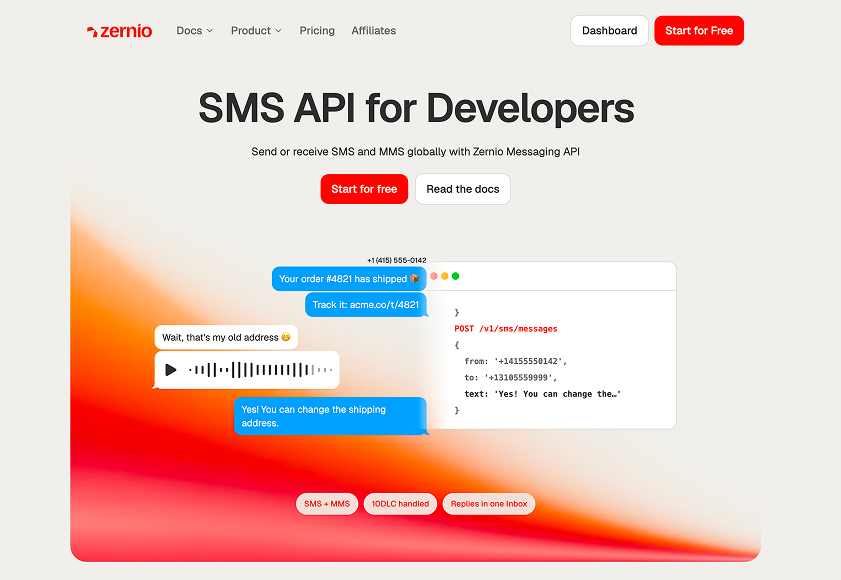
Zernio is a marketing infrastructure platform for products and AI agents. Its SMS API lets you send authentication, marketing, and time-sensitive messages to customers, and receive replies for two-way messaging. It allows you to port in a phone number you already use or purchase international phone numbers for SMS, WhatsApp, and voice calls directly through its API endpoints.
Zernio supports branded sender IDs for one-way international SMS, webhooks for real-time delivery tracking, and automatic STOP opt-out handling. You can also send personalised or bulk SMS messages and automate messaging workflows by connecting AI agents to Zernio’s MCP server.
Zernio is also the only SMS API in this comparison that handles the full social layer, including social media messaging, publishing, comments, ads, and analytics through the same API, so a team that talks to customers on Instagram as much as over SMS doesn't need a second vendor.
Best for: Developers and founders building AI agents or customer engagement apps that need to reach users on social DMs and messaging apps as well as SMS and voice.
Key features
- One API and unified inbox for messages on WhatsApp, iMessage, SMS, RCS, Instagram, Facebook, X, Telegram, Reddit, Bluesky and Slack.
- Supports two-way SMS and MMS messaging globally, including number verification, sender IDs, 10DLC and toll-free registration, and number portability.
- Supports carrier and line-type lookup to identify mobile, landline, and VoIP numbers before sending messages.
- STOP opt-outs are handled by the carrier and exposed as a list that you can sync with your application.
- Branded sender IDs for one-way international SMS and RCS messaging with verified business names, logos, rich cards, carousels, buttons, and SMS fallback.
- Supports webhooks for inbound, delivered, and failed messages with event verification, deduplication, configurable delivery, and automatic retries for failed webhook deliveries.
- Flexible number options that let businesses buy and verify international phone numbers in 50+ countries, port an existing number, or enable SMS on a number they already own.
- Offers a hosted MCP server that allows AI agents to send messages and perform supported read and write API actions.
- Provides a ChatSDK for building chatbots and customer-facing conversational experiences.
- Extends beyond communication APIs with social media management features such as ad management, post scheduling, analytics, user management, and team collaboration.
- Does not charge for failed API requests or failed messages.
Pricing
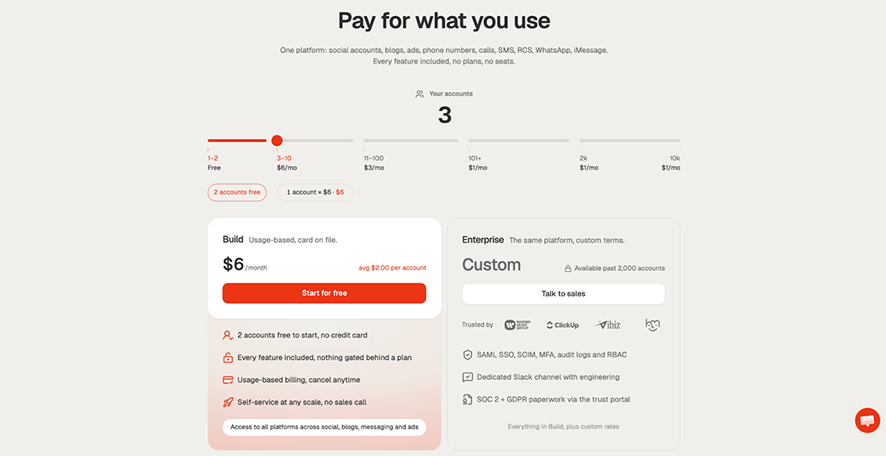
Zernio pricing starts at $0.008 per outbound SMS and $0.010 per inbound SMS. U.S. 10DLC registration costs a one-time $9 fee, while campaign fees start at $4 per month for sole proprietor users. Zernio also uses per-account pricing starting at $6 per month for 3 connected social accounts. This includes social messaging with the first 10,000 sent messages a month free, API and MCP server access, webhooks, ads management, social media scheduling, and analytics.
Limitations
- Best suited for businesses and developers that need broader messaging capabilities beyond SMS.
- Does not provide email APIs or email inbox integration for transactional, marketing, or general email communications.
2. Twilio
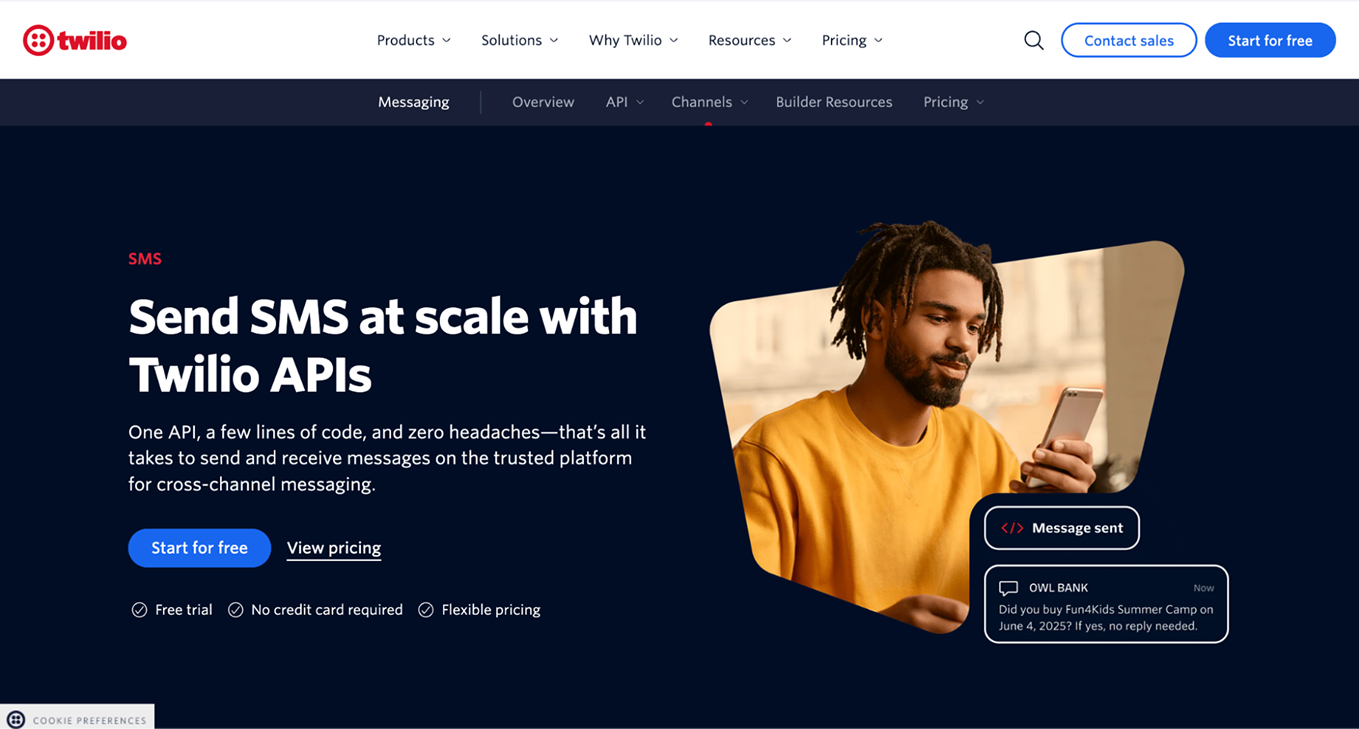
Twilio is a communications API platform that supports messaging across SMS, MMS, RCS, WhatsApp, and email. Its messaging infrastructure supports high-volume use cases, with features for sender selection, fallback routing, deliverability tracking, and throughput management.
Twilio supports one-way SMS for sending transactional messages through its Programmable Messaging API. Businesses can also send messages and receive replies through its Conversations API, which supports threaded conversations and message history. Twilio also provides user verification and protection against SMS pumping fraud through its Verify platform.
Best for: Developers, startups, and large enterprises that need scalable communications infrastructure with messaging, user verification, and fraud protection.
Key features
- Sends transactional and marketing SMS to 180+ countries with localised senders and tools for regulatory compliance.
- Real-time route optimisation that automatically reroutes global traffic to avoid outages and reduce latency.
- Supports inbound message routing through webhooks and message scheduling for SMS, MMS, and WhatsApp with a single API call.
- Real-time messaging analytics for monitoring delivery, engagement, and message performance.
- Global carrier network with 1,500+ tier-1 carrier connections for reliable message delivery.
- High-throughput senders, including toll-free numbers, short codes, alphanumeric sender IDs, and 10-digit long codes.
- AI-powered routing and fraud detection to improve message deliverability and prevent fraudulent SMS traffic.
- Customisable opt-in and opt-out settings to meet local regulations and language requirements.
- Message redaction that hides the last four digits of phone numbers and message bodies to protect sensitive data.
- SMS validity periods that control how long Twilio attempts to deliver queued messages before marking them as failed.
Pricing
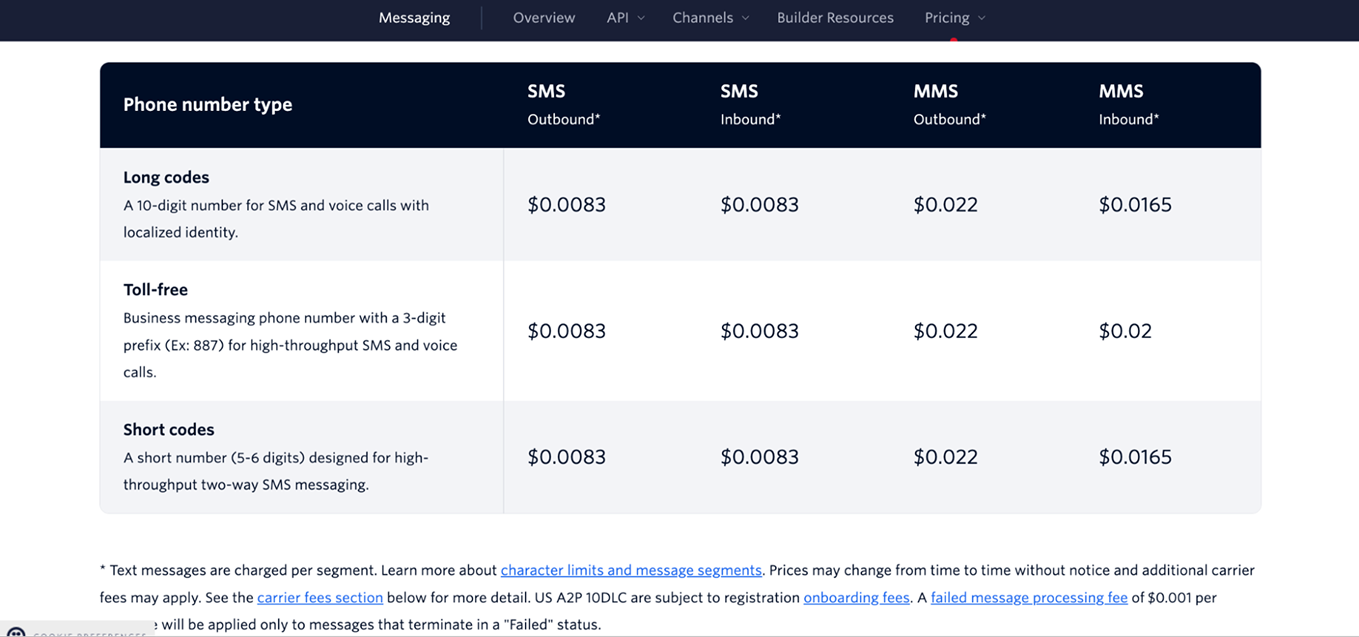
Twilio SMS pricing depends on the destination, message type, and carrier. In the United States, it charges $0.0083 per segment for inbound and outbound SMS sent from long codes, short codes, and toll-free numbers. Twilio also charges a $0.001 processing fee for each SMS that ends with a Failed status.
Limitations
- Twilio’s MCP server does not execute API calls, so AI agents cannot use it to send SMS messages.
- Costs can increase quickly at scale as message volume, active users, phone numbers, and other usage grow.
- Twilio charges a $0.001 processing fee for failed messages.
- Additional carrier, regulatory, phone number, and feature fees may apply depending on the product and channel.
3. Sinch
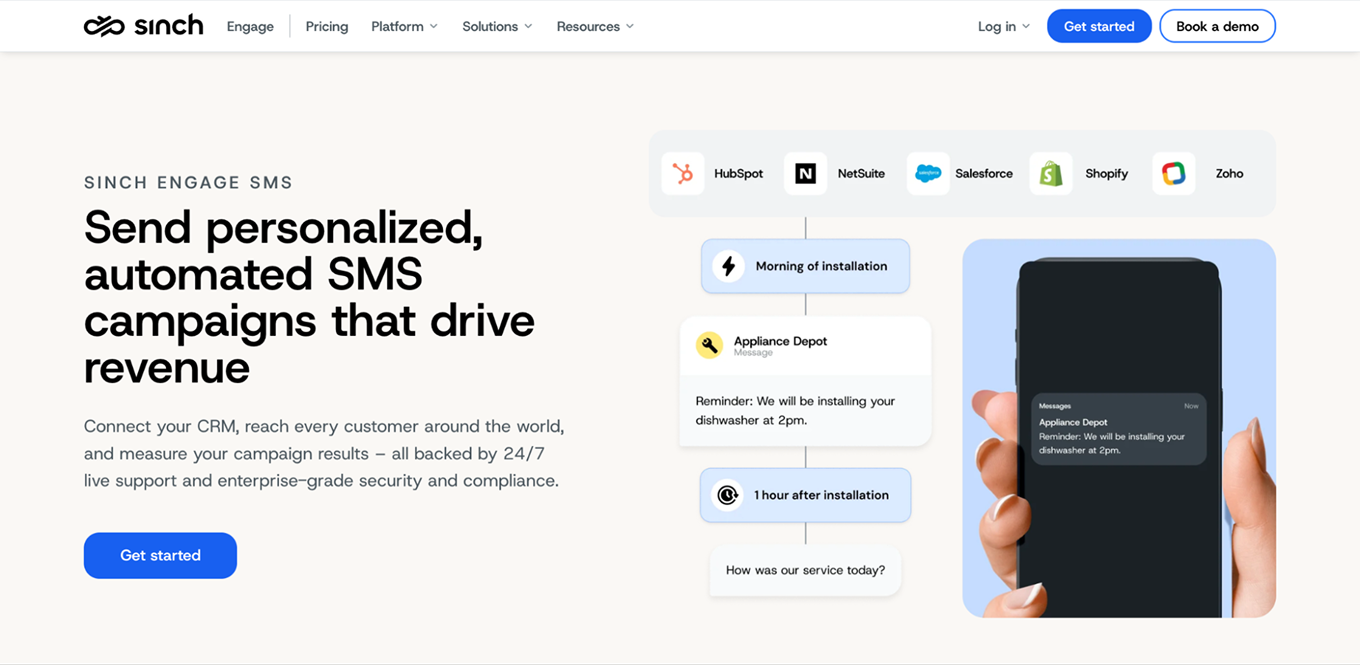
Sinch is a communications platform that provides APIs for messaging, voice calls, and email. Its Conversation API lets businesses communicate with customers across 13 messaging channels, including WhatsApp, Telegram, Facebook Messenger, LINE, Instagram, Viber, WeChat, KakaoTalk, RCS, SMS, MMS, and web chat through a single API.
Sinch has a Tier 1 network with direct carrier connections worldwide for reliable message delivery. Its SMS platform supports personalised and automated campaigns, two-way texting, automated reminders, scheduled messages, and CRM integrations. Businesses can also sync contacts, personalise messages with CRM data, and manage SMS from tools such as HubSpot, Salesforce, and NetSuite.
Best for: Businesses and enterprises that need SMS, multi-channel messaging, and CRM integrations.
Key features
- Supports SMS, MMS, WhatsApp, and RCS messaging through a single Conversation API across multiple countries.
- Supports global messaging with 99.95% SMS uptime, consent tools, encryption, and automatic fallback.
- Two-way messaging with auto-responses, AI, and a unified team inbox.
- Enables contact syncing, automated reminders, and message scheduling with CRM data.
- Provides real-time fraud detection and automated channel fallback to protect messaging workflows and control costs.
- Supports webhooks and activity logs to help teams monitor communication events and workflows.
- Provides OTPs, phone number verification, and multi-factor authentication for secure user sign-ups, log-ins, and password resets.
- Tier 1 network with direct carrier connections for reliable global message delivery.
- Supports 10DLC, short code, toll-free, and alphanumeric sender ID registration.
Pricing
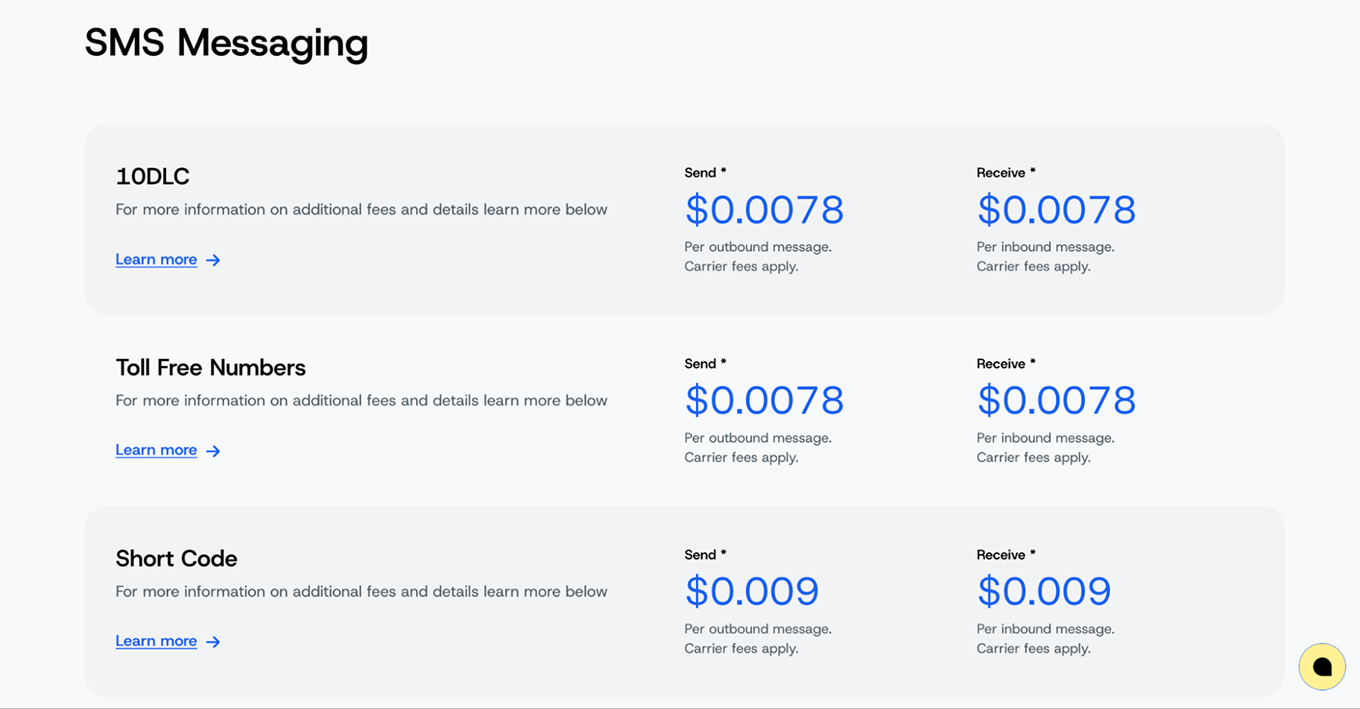
Sinch charges $0.0078 per inbound and outbound message for 10DLC and toll-free numbers, and $0.009 per message for short codes. Additional fees apply for brand and campaign registration, number leasing, carrier charges, and other services.
Limitations
- The MCP server for executing real actions through Sinch APIs is self-hosted and requires additional setup.
- Pricing varies by country, channel, message type, and other factors, making costs harder to predict.
- Overkill for small and medium-sized businesses with low messaging volumes.
- No general iMessage API for outbound consumer messaging.
4. Bird (formerly MessageBird)
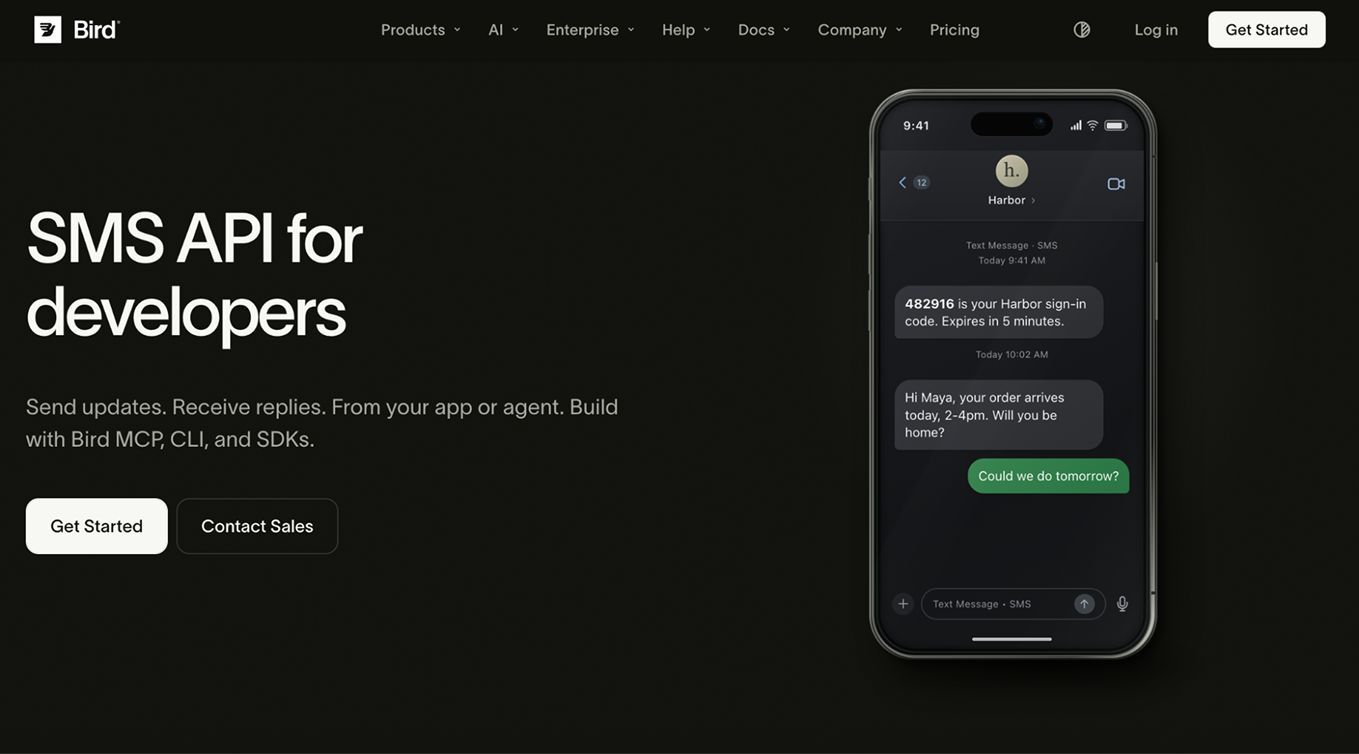
Bird is a communications platform that provides APIs for email, SMS, WhatsApp, Apple Messages, and voice. These APIs allow businesses and developers to integrate messaging, voice, and verification into their applications.
Bird also offers a hosted MCP server that gives AI agents read and write access to supported APIs. Agents can set up channels, manage customers, send messages, and check delivery status directly through MCP.
Best for: Businesses and developers that need multi-channel communication with AI agents that can perform communication tasks through MCP.
Key features
- Supports email, SMS, WhatsApp, and Apple Messages through APIs, MCP, CLI, and SDKs.
- Supports opt-out management and workspace-wide preferences for controlling customer messaging.
- Provides a Verify API for SMS, email, and WhatsApp verification with fallback delivery and country controls.
- Supports verification controls such as code expiry, attempt limits, resend cooldowns, sender branding, logs, and webhooks.
- Provides webhooks and analytics for tracking message delivery, conversations, calls, and verification events.
Pricing
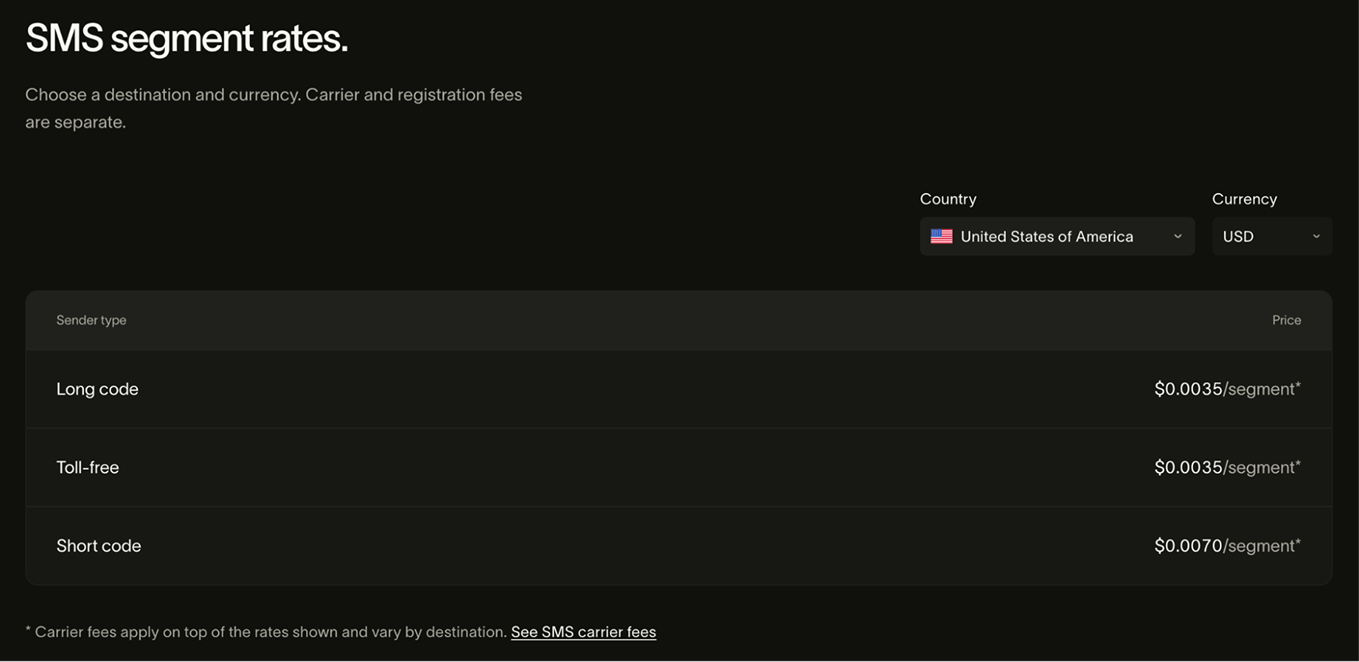
Bird charges per SMS segment, with rates varying by destination. In the US, SMS sent from long-code and toll-free numbers costs $0.0035 per segment, while SMS sent from short codes costs $0.0070 per segment.
Limitations
- Some Bird products require a custom quote, making it harder to estimate costs upfront.
- Bird charges for each automation workflow invocation, while messages sent through a workflow are billed at their respective channel rates.
5. ClickSend
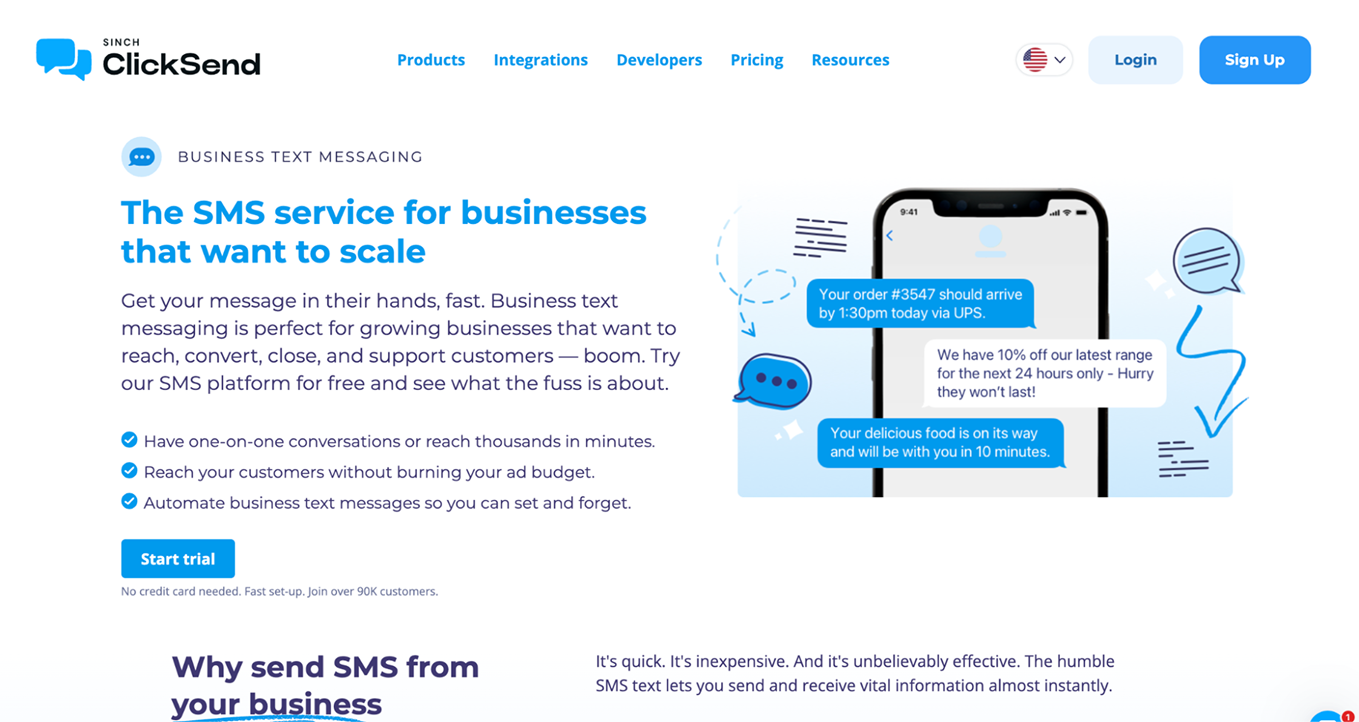
ClickSend is a business communications platform for sending, receiving, and tracking SMS and MMS. It also supports RCS and messaging channels such as Facebook Messenger and WhatsApp Business for real-time customer conversations.
ClickSend provides cloud communication APIs that integrate with business applications and no-code automation tools. It offers a 99.95% uptime SLA and supports both API-based and no-code workflows for businesses that want to automate customer communications.
Best for: Small and medium-sized businesses and developers that need a simple SMS and MMS platform with transparent pricing and no unnecessary enterprise features.
Key features
- Allows SMS and MMS scheduling and automation for recipients in 190+ countries.
- Businesses can purchase dedicated numbers for two-way messaging, customer support, and personalised communications, including short codes, long codes, 10DLC, and toll-free numbers.
- Supports using an existing business or personal number as the sender ID, with number verification required.
- Supports one-to-one and bulk messaging for promotional, transactional, and conversational use cases using reusable templates
- Enable two-way SMS conversations and receive customer replies in the ClickSend dashboard.
- Convert emails to SMS and manage email and SMS communications from the same workflow.
- Provides an MCP server that allows AI assistants to send messages, view statistics, and manage contacts.
Pricing
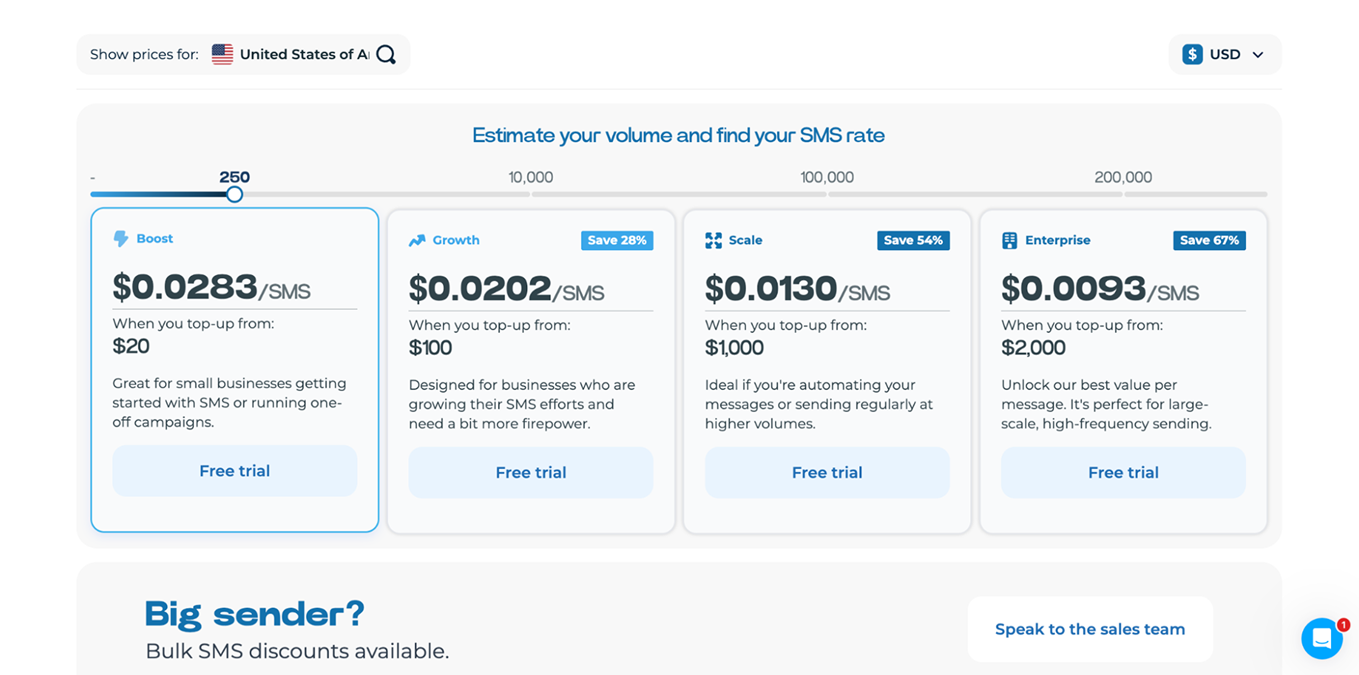
ClickSend charges per message based on volume and destination, with lower rates for higher volumes. In the US, SMS costs as low as $0.0093 per message for large-scale, high-frequency messaging with a $2,000 minimum subscription, and up to $0.0283 per message for one-off campaigns with a minimum $20 recharge.
Limitations
- No shared team inbox for collaborative customer support or managing two-way conversations in one place.
- Lacks advanced routing options for complex messaging workflows.
- Higher per-message costs for small businesses with low messaging volumes
6. EZ Texting
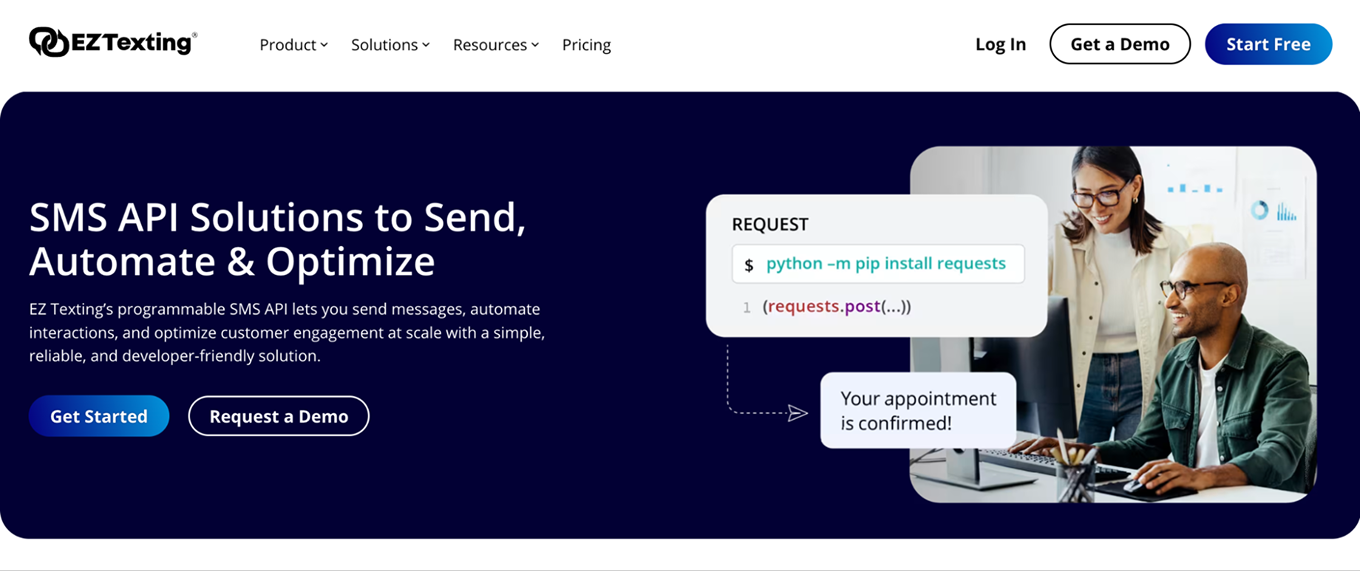
EZ Texting is an SMS marketing platform for sending bulk SMS, two-way SMS, and MMS in the United States and Canada. It supports SMS automation, AI-powered replies based on websites, knowledge bases, and PDFs, and webhooks that send real-time event data directly to your server without requiring constant API polling.
EZ Texting also provides contact management, SMS opt-in collection, audience segmentation, campaign analytics, and reporting. Its platform is designed for businesses that use SMS for marketing, customer engagement, and lead generation while meeting carrier compliance requirements.
Best for: Marketers, local businesses, and non-technical teams in the US and Canada that need an SMS marketing platform with contact management, campaign analytics, automation, and AI-powered messaging.
Key features
- Supports MMS, RCS, and SMS with replies delivered to a shared inbox.
- Supports registered A2P routes with in-platform brand and campaign registration.
- Supports 10DLC numbers, toll-free numbers, short codes, and existing landline numbers as sender options.
- Supports bulk and personalised SMS for sending messages to large contact lists.
- Offers AI-powered tools for writing messages, responding to customers, and supporting multiple languages.
- Supports trigger-based workflows that send messages based on customer actions such as sign-ups, purchases, and missed appointments.
- Webhooks for sending real-time messaging events directly to your server.
- Allows businesses to schedule messages and automated responses for recurring customer communications and track delivery and engagement analytics.
Pricing
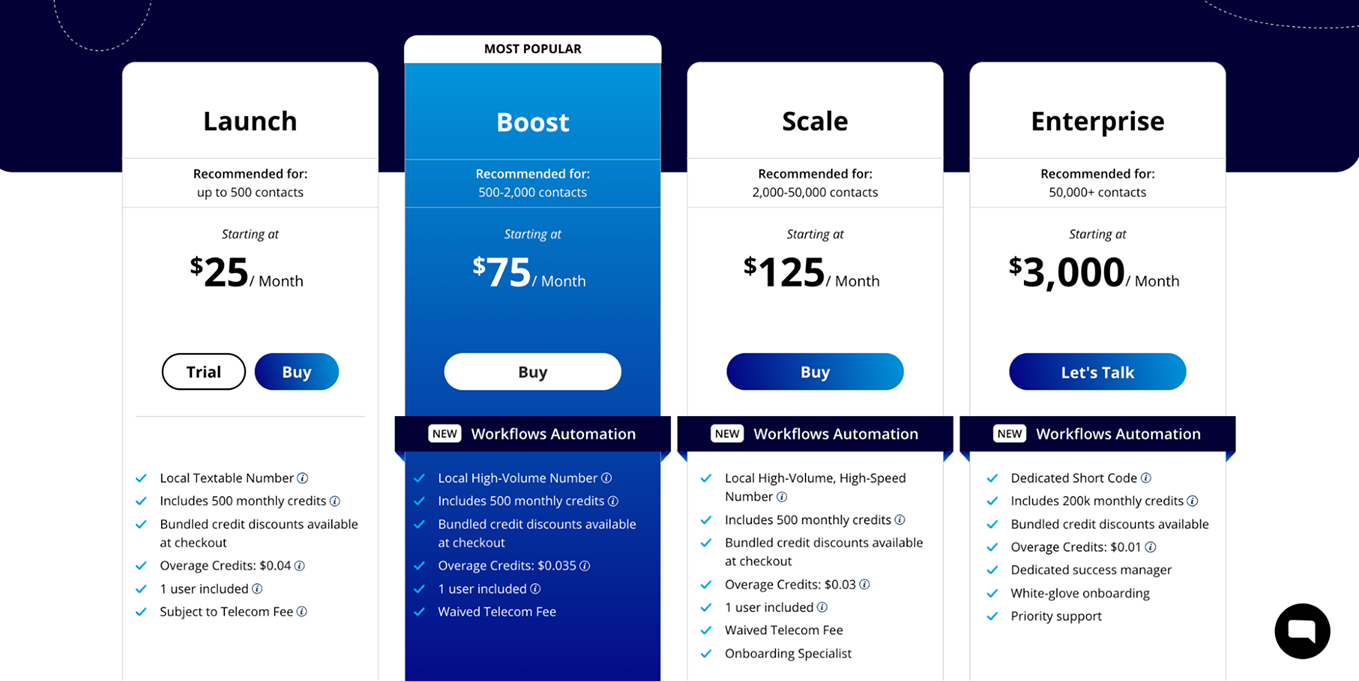
EZ Texting pricing starts at $25/month for up to 500 contacts with a local, registered 10DLC number, plus a $5 monthly telecom fee covering mandatory carrier fees for messaging and number usage. Pricing increases with the number of contacts: $75/month for 500 - 2,000 contacts and $150/month for 2,000 - 50,000 contacts.
Limitations
- SMS reach is limited to the United States and Canada.
- Limited support for multi-user and team management.
- Advanced workflows and message configurations require higher-tier plans.
- Costs increase quickly for high-volume senders, with plans reaching up to $3,000 per month for 50,000+ contacts.
7. Textmagic
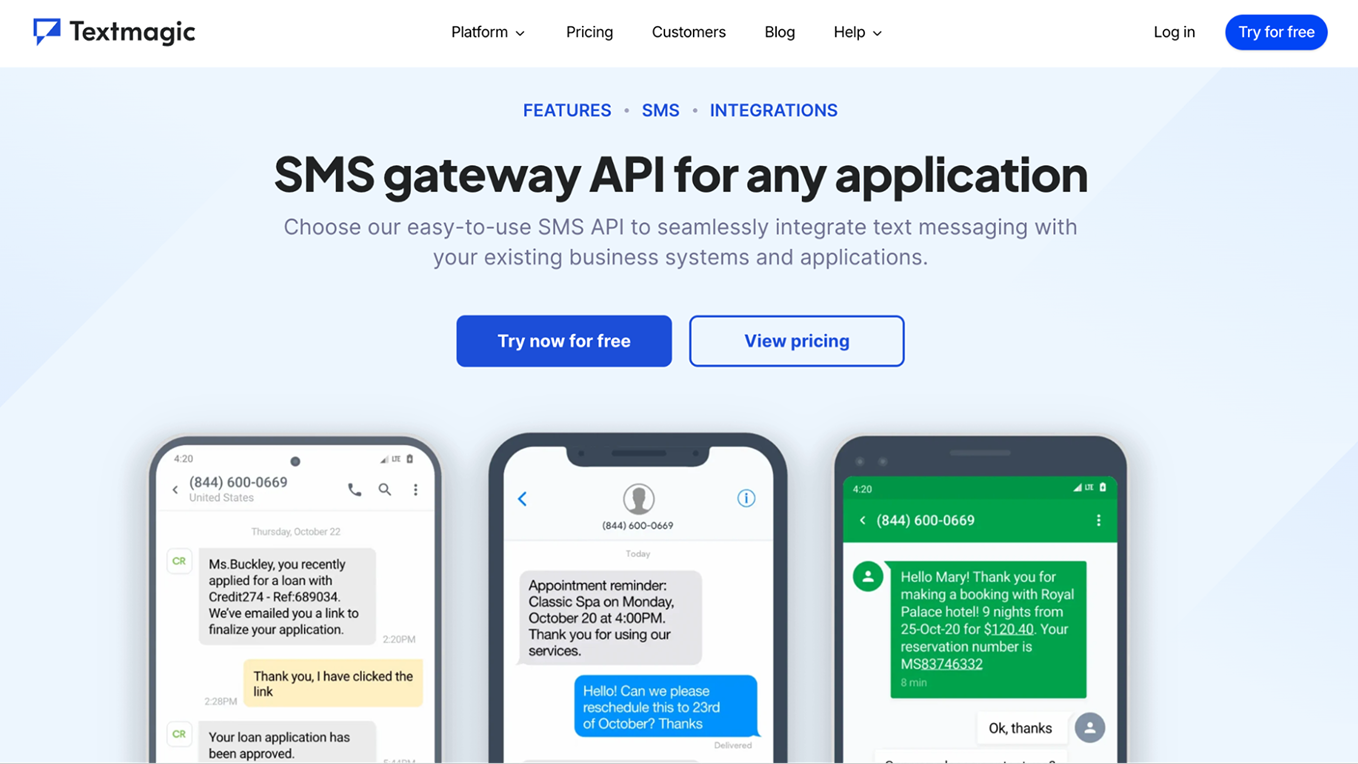
Textmagic is a business communications platform built for business text messaging. Its SMS API supports scheduled and recurring messages, inbound SMS, and delivery status tracking.
Textmagic also provides a shared inbox for managing conversations across SMS, email, WhatsApp, Facebook, its website chat widget, and voice calls. Teams can manage customer communications from one interface while using automation, contact management, and integrations to support their messaging workflows.
Best for: Small and medium-sized businesses that need an intuitive SMS API for mass texting, team collaboration, and customer notifications in North America.
Key features
- Schedule and send personalised bulk SMS, one-time and recurring, to thousands of contacts.
- Supports two-way SMS conversations with shared inboxes for managing customer and team communications.
- Connects to ChatGPT, Claude, Codex, and other AI assistants through its MCP connector to send messages, manage contacts, and automate tasks.
- Support 10DLC, toll-free numbers, and alphanumeric sender IDs for business messaging in 24+ countries.
- Automates follow-ups, drip campaigns, and customer journeys across SMS and email.
- Integrates with HubSpot, Shopify, WooCommerce, Zapier, and other business applications to trigger automated messages from customer and order events.
- Uses carrier lookup and phone number validation to identify invalid numbers and improve delivery rates.
Pricing
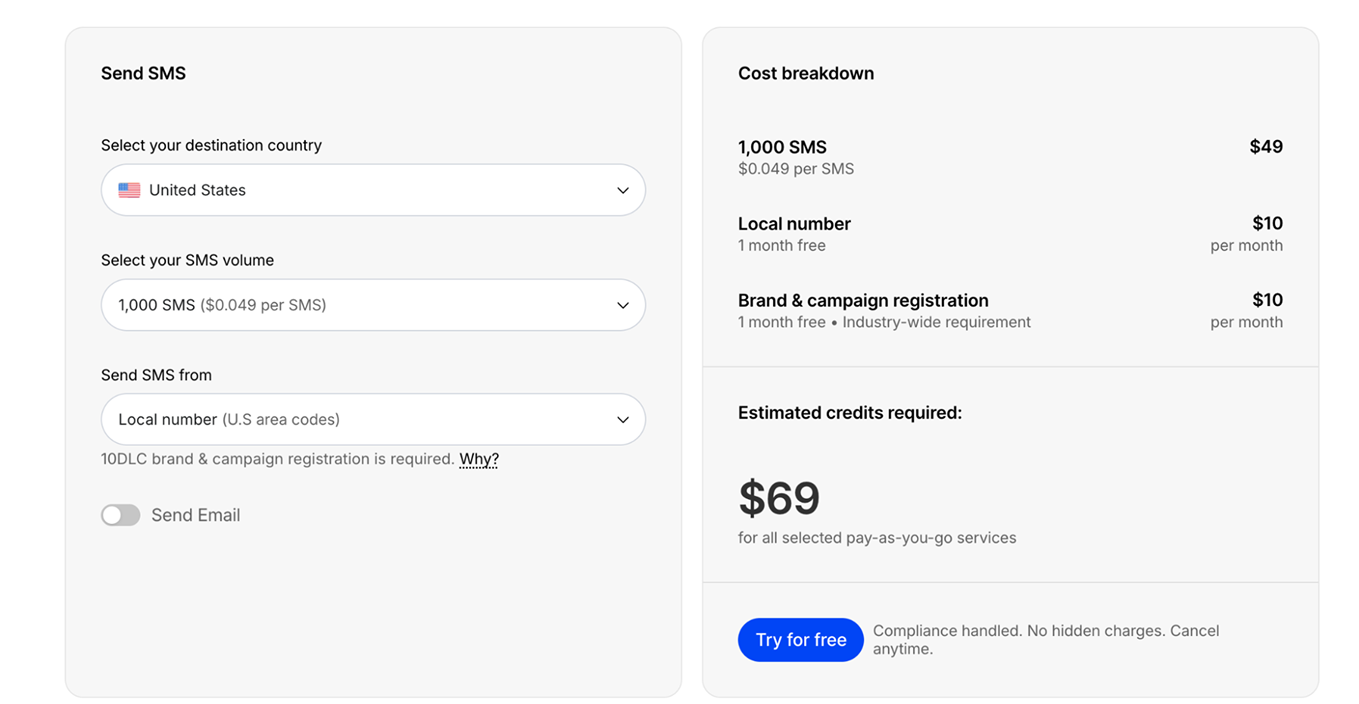
Textmagic uses flexible usage-based pricing, with SMS rates depending on the destination country and message volume. In the US, SMS pricing starts at $0.049 per SMS. Toll-free and local numbers cost $10 per month each, while brand and campaign registration costs $10 per month.
The pricing includes mass texting, automation workflows, a shared team inbox, an omnichannel chat widget, email campaigns, unlimited contacts and users, AI writing and templates, dedicated numbers and sender IDs, integrations and API access, and compliance tools.
Limitations
- SMS coverage is not global, limited to the US, Europe, Australia and a few other countries
- Does not support bulk MMS.
- Textmagic virtual numbers support local messaging only and cannot send SMS internationally.
- Higher per-message costs make it expensive for large-scale or high-frequency messaging.
- Lacks advanced routing and infrastructure features for complex developer workflows.
8. Link Mobility
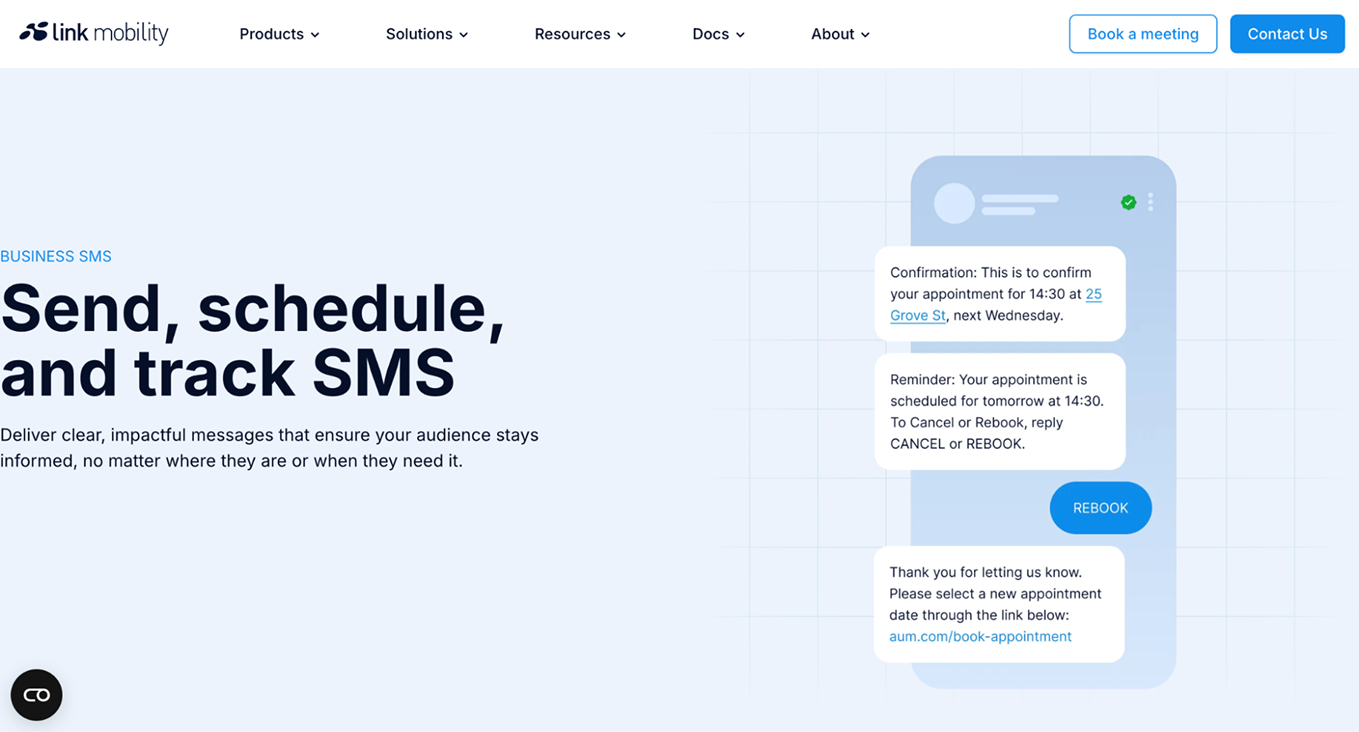
Link Mobility is an enterprise communications platform that supports business messaging across SMS, RCS, WhatsApp, and email.
Link Mobility enables businesses to send, schedule, and track SMS messages across global markets. It supports batch messaging, scheduled campaigns, recurring messaging workflows, and webhooks for delivery reports and incoming messages, providing detailed message status information.
Best for: Brands and enterprises that need large-scale messaging across SMS, RCS, WhatsApp, and email, with strict GDPR compliance and identity verification.
Key features
- Global SMS coverage with local and international numbers for reaching customers across different countries and networks.
- Real-time delivery receipts showing when messages are sent, delivered, or failed.
- Supports alphanumeric sender IDs that display a business name instead of a phone number, short codes and long numbers for different messaging use cases and destinations.
- Detailed delivery analytics covering message status, timestamps, failures, failovers, opt-outs, and responses.
- Scheduled and bulk SMS sending with support for one-time and recurring campaigns.
- Opt-in and opt-out management with tools for GDPR compliance and secure message handling.
- Support for customer journeys, marketing campaigns, and transactional messaging through existing platforms and workflows.
- Integrates with CRMs, ERPs, marketing automation platforms, e-commerce platforms, and custom backend systems.
Pricing
Link Mobility uses volume-based pricing tailored to each enterprise contract and the specific markets being targeted. Pricing is not publicly available, so businesses must provide their company details to request a custom quote.
Limitations
- No public pricing; custom quotes require sales contact.
- No official MCP server for AI agent integration.
- Stronger focus on European and EMEA markets, with less coverage outside the region than global providers such as Zernio or Sinch.
9. Messente
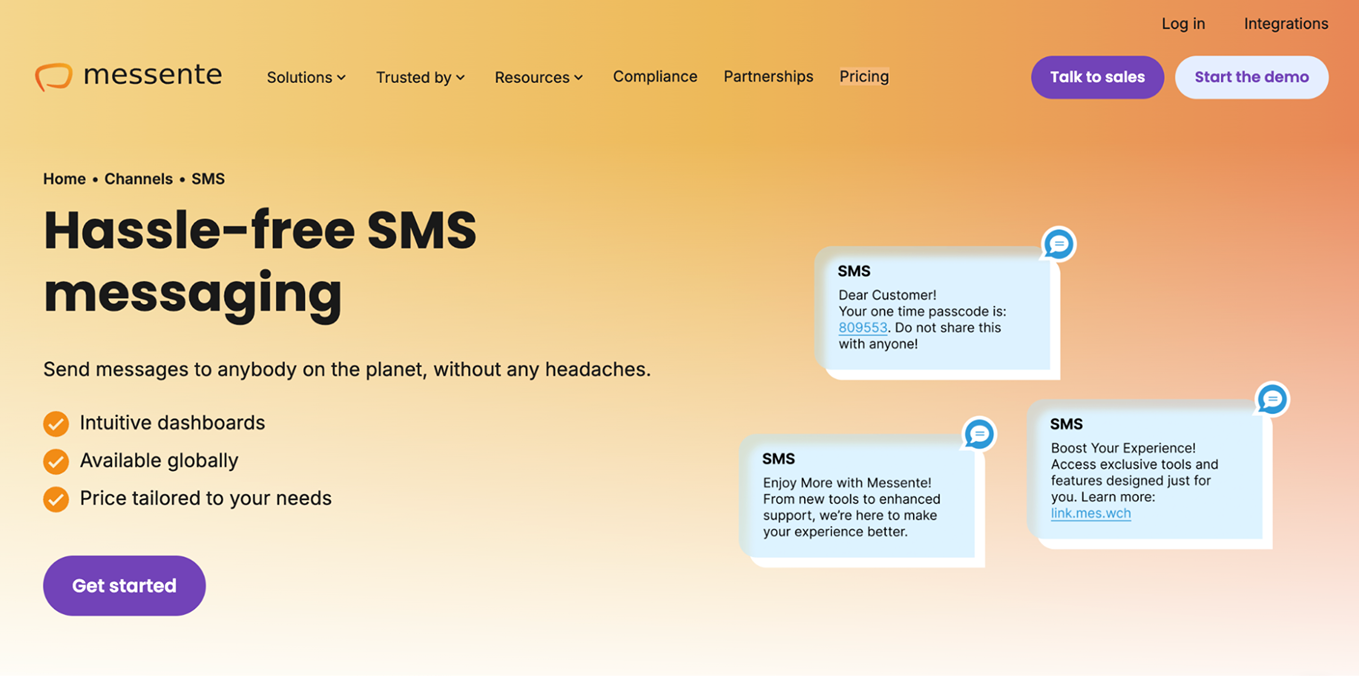
Messente is a business messaging platform that supports multi-channel communication across SMS, RCS, Viber, and WhatsApp. It provides AIT protection that alerts businesses to inflated traffic and blocks known scam numbers from their messaging infrastructure.
Messente connects directly to 800+ carriers and uses intelligent routing to improve message delivery, including in areas with limited internet connectivity. It supports marketing messages, authentication codes, and time-sensitive SMS notifications globally, with a reported 90% open rate.
Best for: Businesses, marketers, and developers that need a simple multi-channel messaging platform with global reach and SMS fraud protection.
Key features
- Omnichannel messaging through the same API for SMS, Viber, and WhatsApp.
- SMS coverage across 197+ countries through partnerships with nearly 1,000 mobile operators.
- Custom message validity periods for controlling how long Messente attempts delivery.
- Traffic prioritisation for sending time-sensitive messages before lower-priority traffic.
- Role-based permissions for team members, with multiple API keys, key invalidation, and IP-based access restrictions.
- Adaptive routing that selects the best-performing messaging channels for delivery.
- Detects and protects against suspicious traffic and scam messages and blocks messages to known scam numbers.
- Per-country statistics, delivery reports and campaign history for monitoring message status and performance.
Pricing
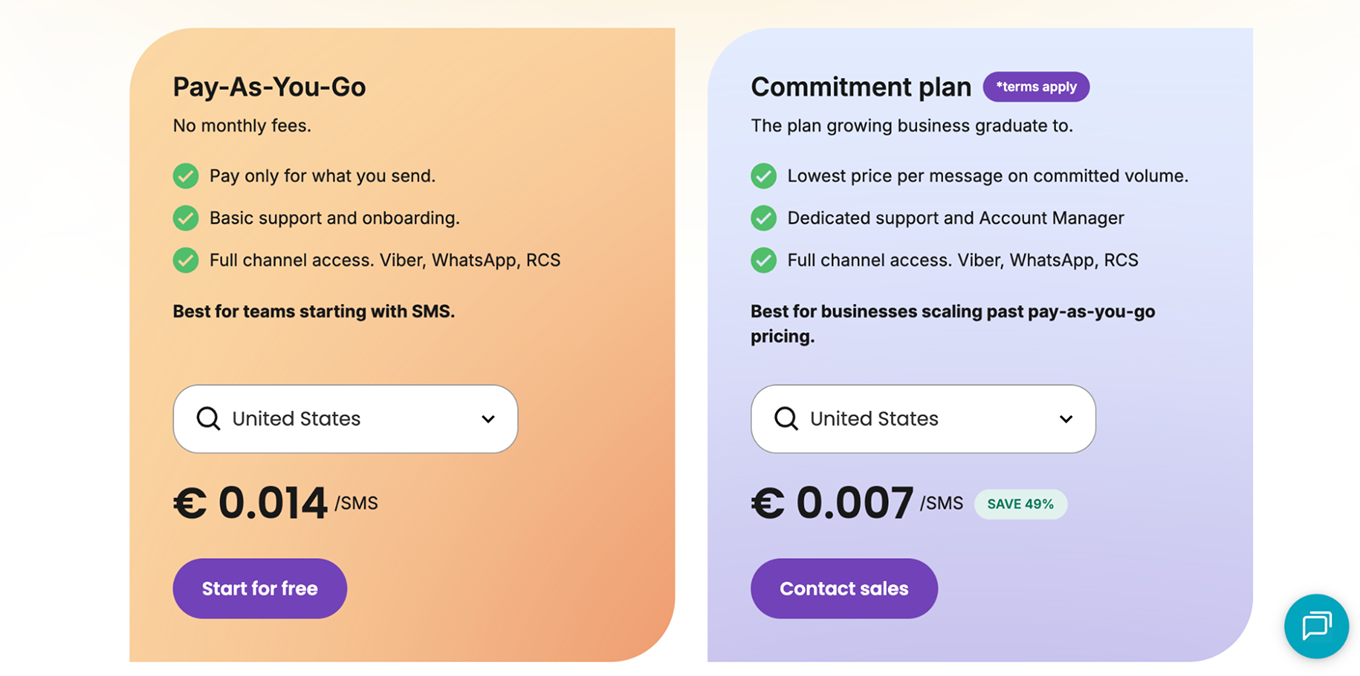
Messente uses pay-as-you-go pricing, with rates varying by destination country. In the United States, SMS costs €0.014 per message.
Limitations
- No official MCP server for AI agent integration.
- Not suited for long-form conversations, support chat, or complex marketing campaigns.
- Primarily focused on transactional and secure messaging.
- High messaging costs for large-volume or high-frequency campaigns, depending on the destination.
- Charges €0.002 per phone number lookup.
10. Mitto
Mitto is an omnichannel communications platform that supports messaging across SMS, RCS, Telegram, Viber, WhatsApp, Facebook, and Instagram. Its SMS API supports one-to-one and bulk messaging, delivery status callbacks, and custom metadata returned with message callbacks.
Mitto supports both one-way and two-way SMS for use cases such as alerts, reminders, authentication codes, marketing promotions, customer support, feedback collection, and appointment management.
Best for: Businesses scaling omnichannel communications and customer engagement across multiple messaging channels.
Key features
- Omnichannel messaging across SMS, RCS, WhatsApp, Telegram, Instagram, Viber, Facebook Messenger, and voice.
- SMS verification for user authentication, account security, and transaction protection with two-factor authentication and one-time passcodes.
- AI-powered routing that selects efficient and cost-effective routes based on real-time network conditions.
- Scalable infrastructure designed to deliver hundreds to millions of messages across multiple time zones.
- 800+ direct carrier connections with global coverage and Tier 1 network partnerships.
Pricing
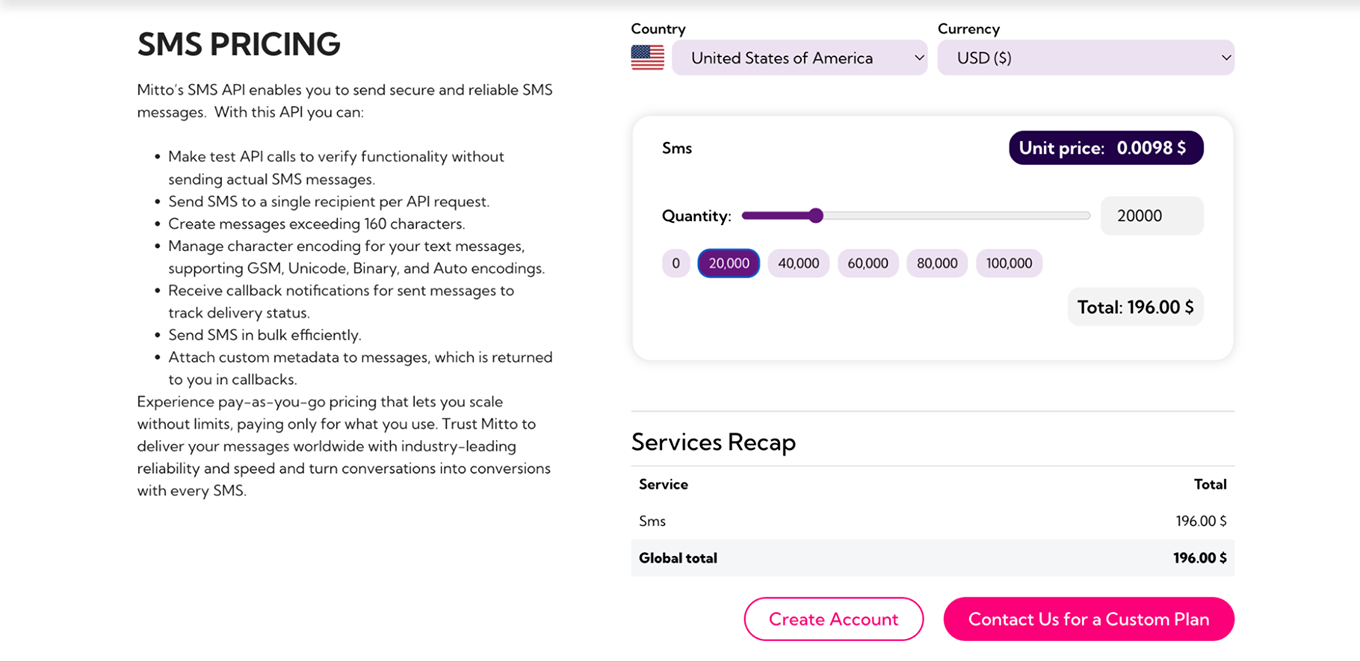
Mitto uses pay-as-you-go pricing, with rates varying by destination country and volume discounts available as usage grows. In the United States, SMS costs $0.0098 per message.
Limitations
- No official MCP server for SMS sending and automation via AI assistants.
- Two-way SMS requires a dedicated Mitto number and webhook configuration through an account manager.
- API access requires customers to whitelist their requesting IP addresses.
- Delivery reports require a callback URL configured and whitelisted by Mitto.
- API usage reports support a maximum query period of 31 days per request
How to Choose the Best API for Your Business
The best SMS API depends on where you send messages, how you use SMS, the volume you expect, and the features your application needs. Consider the following factors before choosing a provider.
1. API capabilities
Check whether the API supports the messaging features your application needs, including sending and receiving SMS, bulk messaging, scheduling, two-way messaging, delivery tracking, and phone number verification. If you are building AI-powered workflows, check whether the provider offers an MCP server that lets AI agents perform actions through the API. For example, Zernio, Bird, ClickSend, and Textmagic offer official MCP servers, while Twilio’s MCP server does not execute API calls.
2. Coverage
Check the countries and mobile networks that the provider supports, especially if you send international SMS. Some providers focus on specific markets, while others offer global coverage. For example, EZ Texting focuses on the US and Canada, while Messente supports SMS across 197+ countries.
3. Pricing
Compare per-message rates, monthly fees, phone number costs, registration fees, minimum commitments, and charges for additional services. Also check whether the provider charges for failed messages, inbound messages, or phone number lookups. For example, Twilio charges a processing fee for failed SMS, while Zernio does not charge for failed API requests or failed messages.
4. Reliability
Look for providers with strong delivery infrastructure, high uptime, delivery tracking, and support for high message volumes. Direct carrier connections and intelligent routing can also improve delivery rates and reduce latency. For example, Sinch and Mitto use Tier 1 carrier networks, while Mitto uses AI-powered routing to select messaging routes based on real-time network conditions.
5. Webhooks support
Webhooks let your application receive events without repeatedly polling the API. Check whether the provider supports webhooks for delivery statuses, incoming messages, failures, verification events, and other messaging events. For example, Zernio supports webhook authentication, event verification, deduplication, configurable delivery, and automatic retries for failed webhook deliveries.
6. Sender options
Check which sender types are available in your target markets. Depending on the country and use case, you may need a local number, toll-free number, short code, long code, 10DLC number, or alphanumeric sender ID. For example, Zernio supports bringing an existing number, purchasing new numbers, and registering sender IDs through its API.
7. Security and compliance
Consider how the provider protects message data and authenticates API requests, as well as the regulatory requirements for your target markets. Check for features such as API key controls, IP restrictions, encryption, opt-in and opt-out management, sender registration, and compliance with local messaging regulations. Providers such as Zernio and Messente support API access controls and multiple API keys, while Link Mobility provides tools for managing opt-ins, opt-outs, and GDPR requirements.
FAQs
How does an SMS API work?
Your application sends an authenticated API request containing the recipient, message, and sender information. The SMS provider processes the request and routes the message through mobile networks. The provider can then return delivery information through the API or webhooks.
Can I send SMS from my website or app?
Yes. An SMS API lets a website, mobile app, backend, CRM, or other software send messages programmatically. For example, an e-commerce application can automatically send an order confirmation after a customer completes a purchase.
Can an SMS API receive replies?
Yes, SMS providers like Zernio support two-way SMS communication, allowing your application to receive incoming messages and respond programmatically. Webhooks can notify your application when a customer replies or when a message reaches a particular delivery status.
Can an SMS API send bulk SMS?
Yes, SMS APIs such as Zernio, ClickSend, EZ Texting, Textmagic, Link Mobility, and Mitto support bulk messaging for sending notifications, marketing campaigns, alerts, and other messages to large numbers of recipients.
Can AI agents send SMS through an API?
Yes. Zernio, Bird, ClickSend, and Textmagic provide hosted MCP servers that let AI agents send and manage SMS messages through their APIs.