Developers and founders building AI agents and customer engagement apps on SMS, WhatsApp, or voice run into two limits with Twilio. Costs climb quickly because Twilio charges its own messaging and call fees on top of carrier and Meta charges, and even failed messages can incur fees. Its MCP server can search the documentation, but it cannot send a single message.
The best Twilio alternatives for CPaaS are Zernio, Sinch, Vonage, Bandwidth and Bird. Zernio covers the most messaging channels in one API, Sinch and Vonage are strongest on voice and verification, and Bandwidth fits carrier-grade enterprise volume.
In this guide, you’ll learn why businesses consider alternatives to Twilio, the best Twilio alternatives, what CPaaS is and what it covers, and how to choose a CPaaS provider for your business.
What is CPaaS?
CPaaS, or Communications Platform as a Service, is a cloud-based platform that allows businesses and developers to add communication capabilities such as messaging, voice calls, video calls, and email to their applications through APIs, SDKs, or an MCP server. Instead of building communication infrastructure from scratch and going through carrier registrations, businesses can use a CPaaS provider to integrate these features into their existing software.
For example, a customer support platform can use CPaaS to send and receive messages, initiate voice calls with customers, and send email or SMS notifications when a support request is resolved. These communication features can be built directly into the platform, so customers and support agents do not need to switch between separate communication tools.
What CPaaS Covers
CPaaS typically covers several communication and customer engagement features, including:
1. Messaging: CPaaS allows businesses to send and receive messages through channels such as SMS, MMS, RCS, WhatsApp, and other messaging platforms, supporting customer communication, notifications, and alerts.
2. Voice: CPaaS allows businesses to add voice calls, VoIP, interactive voice response (IVR), and call management to their applications, supporting customer service, call routing, automated phone systems, and other voice-based interactions.
3. Video: CPaaS enables businesses to integrate one-to-one and group video calls into their applications for virtual meetings, remote consultation or support, and other real-time communication.
4. Email: CPaaS provides email delivery for transactional and marketing messages. Businesses can use email APIs to send notifications, confirmations, receipts, password resets, and promotional messages directly from their applications.
5. Verification: CPaaS helps businesses verify users through one-time passwords (OTPs), two-factor authentication, and other identity verification methods. These features help to confirm phone numbers, authenticate users, and protect accounts from unauthorised access.
6. Communication automation: CPaaS can automate notifications, reminders, alerts, and other customer communications based on events, schedules, or user actions. For example, an application can automatically send an appointment reminder or order update without manual intervention.
Why are People Switching from Twilio?
Twilio’s broad API offering makes it a popular choice for businesses and developers, but its pricing structure, channel coverage, and costs at scale may not suit every application.
Some of the reasons why businesses consider switching from Twilio are:
1. Limited messaging channel coverage
Twilio supports messaging across SMS, MMS, RCS, WhatsApp, and Facebook Messenger. However, businesses building applications that need to communicate with customers across a wider range of messaging platforms may need additional providers or integrations.
For example, Twilio does not currently provide native messaging APIs for channels such as Instagram, Telegram, Viber, WeChat, or LINE. This can be a drawback for businesses whose customers are active across multiple messaging platforms and want to manage those channels through a single API.
2. MCP server does not execute API calls
Twilio offers a read-only Model Context Protocol (MCP) server that lets AI coding agents search its API documentation and retrieve API specifications. It provides tools to find relevant API operations and retrieve their parameter and response schemas, but it does not execute those API calls for a user.
This can be a drawback for businesses that want AI agents to perform actions such as creating messages, managing conversations, or retrieving data through an MCP connection. They still need to implement the API calls separately instead of allowing the AI agent to perform these operations directly through Twilio’s MCP server.
3. Additional platform and carrier fees
Twilio’s pricing includes additional charges beyond the base per-message or per-minute rate. Depending on the product and channel, businesses may pay carrier, regulatory, phone number, or feature fees.
For example, Twilio charges $0.005 per inbound or outbound WhatsApp message, plus applicable Meta fees. This means businesses using Twilio pay both Twilio’s messaging fee and the underlying channel costs, making them consider other WhatsApp messaging API providers with better pricing.
4. Pricing becomes expensive at scale
Twilio uses a pay-as-you-go pricing model across many of its communication products. This makes it easy to start without a large upfront commitment, but costs can quickly add up as message volumes, active users, phone numbers, and other usage grow.
For example, Twilio Conversations charges based on monthly active users, starting at $0.05 per active user per month after the first 200 active users. It also charges for media storage, while standard SMS/MMS and WhatsApp rates still apply. This usage-based model can make communication costs harder to predict when an application experiences a sudden increase in users or a spike in messaging activity.
5. Failed messages incur charges
Twilio charges a $0.001 processing fee for messages sent through Programmable Messaging that end in a Failed status. The fee applies once per failed message, regardless of the number of segments.
Although certain failures, including Twilio internal errors, some account restrictions, and geographic permissions, are exempt from the fee, businesses with a high volume of failed messages can still incur additional messaging costs.
Stop Paying Twilio $500/Month for WhatsApp (Do This Instead)
A quick look at the best Twilio Alternatives
The table below compares the best Twilio alternatives based on their key features, supported communication channels, and ideal use cases.
| CPaaS Platform | Key features | Supported Platforms | Best for |
|---|---|---|---|
| Zernio | Multi-channel messaging, voice calling, phone numbers, webhooks, hosted MCP, messaging automation | Voice, SMS, MMS, iMessage, RCS, WhatsApp, Instagram, Facebook, Telegram, TikTok, X, Threads, Reddit, Slack, and more | Businesses and developers building broad multi-channel and social media communication workflows with support for AI agent integration. |
| Sinch | Conversation API, voice APIs, email, verification, fraud prevention, self-hosted MCP | Voice, SMS, MMS, WhatsApp, RCS, Telegram, Facebook Messenger, LINE, Instagram, Viber, WeChat, KakaoTalk, web chat, and more | Businesses that need broad omnichannel messaging with voice, email, and verification |
| Vonage | Messaging, programmable voice, video, authentication, branded calling, MCP | SMS, MMS, RCS, WhatsApp, Facebook Messenger, Viber, email, voice, and video | Businesses that need messaging, voice, video, and authentication APIs |
| Bandwidth | SMS, MMS, RCS, voice, emergency calling, WebRTC, authentication, Tier 1 network | SMS, MMS, RCS, voice, WebRTC, SIP, and emergency services | Enterprises and high-volume applications requiring carrier-grade communications infrastructure |
| Bird | Messaging, email, voice, verification, webhooks, hosted MCP, AI agents | Email, SMS, WhatsApp, Apple Messages, voice, and verification | Developers and businesses that need a limited range of communication channels with support for AI agent integration. |
Stop building social integrations from scratch.
One API call to publish, schedule, and manage posts across 17 platforms.
5 Best Twilio Alternatives for CPaaS
1. Zernio
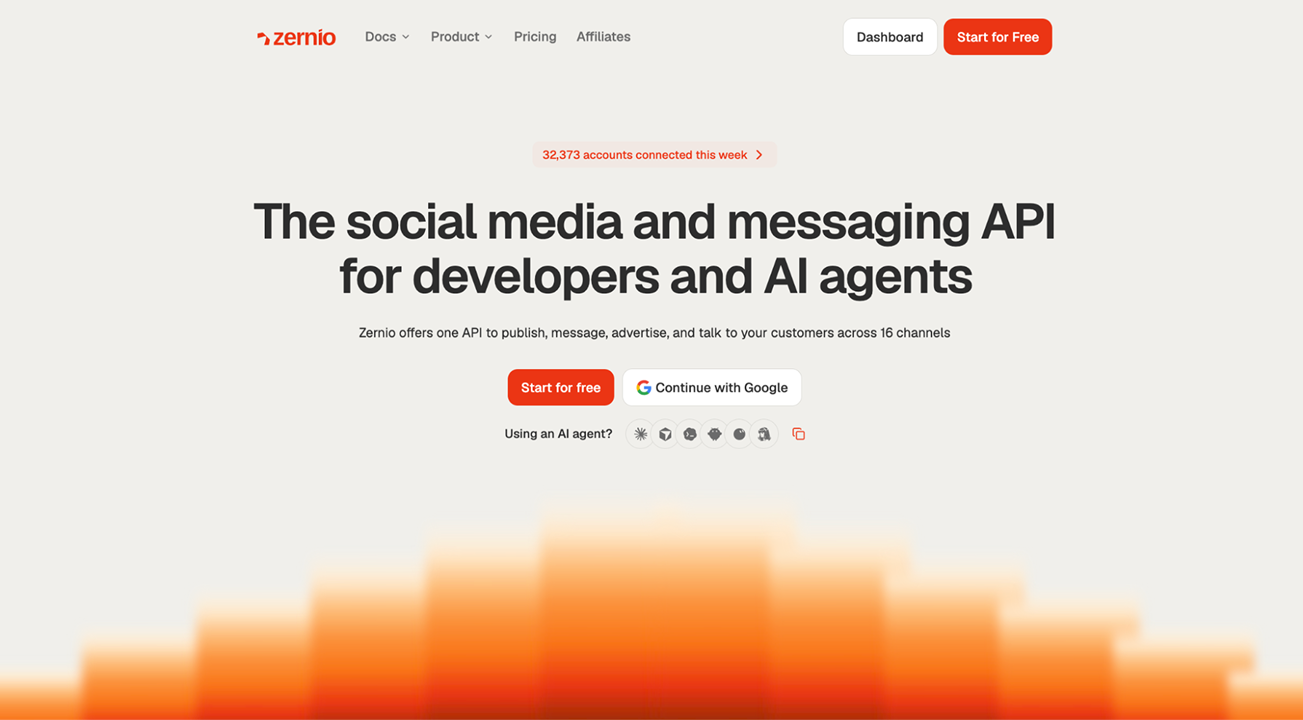
Zernio is marketing infrastructure for products and AI agents. Its unified API covers every channel your product uses to reach its users, from support conversations to campaigns: SMS, RCS, iMessage, WhatsApp, voice calls, and DMs on Instagram, Facebook, X, Telegram and other social platforms.
Zernio is also the only CPaaS provider in this comparison that handles the full social layer, including publishing, comments, ads and analytics through the same API, so a team that talks to customers on Instagram as much as over SMS doesn't need a second vendor.
Its hosted MCP server exposes API actions as tools, allowing Claude, Cursor, or your own AI agent to send messages, place calls, and buy phone numbers, rather than just reading documentation like Twilio's MCP server.
Best for: Developers and founders building AI agents or customer engagement apps that need to reach users on social DMs and messaging apps as well as SMS and voice.
How to Send SMS Using the Zernio API
Key features
- One API and unified inbox for messages on WhatsApp, iMessage, SMS, RCS, Instagram, Facebook, X, Telegram, Reddit, Bluesky and Slack.
- Supports SMS and MMS messaging globally, including number verification, opt-out management, sender IDs, 10DLC registration, and number portability.
- Provides branded calling and RCS messaging with verified business names, logos, rich cards, carousels, buttons, and SMS fallback.
- Supports inbound, outbound, and browser-based voice calling, with call routing to phone numbers, SIP, menus, or AI agents.
- Provides call recordings, transcripts, call logs, and destination cost estimates before calls are placed.
- Allows businesses to purchase and verify international phone numbers in 50+ countries, giving them local numbers to contact customers.
- 99.97% uptime SLA with message delivery tracking and automatic message retries.
- Supports webhooks with event verification, deduplication, configurable delivery, and automatic retries for failed webhook deliveries.
- Offers a hosted MCP server that allows AI agents to perform supported read and write API actions.
- Provides a ChatSDK for building chatbots and customer-facing conversational experiences.
- Provides a built-in no-code messaging automation workflow that supports automated messaging, keyword-based responses, and handing over to human agents.
- Real-time activity logs that monitor API requests, track events, and help debug issues.
- Extends beyond communication APIs with social media management features such as ad management, post scheduling, analytics, user management, and team collaboration.
- Does not charge for failed API requests or failed messages.
Pricing
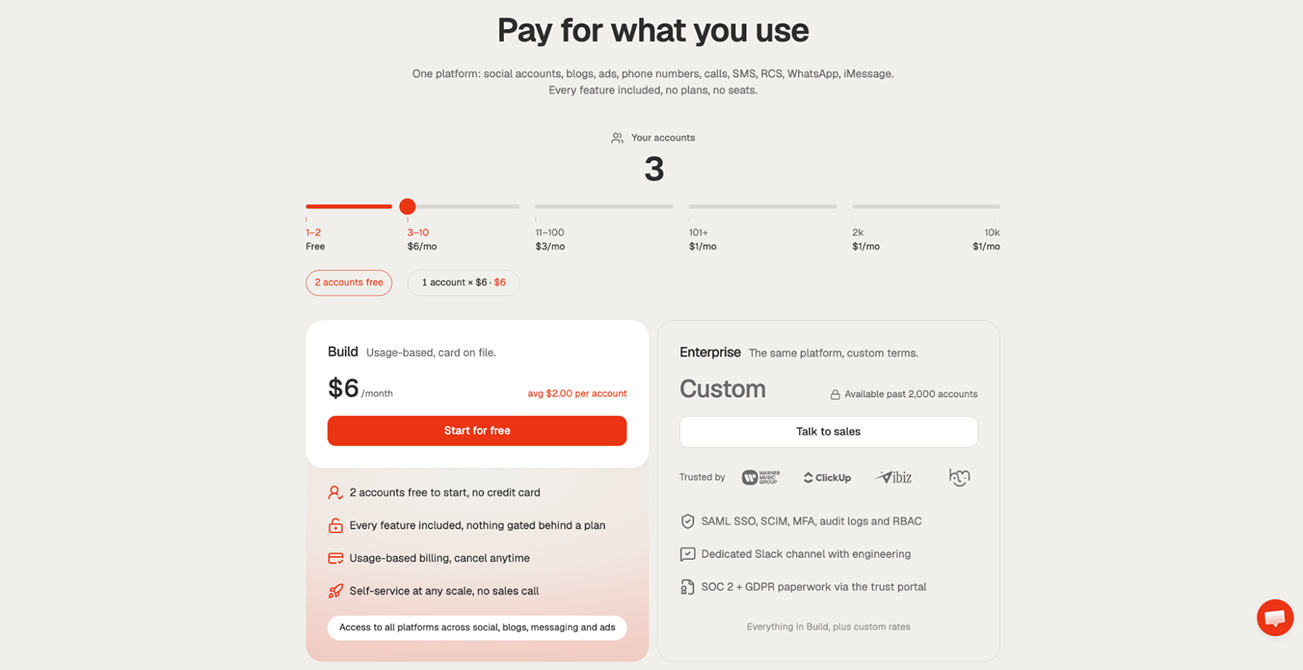
Zernio uses per-account pricing starting at $6 per month for 3 connected social accounts. This includes social messaging with the first 10,000 sent messages a month free, API and MCP server access, webhooks, ads management, social media scheduling, and analytics.
Additional fees apply to phone numbers and advanced communication features.
- Phone numbers: Dedicated numbers start at $3 per month, depending on the number type and country.
- Voice: Outbound calls start at $0.01 per minute, while call recording costs $0.004 per minute.
- SMS: Outbound SMS starts at $0.008 per message segment. U.S. 10DLC registration costs $9 one-time, with campaign fees starting at $4 per month.
- Branded calling: Costs $100 per month per brand plus $0.10 per branded call to a US destination.
- iMessage: Dedicated iMessage senders cost $200 per month.
- RCS: Setup costs $150, U.S. carrier approval costs $750, and monthly fees start at $75. Messages start at $0.0098 each.
Limitations
- Does not provide email APIs or email inbox integration for transactional, marketing, or general email communications.
- Does not provide a Video API for building or managing WebRTC video communication.
2. Sinch
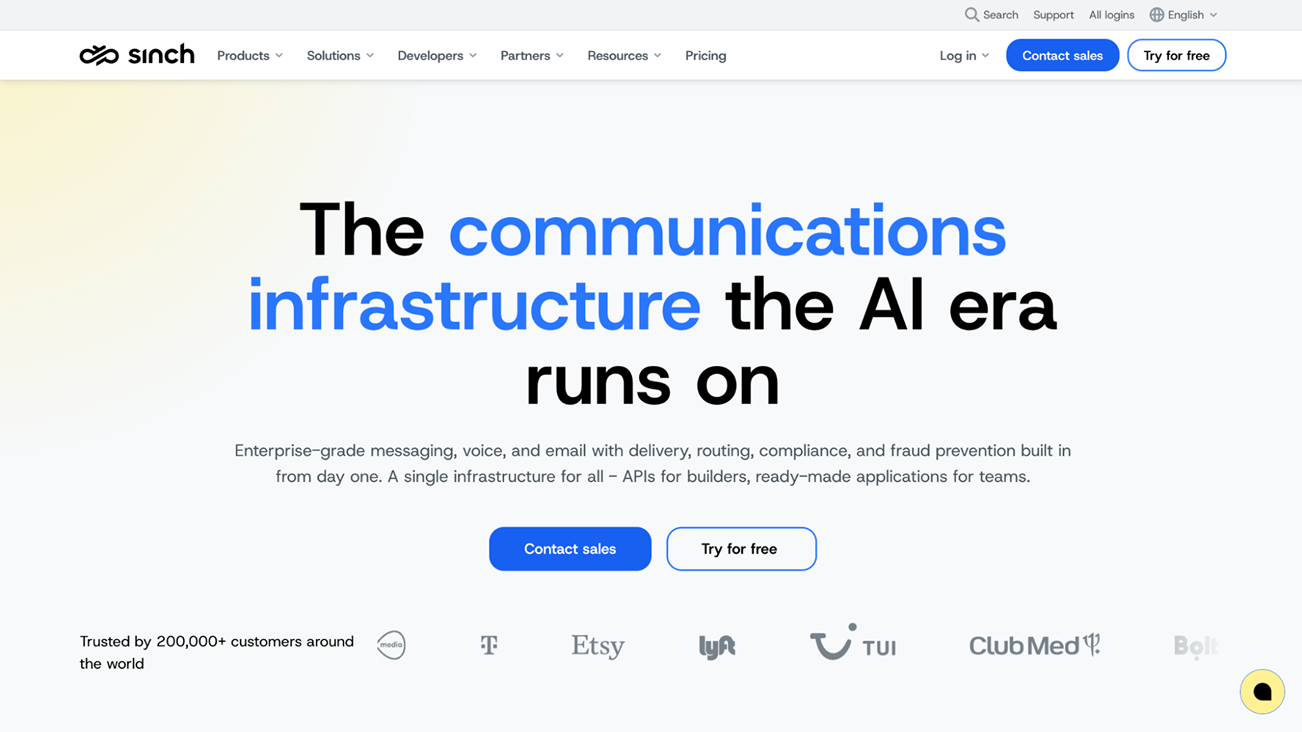
Sinch is a communications platform that provides APIs for messaging, voice calls, and email. Its Conversation API lets businesses communicate with customers across 13 messaging channels, including WhatsApp, Telegram, Facebook Messenger, LINE, Instagram, Viber, WeChat, KakaoTalk, RCS, SMS, MMS, and web chat through a single API.
Sinch also provides APIs and SDKs for inbound, outbound, and in-app voice calls, and allows businesses to purchase international phone numbers. It also offers a self-hosted MCP server with production-ready, schema-validated tools that let AI agents use Sinch APIs to perform actions on behalf of users.
Best for: Developers and enterprises that need multi-channel messaging, voice calling, and AI agents that can perform actions through communication APIs.
Key features
- Supports SMS, MMS, WhatsApp, and RCS messaging through a single Conversation API across multiple countries.
- Supports global messaging with 99.95% SMS uptime, consent tools, encryption, and automatic fallback.
- Provides real-time fraud detection and automated channel fallback to protect messaging workflows and control costs.
- Supports high-volume email delivery through the Email API, powered by Mailgun, with 99.99% uptime, reputation management, and delivery analytics.
- Provides real-time and batch email validation to detect typos, spam traps, and invalid addresses before sending.
- Supports webhooks and activity logs to help teams monitor communication events and workflows.
- Supports millions of calls daily with voice APIs and SDKs for call routing, answering machine detection, and text-to-speech.
- Allows businesses to automate notifications, alerts, and agent calls through PSTN, SIP, or app-to-phone calling.
- Provides OTPs, phone number verification, and multi-factor authentication for secure user sign-ups, log-ins, and password resets.
Pricing
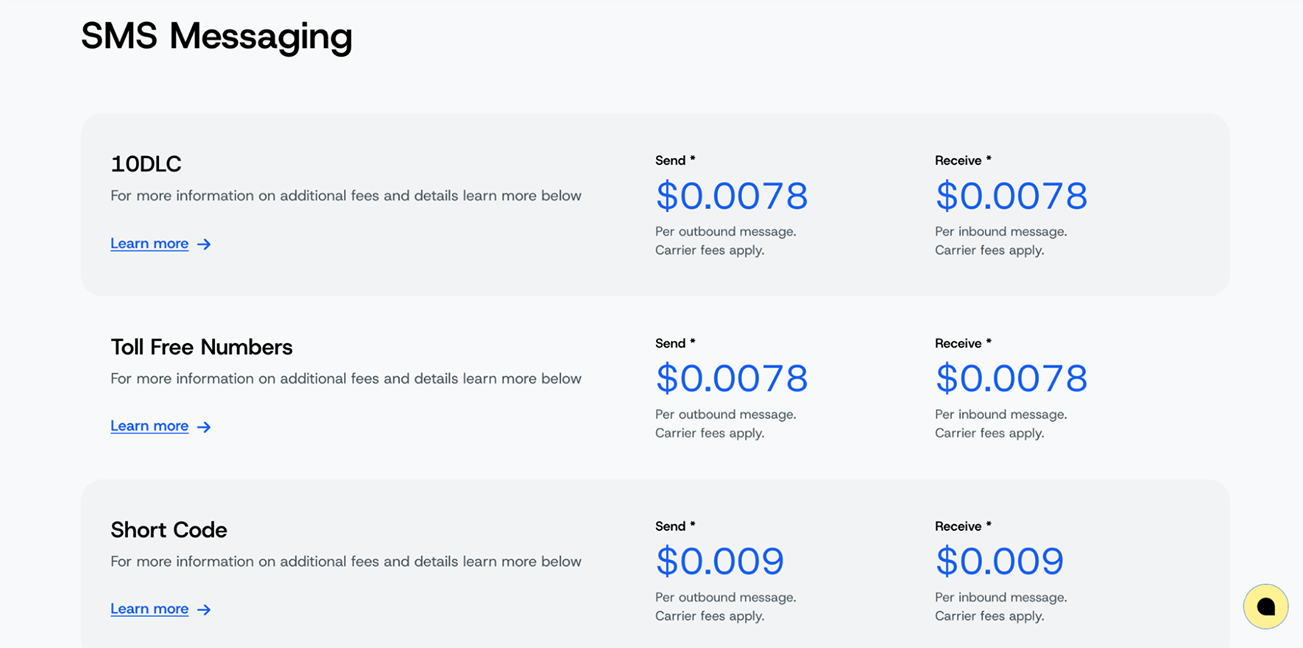
Sinch uses a pay-as-you-go pricing model, and rates vary by country. For example, in the US, Sinch charges $0.0078 per inbound or outbound SMS, while short code SMS messages cost $0.009 per message.
Sinch charges a one-time $0.80 setup fee and a $0.80 monthly fee for US phone numbers. Receiving domestic calls costs $0.008 per minute, while making domestic calls costs $0.01 per minute. International calls from the US cost $0.01 per minute, while inbound and outbound in-app calls using Sinch SDKs cost $0.003 per minute.
For RCS messaging in the US, rich RCS messages cost $0.0078 per message, while rich media messages cost $0.0188 per message. Carrier fees also apply.
Limitations
- No general iMessage API for outbound consumer messaging.
- The MCP server for executing real actions through Sinch APIs is self-hosted and requires additional setup.
- Pricing varies by country, channel, message type, and other factors, making costs harder to predict.
- Carrier and channel fees can increase the total messaging cost.
3. Vonage
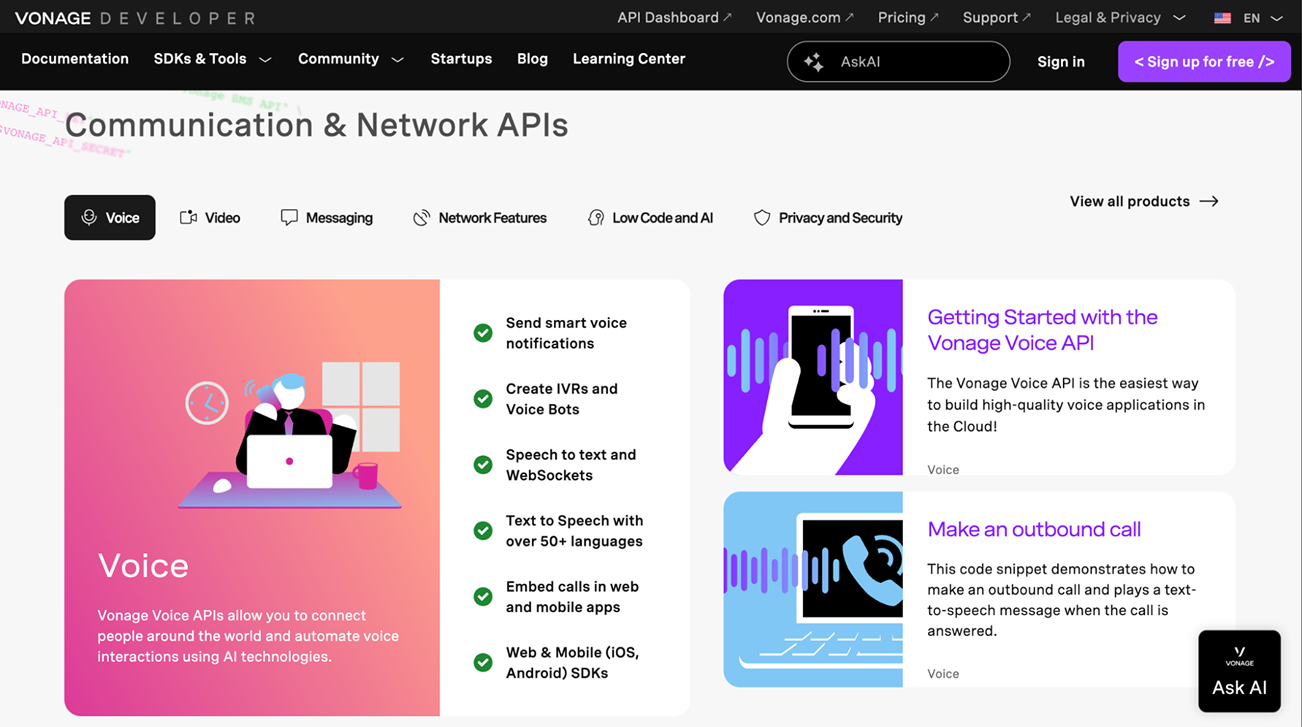
Vonage is a business communications platform that provides programmable APIs for messaging, voice, and video. It also offers a Verification API for omnichannel two-factor authentication (2FA), with built-in fraud prevention, real-time monitoring, alerts, and notifications for SMS and voice traffic.
Vonage supports messaging through SMS, MMS, RCS, WhatsApp, Facebook Messenger, Viber, and email. It also provides voice calling, local phone number provisioning, SIP connectivity, and WebRTC video for web, mobile, and desktop applications.
Best for: Businesses that need an omnichannel communications platform for voice, video, and messaging, with features such as call routing, local and toll-free numbers, business SMS, team messaging, and video conferencing in one platform.
Key features
- Supports messaging and two-factor authentication (2FA) across SMS, voice, WhatsApp, email, and silent authentication, with failover workflows and built-in fraud prevention.
- Provides branded calling to embed branded voice calls directly into applications and websites.
- Supports programmable voice calls over IP and PSTN, with AI-powered voice interactions, voice bots, and integrations with third-party AI services.
- Supports text-to-speech with natural-sounding voices for automated menus, notifications, and other voice-based interactions.
- Provides automatic speech recognition in more than 120 languages for voice control and self-service applications.
- Provides a Video API with AI-enhanced features such as live captions, translations, background blur, remote monitoring, and AI-assisted proctoring.
- Provides an MCP server that allows LLM assistants and IDEs to access Vonage APIs and perform supported actions.
- Provides a Report API that analyses customer communication data, accesses CDRs, and builds custom reporting dashboards.
- Provides a Dispatch API that optimises message delivery with flexible routing, real-time insights, and automatic failover.
Pricing
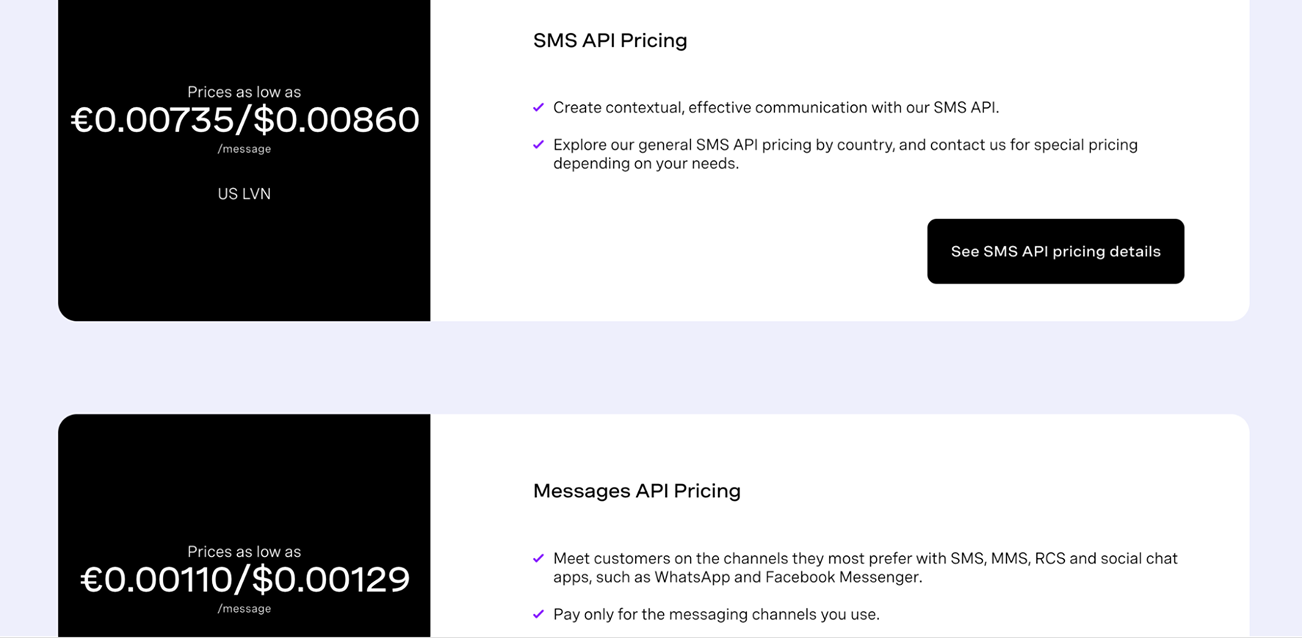
Vonage uses usage-based pricing, with rates varying by country, channel, and API.
- SMS: Starts at $0.00860 per message.
- Messaging API: Starts at $0.00129 per message for SMS, MMS, RCS, WhatsApp, Facebook Messenger, and other supported messaging channels. You only pay for the channels you use.
- Voice API: Starts at $0.01538 per minute, with per-second billing available.
- Video API: Starts at $0.0041 per minute for video streaming, recording, broadcasting, and other features.
- In-app messaging: Starts at $0.00085 per message for messaging within web and mobile applications.
Limitations
- Pricing can be difficult to estimate because rates vary by country, channel, and usage, while some pricing requires contacting Vonage for a quote.
- Limited messaging channels, with no standard consumer messaging API for iMessage or Telegram.
- Advanced features such as call queues and workforce management may require additional products or add-ons.
4. Bandwidth
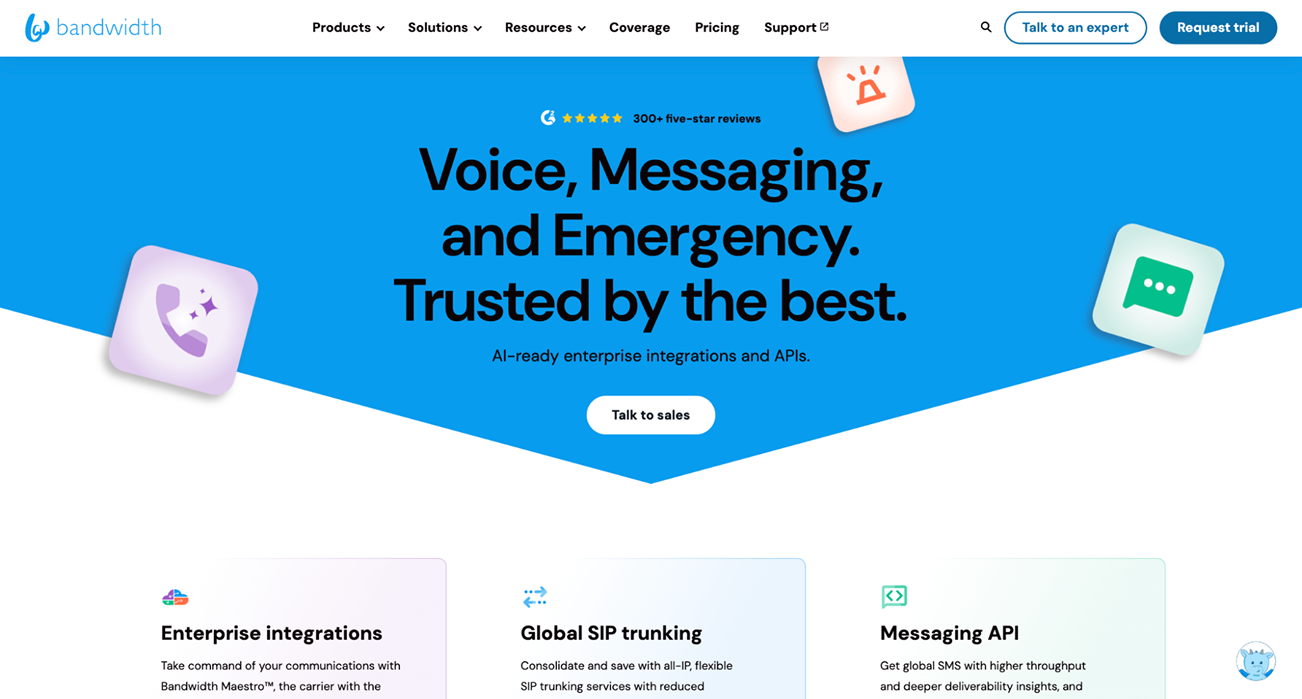
Bandwidth is an AI-ready enterprise communications platform that provides APIs for SMS, MMS, RCS, voice and emergency calling, media streaming, WebRTC, and authentication. It also integrates with business communications platforms such as Webex Calling, Zoom Phone, and Microsoft Teams.
Bandwidth supports enterprise telecom integrations, allowing businesses to choose their own telecom provider for voice, messaging, and emergency services. This gives businesses more control over their telecom services, instead of relying on a default carrier.
Best for: Large enterprises and high-scale applications that need reliable voice, messaging, and emergency calling with global coverage and high message volumes.
Key features
- Supports inbound and outbound voice calling and AI agents through a programmable Voice API.
- Supports embedded calling in web and mobile applications.
- Supports text-to-speech, speech-to-text, call recording, conferencing, media streaming, call transfers, call forwarding, and call bridging.
- Operates an owned Tier 1 network for voice, messaging, emergency calling, and contact centre services.
- Provides traffic monitoring and alerts to help businesses track blocked and unregistered messaging traffic.
- Provides an Emergency Calling API that connects users to more than 6,000 public safety answering points (PSAPs) and shares their location with emergency services.
- Allows businesses to send customer information through SIP headers so contact centre agents can access relevant context during calls.
- Provides a 2FA API for sending branded authentication messages and verifying users.
Pricing
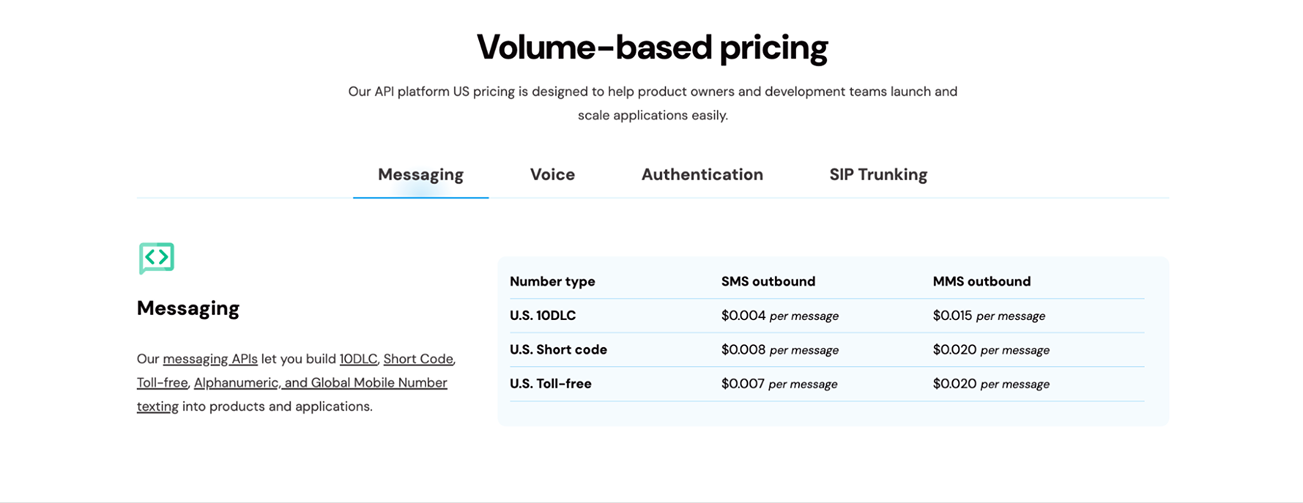
Bandwidth uses volume-based pricing, with rates varying by service and communication type.
- Messaging: U.S. SMS starts at $0.004 per outbound 10DLC message, while MMS starts at $0.015. Short code and toll-free messaging have separate rates.
- Voice: U.S. local calls start at $0.01 per minute for outbound calls and $0.0055 per minute for inbound calls.
- Authentication: Two-factor authentication costs $0.05 per authentication, while Call Verification costs $0.15 per call.
Limitations
- Does not provide native messaging APIs for WhatsApp or other major social messaging channels.
- Primarily targets enterprise businesses and high-volume communication use cases.
- Some services and messaging channels have country-specific availability and requirements.
5. Bird (formerly MessageBird)
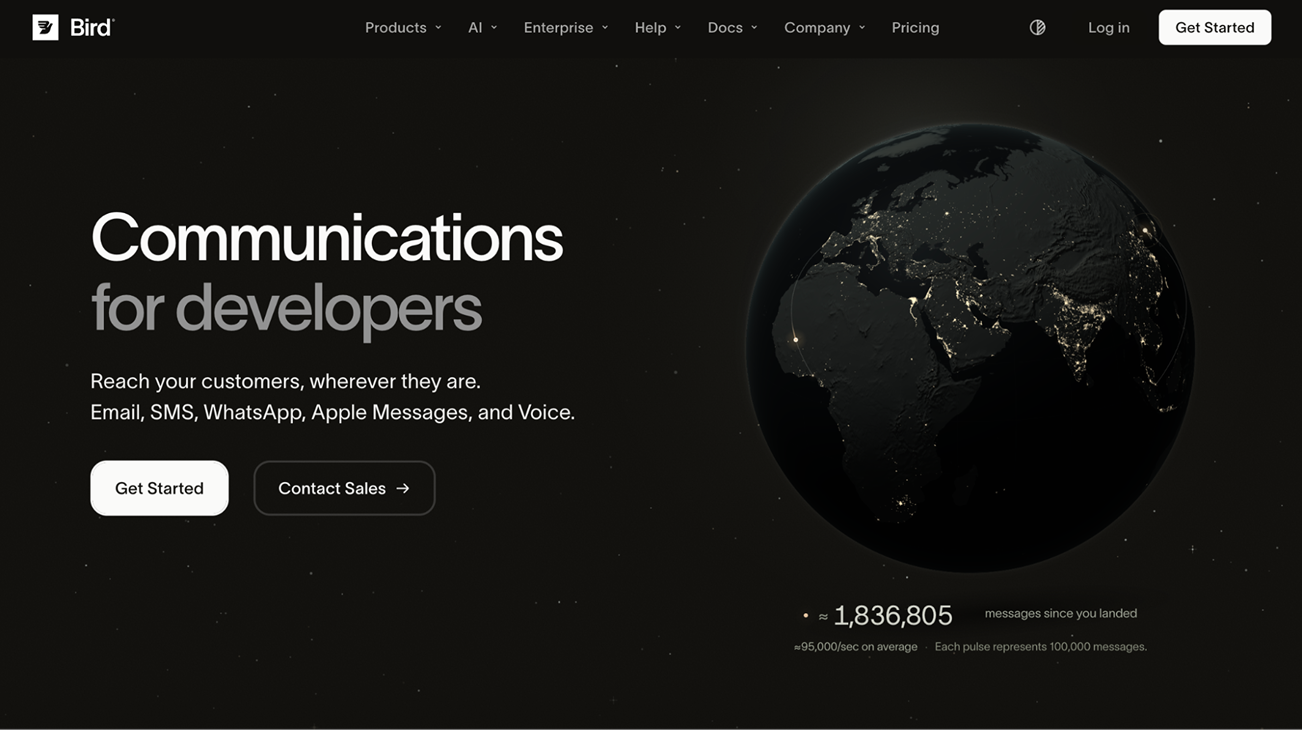
Bird is a communications platform that provides APIs for email, SMS, WhatsApp, Apple Messages, and voice. These APIs allow businesses and developers to integrate messaging, voice, and verification into their applications.
Bird also offers a hosted MCP server that gives AI agents read and write access to supported APIs. Agents can set up channels, manage customers, send messages, and check delivery status directly through MCP.
Best for: Businesses and developers that need multi-channel communication with AI agents that can perform communication tasks through MCP.
Key features
- Supports email, SMS, WhatsApp, and Apple Messages through APIs, MCP, CLI, and SDKs.
- Provides WhatsApp templates, broadcasts, interactive flows, commerce features, and AI agents for customer conversations.
- Supports opt-out management and workspace-wide preferences for controlling customer messaging.
- Provides a Voice API for outbound and inbound calls, call routing, recordings, caller IDs, SIP trunking, and browser-based calling.
- Provides a Verify API for SMS, email, and WhatsApp verification with fallback delivery and country controls.
- Supports verification controls such as code expiry, attempt limits, resend cooldowns, sender branding, logs, and webhooks.
- Provides webhooks and analytics for tracking message delivery, conversations, calls, and verification events.
Pricing
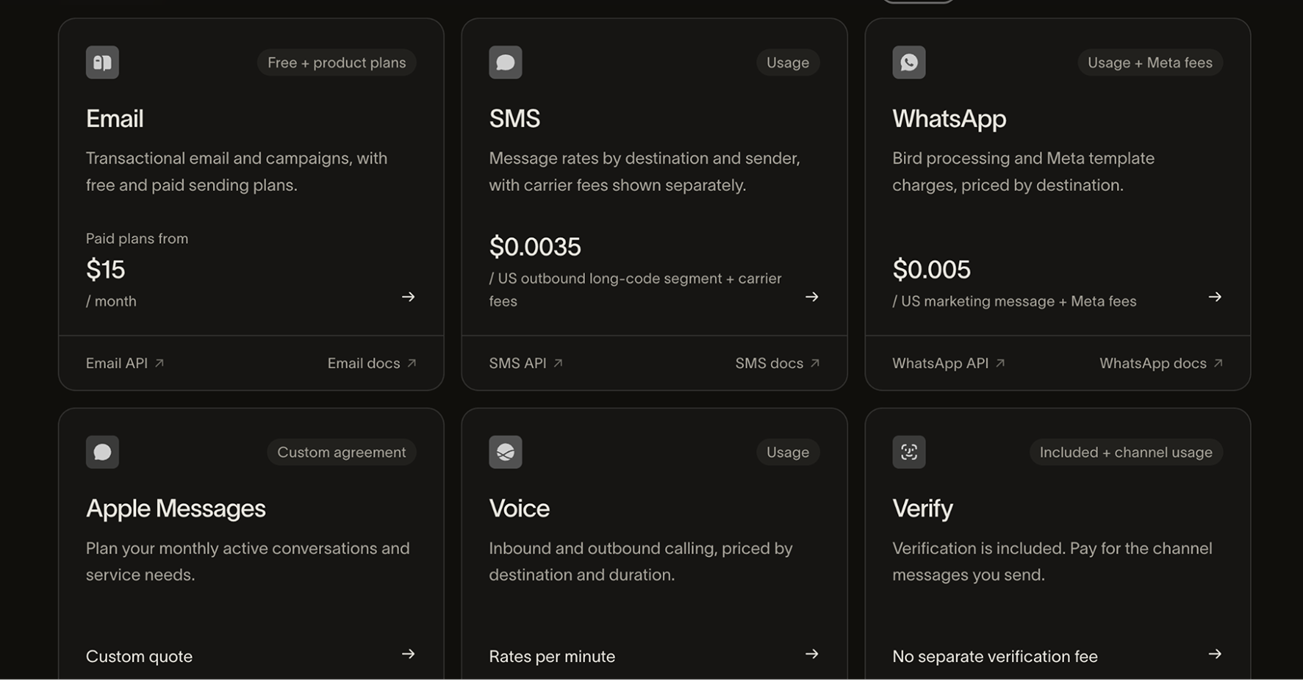
Bird uses usage-based pricing, with rates varying by communication channel and destination.
- Email: Paid plans start at $15 per month for 50,000 to 100,000 emails.
- SMS: U.S. SMS starts at $0.0035 per segment for long-code and toll-free numbers, and $0.007 per segment for short codes. Carrier fees also apply.
- WhatsApp: U.S. marketing messages cost $0.005 per message, plus applicable Meta fees.
- Outbound calls: Calls to U.S. landlines and toll-free numbers cost $0.0049 per minute.
- Inbound calls: U.S. local and national numbers cost $0.009 per minute, while toll-free numbers cost $0.018 per minute. Number rental starts at $0.50 per month.
- Call handling: An additional $0.004 per minute handling fee applies to every call. Calls are billed per second but rounded up to the nearest whole minute.
Limitations
- Some Bird products require a custom quote, making it harder to estimate costs upfront.
- Social messaging is limited to WhatsApp and Apple Messages.
- WhatsApp messaging incurs additional platform and processing fees.
- Bird charges for each automation workflow invocation, while messages sent through a workflow are billed at their respective channel rates.
Summary: Best Twilio Alternatives for CPaaS
The best Twilio alternative depends on your preferred communication channels, budget, geographic coverage, and whether you need features such as voice, video, verification, or AI agent support.
Zernio is an excellent choice for businesses and developers that need broad messaging channel coverage across SMS, RCS, WhatsApp, social media, and other platforms, alongside voice calling, international virtual phone numbers, webhooks, and AI agent integration in one platform.
Sinch is a good choice for businesses that need omnichannel messaging across a wide range of channels, with additional APIs for voice, email, and verification. Vonage is well suited to businesses that need messaging, programmable voice, WebRTC video, and advanced authentication through its communications APIs.
Bandwidth is a good option for enterprises that need carrier-grade messaging and voice infrastructure, emergency calling, and high-volume communications. Bird helps developers build customer communication workflows across email, SMS, WhatsApp, Apple Messages, and voice, with AI agents that can operate through MCP.
If you’re building a customer engagement platform, SaaS application, or AI-powered communication workflow and want to manage multiple communication channels through a single API and MCP integration, Zernio is an excellent choice for simplifying development and supporting a wider range of customer communication channels.
FAQs
What are the best Twilio alternatives?
Zernio is the best Twilio alternative for multi-channel messaging, social messaging, voice, and AI agent workflows. Sinch is best for broad omnichannel messaging with voice, email, and verification. Vonage is best for businesses that need messaging, programmable voice, video, and authentication APIs. Bandwidth is best for enterprises that need carrier-grade messaging, voice, emergency calling, and high-volume communications. Bird is best for developers who need multi-channel communication with email, messaging, voice, and AI agent capabilities.
What is the difference between CPaaS and UCaaS?
CPaaS provides APIs and developer tools for embedding custom communication features into existing applications, while UCaaS provides ready-to-use communication tools such as business phone systems, video conferencing, team chat, and collaboration in one cloud platform.
Is there a cheaper alternative to Twilio?
Yes. Several Twilio alternatives offer usage-based or account-based pricing, and the cheaper option depends on your communication channels, traffic volume, and destination countries. Zernio offers transparent pricing, so businesses can clearly understand their underlying channel costs. For example, Zernio only charges applicable Meta fees for WhatsApp messaging and does not add platform fees.
Which Twilio alternative is best for AI agents?
Zernio is the best Twilio alternative for AI agent workflows. It supports voice calls, phone number verification, and call routing to AI agents. Its hosted MCP server lets AI agents manage conversations and perform supported communication API actions.
What should I look for in a Twilio alternative?
Consider the messaging and communication channels you need, API and SDK support, pricing, geographic coverage, phone number availability, webhook support, reliability, authentication, AI capabilities, and how easily the platform integrates with your existing application.