I run AI Biznes Lab in Poland. We are two people. We sell a few programs and we post on LinkedIn, Facebook and Instagram.
Until July 2026 every post meant fifteen minutes of clicking. Three panels. Three sets of limits. The same text three times. With two people in the company that is an hour a week we do not have.
The second problem was worse. One Instagram post from July 22 failed. Nobody noticed for seven days, because nobody owned it.
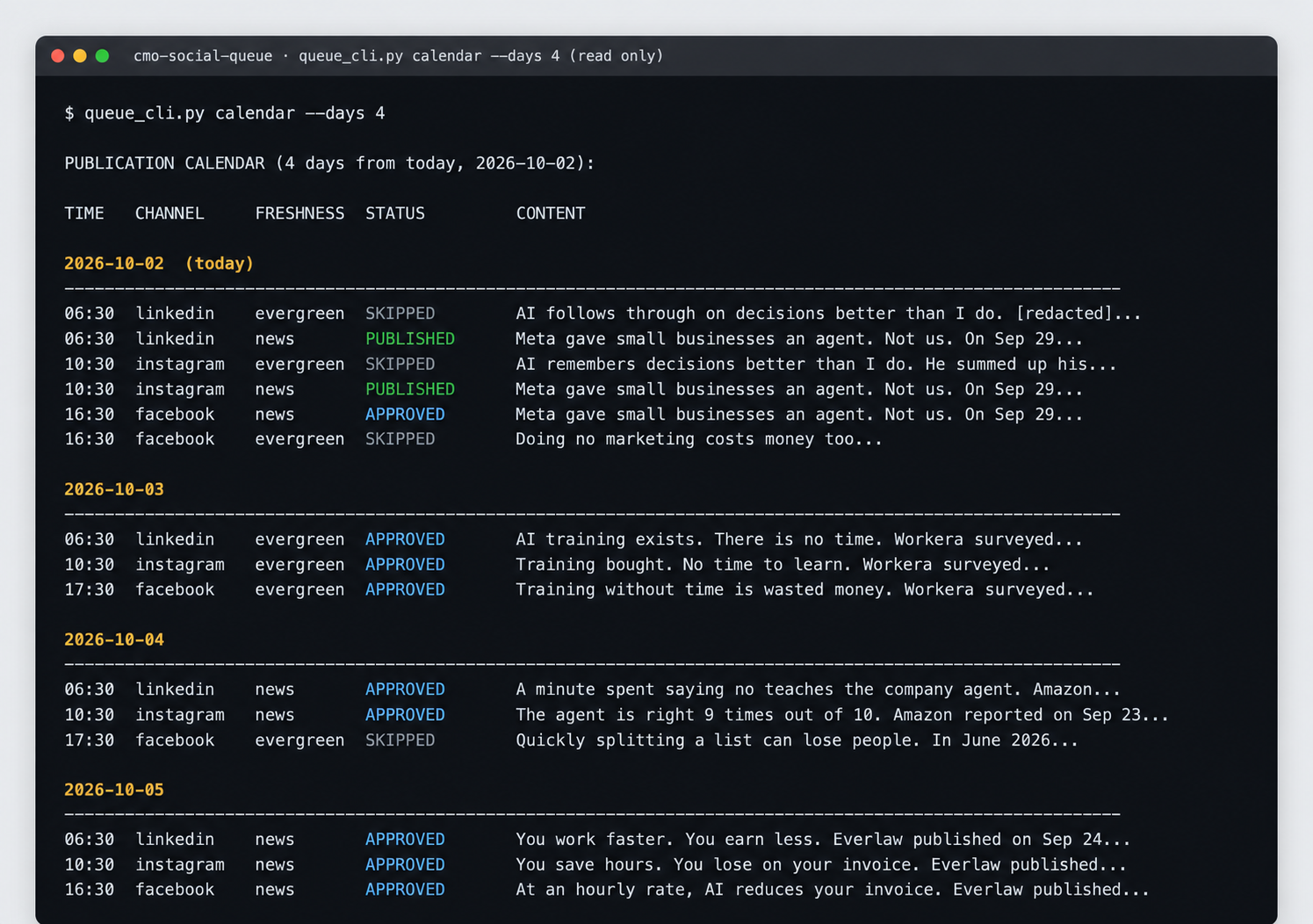
So on July 7 I made one decision. Every channel gets published through one shared hand. We tested it on our Facebook page. It worked the first time. Since that day that hand is Zernio.

Why Zernio became the hand, not the head
I did not want a tool that writes posts for me. I wanted a tool that publishes what my system already decided.
Zernio gives me one call for three platforms. I send the text and the graphic. I pick the account and the time. The differences between LinkedIn, Facebook and Instagram stay on Zernio's side. It also has the boring things that matter when a machine publishes alone. Drafts. Scheduling. Checking a post before publishing it. Protection against publishing the same post twice.
Everything before publishing happens on our side. Strategy, evidence, text and graphic. Zernio gets a finished package and executes it.
What I built around it
The machine has a few AI assistants. Each one has one job.
Strategy first. Every post has to name the business goal it serves. No goal, no post.
Evidence before text. A number with a source or a real case. News older than 14 days cannot carry a post.
One emotion per post. Before a sentence exists, the post gets one target reaction. For example funny, warm or "now I get it".
Text in my voice. A separate assistant knows my style. Short sentences, no emoji, no hashtags. A script checks it, not a person.
Graphic after the text is frozen. One format, one size, our style. If the graphic has a flaw, we make a new one. We do not patch the old one.
A blind check. A reviewer sees the final post without knowing the target emotion and says what they felt. Miss means rewrite.
All of it goes into one package. The system checks that nothing changed along the way. Only then the package enters the queue with a date, a time and a channel.
Every half hour an automation checks the queue. One more check asks whether the post is still current. Then Zernio publishes it on the right account. We store the post number and the URL.
Day one: every post went out three times
On July 10 we switched the automation on. That same day Instagram and Facebook got three identical posts each.
Zernio worked correctly. It returned success and the published post. My code could not read the post number from that response. It treated success as failure and tried again. Three attempts, three posts.
The rule we wrote into the code that day: a success response from Zernio means the post is published. We retry only when the request never arrived.
The second lesson was about testing. Our dry tests did not catch it, because the fake response looked different from the real one. Since then the first real post on a real account is part of every rollout. Zernio has its own duplicate protection today. We keep ours too.
The report said zero comments
For a few weeks the daily report showed zero comments. And people were commenting.
My automation read only private messages. Zernio keeps comments under posts separately, per post. We fixed it on July 25. Now comments come in every day and get sorted into five groups. Questions and topic ideas. Buying signals and discussion. Noise. One person's question is usually a topic more people are looking for. It is the cheapest topic planner we have.
The lesson for any marketer: zero in a report is not always the truth. Sometimes it is a missing reading.
Stop building social integrations from scratch.
One API call to publish, schedule, and manage posts across 16 platforms.
The link that vanished on the worst possible day
On September 4 we were closing enrollment in one of our programs. The post went out. The comment with the link did not.
Instagram had not yet given the post its number, so the comment had nothing to attach to. My code did not expect that delay. Now such a comment waits and retries for 24 hours. A small thing. But on a day when the link is the only reason for the post, the small thing is the whole post.
The same day the freshness check held a correct post three times. The post said "tonight we close enrollment". The model judging it did not know what time it was in Poland. The post went out two hours late. Now the check gets the current Polish time and the planned slot.
What I read every morning
Every morning an automation pulls the numbers from Zernio and sends me a short digest. Every post gets a reading after 24 hours and after 7 days. One decision comes out of it. Repeat the format. Change exactly one element. Or drop the combination for two weeks.
Once a week I get one report for all three channels. Posts and impressions. Engagement and follower change. The first such report came on August 2. LinkedIn showed 17 posts and 13,853 impressions in seven days. Plus 54 new followers. Data like this turns "I think" into "I see".
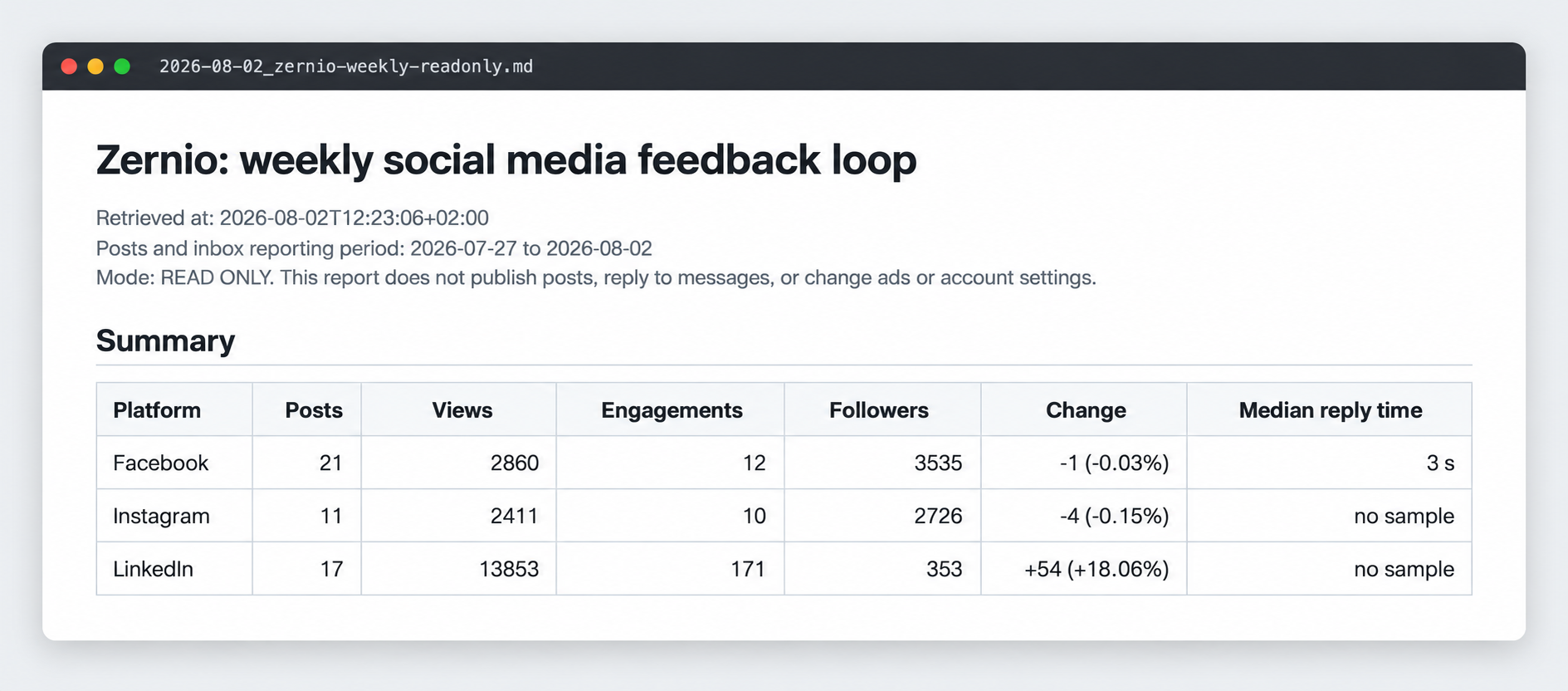
By the end of August Zernio had published more than 90 posts from this system. 35 on LinkedIn, 29 on Facebook, 26 on Instagram.
Two limits worth knowing
LinkedIn does not let outside tools read private messages. So cold outreach does not go through Zernio, and it should not.
The second limit is ours. Zernio exposes almost five hundred tools to AI agents. My agent gets a short list. Read first. Then drafts. Then publishing. In that order.
From my company to my students
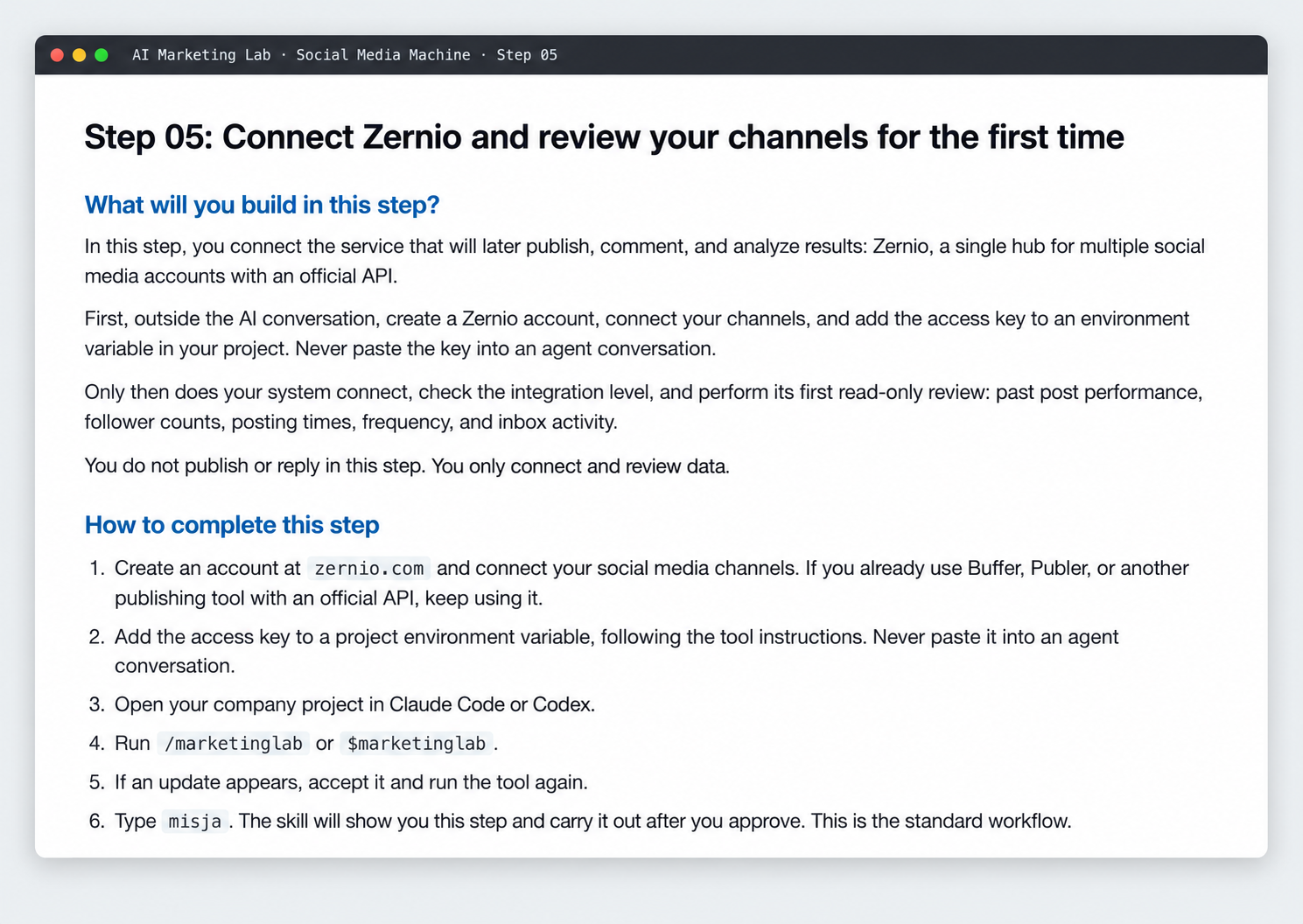
AI Marketing Lab is our program where entrepreneurs build their own AI system for getting customers. Everything above ran on our accounts first. Only a pattern that survived production goes to the members.
In the social media part of the program, members connect Zernio in the fifth step and run the first reading of their own accounts. Then they get the same rules we use. A separate key with a narrow scope for the agent. Read first, then drafts, then publishing after approval. One place for exceptions. One weekly reading of results.
We do not force one vendor. We teach the pattern. Many members simply pick Zernio, because it is the hand the pattern was built on.
Three things I would tell any marketer
Before you trust an automation, publish one real post on a real account and check it on the platform. Dry tests will not catch everything.
Decide up front what the machine does alone and what a human has to see. Everything else should run without clicking.
Turn every manual fix into a rule the system checks itself. Otherwise you will fix the same thing every week.