A year ago, when we started building Zernio, we made a bet. The bet was that developers building on social media didn't just need a posting API. They needed the whole operation: publish, engage, analyze, and promote, all possible through one integration.
We shipped three of those pillars first: posting across 15 platforms, a unified comments and DMs inbox, and analytics across every connected account. One bearer token, one set of SDKs, one API. That covered publish, engage, and analyze.
Today, we're shipping the fourth pillar — Zernio social media ads API.
You can boost your best-performing organic posts as paid ads. You can create standalone ads with custom creative. You can sync custom audiences from your own database. You can pull ad-level analytics with the same endpoint structure you already use for organic analytics. And you can do it all with the exact same bearer token, SDKs, and webhooks you're already using for publishing.
This is the biggest release we've shipped since the rebrand. Here's the whole story.
Why we built a social media advertising API
I want to start with the problem, because we didn't build this because "ads is a cool feature to add." We built it because we kept hearing the same thing from customers.
The developers building on Zernio — marketing tool startups, AI content platforms, SaaS products embedding social features, creator-economy tools — would integrate our social media posting API in under an hour. Then a few months later they'd come back and say: "our users want to promote their best-performing posts. Do you have an ads API?"
We didn't. Not until today.
So they'd go off and look at the alternative, which was integrating the Meta Marketing API directly. And a few weeks later they'd come back saying some version of: "we looked at it and it's a nightmare."
They were right. Integrating platform ads APIs directly is one of the most painful build projects in all of social media infrastructure. Here's what it actually takes if you try to do it yourself with just Meta ads API:
- A Meta Developer account and app approval for advertising permissions
- OAuth scopes for
ads_management,ads_read,business_management, andpages_read_engagement - The ad account permission tree, understanding the difference between a Business, an ad account, a page, and a user role
- Rate limit management across multiple API surface layers (Graph API, Marketing API, Business SDK)
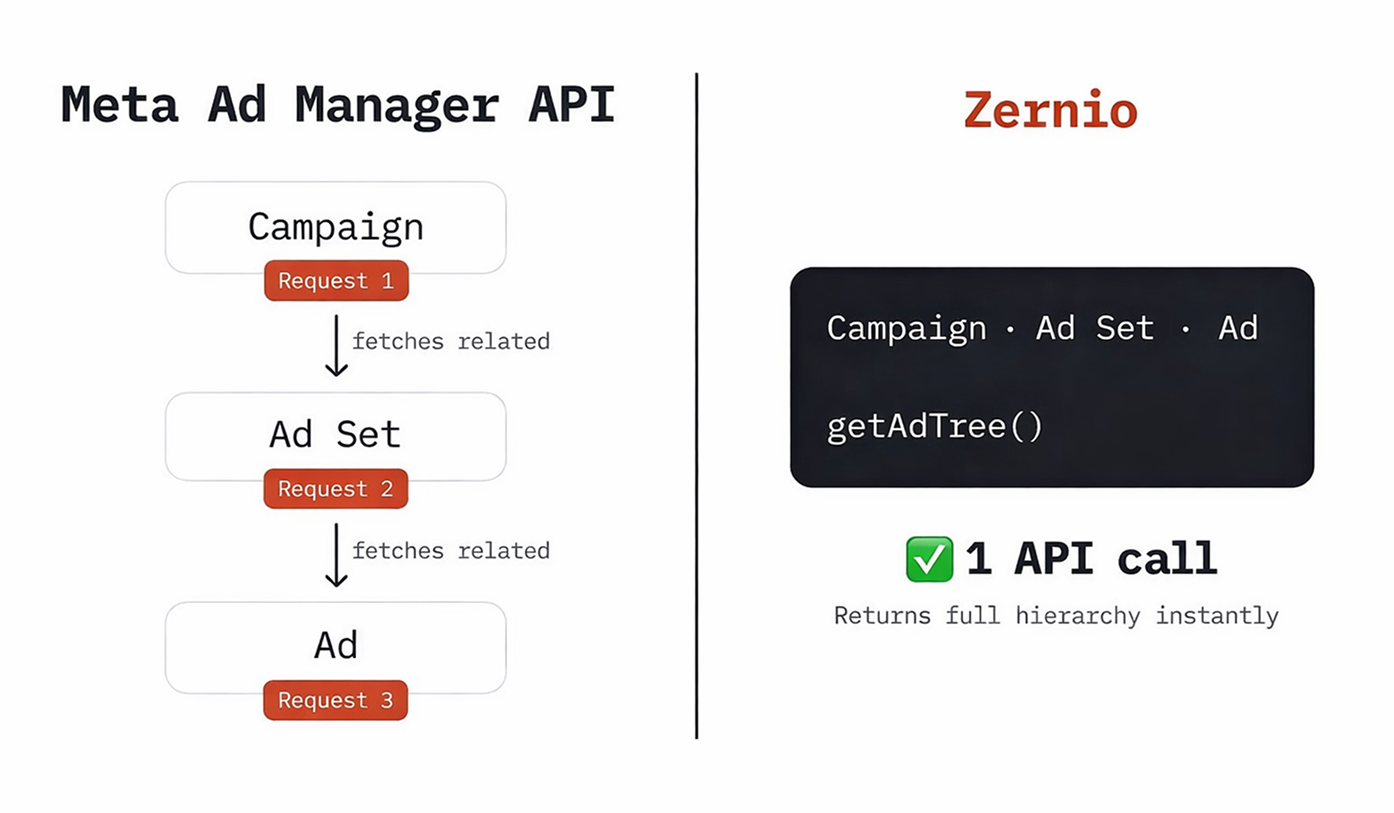
- The campaign → ad set → ad hierarchy, where each level has its own create, update, and read endpoints
- Custom audience hashing with SHA-256, formatted per Meta's exact specification
- Webhook subscriptions for ad delivery events
- Handling the constant breaking changes (Meta deprecated v18 of the Graph API six months after releasing it)
And that's just Meta. Want to support TikTok ads? Different API, different auth flow, different campaign hierarchy, different audience format. LinkedIn Ads API? Different again. Pinterest Ads API? Different again. Each one is its own multi-month engineering project with its own ongoing maintenance burden.
For a small SaaS team building the actual product their users care about, this is a tax that doesn't stop. You don't ship ads once and move on — you maintain it forever as platforms change their APIs, rotate their tokens, update their rate limits, and deprecate endpoints.
Our bet was that this was exactly the kind of problem Zernio should solve. One API. One bearer token. One integration. Ads across every platform we support, using the same conventions you already know.
So we built it. Zernio Ads API for developers now supports the following platforms:
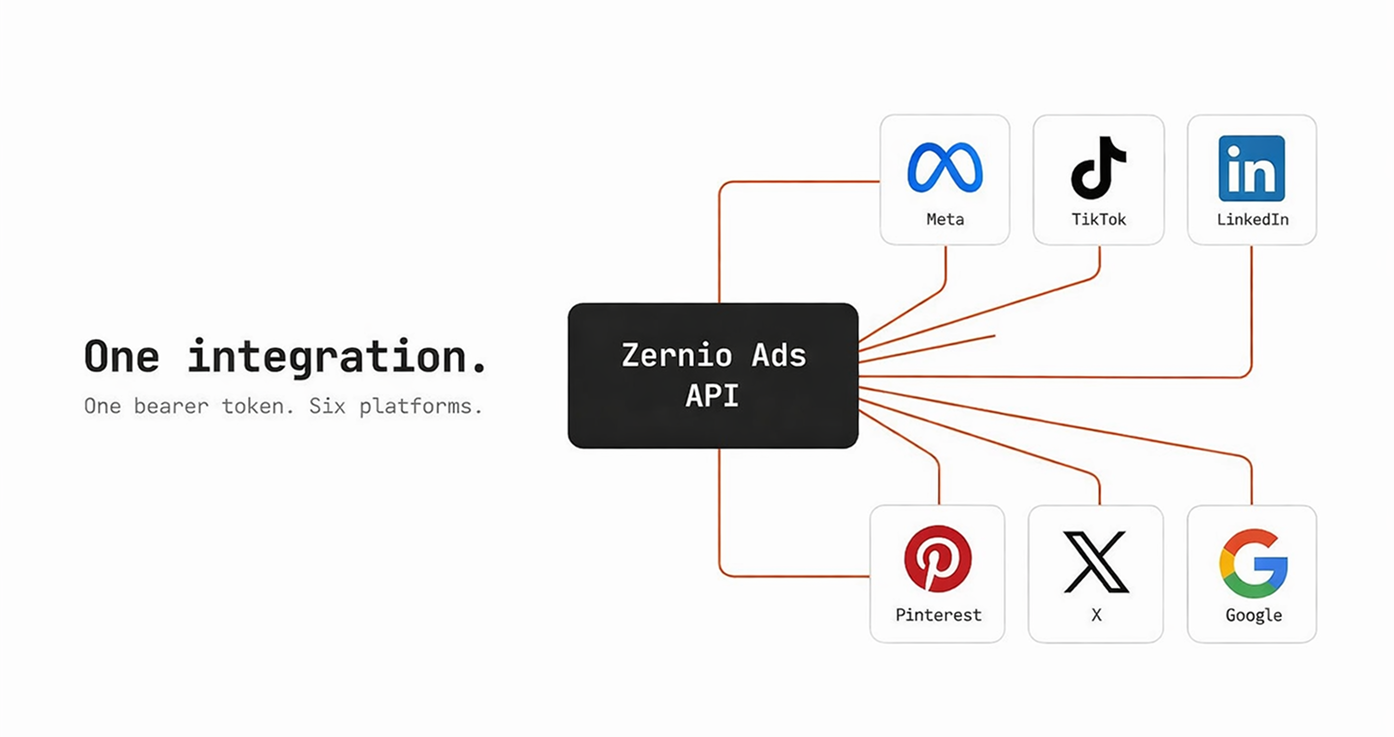
- Google Ad Manager API
- Meta Ad Manager API (Instagram and Facebook)
- LinkedIn Ads API
- Pinterest Ads API
- TikTok Ads API
- X Ads API
Update: ChatGPT ads are now live too. OpenAI Ads joined the Zernio Ads API as the 7th network, so you can create and manage ChatGPT campaigns with the same bearer token as everything above. Read the ChatGPT Ads API announcement →
What actually shipped today
Three new API sections are now live in the Zernio API, plus new connect and disconnect endpoints for attaching ad accounts to your existing social connections.
The Ads API
This is the layer where individual ads live. Nine endpoints cover the full lifecycle of a single ad:
- Boost post API — promote an existing Zernio-published post as a paid ad. This is the killer endpoint. If you're already using Zernio to publish, you can turn any post into a paid promotion with one more API call. Same post object, now a paid object.
- Create standalone ad — create a paid ad with custom creative that isn't tied to an existing organic post. This is the full Ads Manager path, not the boost path.
- Update ad — pause, resume, change budget, change targeting, rename
- Delete ad — cancel an ad
- Get ad and list ads — read single or many
- Get ad analytics — daily performance breakdown with impressions, reach, clicks, spend, and conversions
- Search ad interests — look up Meta targeting interests (the same autocomplete you use when building audiences in Ads Manager)
The Ad Campaigns API
Three endpoints that expose the campaign hierarchy:
- List ad campaigns — returns campaigns with aggregate metrics rolled up
- Get ad tree — returns the full nested campaign → ad set → ad structure in one call. Originally, Meta ad manager API forces you to traverse three levels with separate requests. We collapse that into one call, which makes dashboard building dramatically faster.
- Update ad campaign status — pause or resume at the campaign level
The Ad Audiences API
Five endpoints for managing custom audiences:
- Create ad audience — create a Meta custom audience from a customer list
- Add users to ad audience — push users into a customer list audience with the correct SHA-256 hashing handled for you
- Get ad audience and list ad audiences — read
- Delete ad audience
Zernio Documentation for Ads Manager API ->
If you've built a SaaS with a user base, this is probably the most valuable endpoint set for you. Syncing your users into a Meta custom audience — so your customers can retarget them with ads — is a feature your users will pay for, and it used to be a multi-week engineering project. Now it's a loop over your user table and a few API calls.
The loop that changes everything: publish → analyze → boost posts API
Here's the workflow that sold us on shipping this exact set of endpoints.
A developer publishes a post through Zernio. They watch the analytics for the first few hours. The post outperforms their average by 3x. They boost it as a paid ad with a $50 budget. The whole loop runs in about 60 lines of code:
import Zernio from '@zernio/node';
const zernio = new Zernio();

// 1. Publish a post
const { data: postData } = await zernio.posts.createPost({
  body: {
    content: 'Our biggest product update of the year is live.',
    mediaItems: [{ type: 'image', url: 'https://cdn.example.com/launch.jpg' }],
    platforms: [
      { platform: 'instagram', accountId: 'acc_ig_123' },
      { platform: 'facebook', accountId: 'acc_fb_456' },
    ],
    publishNow: true,
  },
});

// 2. Wait 6 hours, then pull analytics
await sleep(6 * 60 * 60 * 1000);
const { data: analyticsData } = await zernio.analytics.getAnalytics({
  query: { postId: postData.post._id },
});

// 3. If engagement beats the baseline, boost it
const { likes, shares, comments } = analyticsData.analytics;
const baseline = 500;

if (likes + shares + comments > baseline * 3) {
  // Look up real interest IDs first
  const { data: interestResults } = await zernio.ads.searchAdInterests({
    query: { q: 'technology', accountId: 'acc_fb_456' },
  });

  const { data: adData } = await zernio.ads.boostPost({
    body: {
      postId: postData.post._id,
      accountId: 'acc_fb_456',
      adAccountId: 'act_123456789',
      name: 'Boost: Product Update',
      goal: 'engagement',
      budget: { amount: 50, type: 'daily' },
      schedule: { endDate: '2026-04-17T00:00:00Z' },
      targeting: {
        countries: ['US'],
        interests: interestResults.interests.slice(0, 2),
      },
    },
  });
  console.log(`Boosted as ad: ${adData.ad._id}`);
}
That's the whole thing. Publish, analyze, and boost in one script, with one bearer token, no separate Meta Ads API integration required. Before today, doing this same loop would have required a Zernio integration for publishing, a Zernio integration for analytics, and a separate direct integration with Meta's Marketing API for the boost step. Three different auth flows, three different rate limiting systems, three different error handling patterns.
Now it's one API.
Stop building social integrations from scratch.
One API call to publish, schedule, and manage posts across 15+ platforms.
What you can build with Zernio Ads Manager API
A few of the patterns we're already seeing from testing this over the past weeks:
The auto-boost agent for AI-agent-builder SaaS
If you're building an AI agent that acts on social media, ads were the missing piece. Now your agent can watch the performance, decide which posts are worth promoting, and boost them autonomously. The full agent loop — create → publish → measure → promote — now runs through one API. For teams building on MCP (the Model Context Protocol), the Zernio MCP server already exposes all the new ads endpoints as tools, so Claude, Cursor, and any other MCP-compatible client can use them out of the box.
The CRM-to-ads sync for B2B SaaS
If you're building a B2B SaaS, your users have customer lists. They want to retarget those customers with social ads. Now you can build a feature that says "sync your customers into a Meta custom audience with one click," and ship it in an afternoon using the Ad Audiences API. The hashing, the formatting, the chunking for API limits — Zernio handles all of it.
The "promote your best post" button for creator tools
If you're building a creator tool or marketing automation product, your users are publishing content through your product. They want a button that says "promote this post." Previously, that button required a full Meta Marketing API integration. Now it requires one call to boostPost.
The unified ads dashboard for agencies
If you're building for agencies, they need to see campaign performance across multiple clients and multiple ad platforms in one view. The getAdTree endpoint was built specifically for this, and one call returns the full hierarchy, ready to render.
The lead capture loop for lead generation products
If you're building a marketing tool or CRM where your users run lead generation campaigns, the Ads API covers that use case too. Create a native Meta Instant Form, attach it to a boost or standalone ad with goal: "lead_generation", and receive submitted leads in real time via the lead.received webhook — all through the same integration. Leads land directly in your product's webhook handler without a separate Ads Manager step or manual export.
How Zernio Ads Manager API compares to the alternatives
I want to be fair here, because there are other ways to solve this problem, and they make sense in some cases.
Integrating Meta Marketing API directly gives you the deepest possible feature coverage for Meta specifically. If your entire product is a Meta-only ads tool and you need every edge case Meta supports, going direct might still be right for you. But you pay the integration and maintenance tax forever, and you only get Meta ads API. If your roadmap includes TikTok or LinkedIn as well, you're back to square one.
Using a point solution like the LinkedIn Ads API or Pinterest Ads API directly has the same trade-off. Each platform's marketing API is its own project. For developers building products that need cross-platform ads API, stacking three or four direct integrations is a quarter of engineering work, minimum, and the ongoing maintenance is brutal.
Google Ad Manager API is a different thing entirely — it's Google's platform for publishers managing their own ad inventory, not a social ads API. If you're looking for social ads across Meta, TikTok, LinkedIn, and Pinterest, Google Ad Manager isn't the tool you want.
Ayrshare technically offers ads functionality, but it's narrower than it sounds. Their Ads API is limited to boosting existing Facebook posts into Facebook ads. Zernio's Ads API is an Ayrshare alternative that is built as a true multi-platform ad layer from day one, with the full campaign lifecycle (create, manage, analyze) across the platforms our customers actually run paid on.
Building your own layer over multiple platform APIs is what we did. It took us months. We're offering you the shortcut.
If your product needs social ads and you have more than one platform on your roadmap, a unified ads API like Zernio is almost certainly the right call.
The bigger picture
A quick word on why this release matters beyond "we shipped a feature."
When we started building Zernio, the category was "unified social posting API." That was the scope people expected. Over the past year, we've been expanding what the category actually means. We added a comments and DMs inbox. We added a full analytics layer. We added an MCP server and CLI for AI agents. And today we added ads.
I don't think "unified social posting API" is the right name for the category anymore. A social API that doesn't cover ads is half an API. A social API that doesn't work with AI agents is built for the wrong decade.
What we're building is the full social operations API — everything a developer needs to embed social media into their product, from the first OAuth connection all the way through to the paid ad that promotes the winning post. One integration. Transparent pricing. Built for the AI agent era.
If you're building something in this space, whether it's a marketing tool, a creator platform, an AI agent, or an internal tool at a bigger company, I'd genuinely love to hear what you're working on. You can find me on LinkedIn.
FAQ
What is the Zernio Ad Manager API?
The Zernio Ads API is a multi-platform ad management API that lets developers create, manage, and analyze paid ads across social platforms and Google ads through a single integration. It covers the full lifecycle, like boosting organic posts, creating standalone ads, managing campaign hierarchies, and syncing custom audiences — all alongside Zernio's existing social media posting API, engagement API, and analytics APIs.
Which platforms does the Zernio Ad Manager API support?
Zernio API for ads management currently supports 6 platforms: Meta, LinkedIn, Pinterest, TikTok, Google, and X.
How is this different from using Meta Marketing API or LinkedIn Ads API directly?
Integrating platform ads APIs directly means building and maintaining a separate integration for each platform, each with its own auth flow, rate limits, campaign hierarchy, and breaking changes. Zernio abstracts all of that behind a single API with one bearer token, shared SDKs, and unified webhooks. If you're building a product that needs ads across multiple social platforms, a unified ads API saves months of engineering work and all the ongoing maintenance.
Is this the same as Google Ad Manager API?
No. Google Ad Manager API is Google's publisher-side ad-serving platform for managing display inventory on your own properties. Zernio Ads API is for buying paid ads on social platforms like Meta, TikTok, and LinkedIn. Different tools, different use cases.
Can I use the Ads API with AI agents or automation tools like n8n?
Yes. Zernio's Ads API works with any tool that can make HTTP requests. For AI agents, Zernio offers an MCP server with 280+ tools including ad management. For no-code automation, use the official n8n node, Make integration, or Zapier integration to automate ad creation, budget adjustments, and analytics reporting.